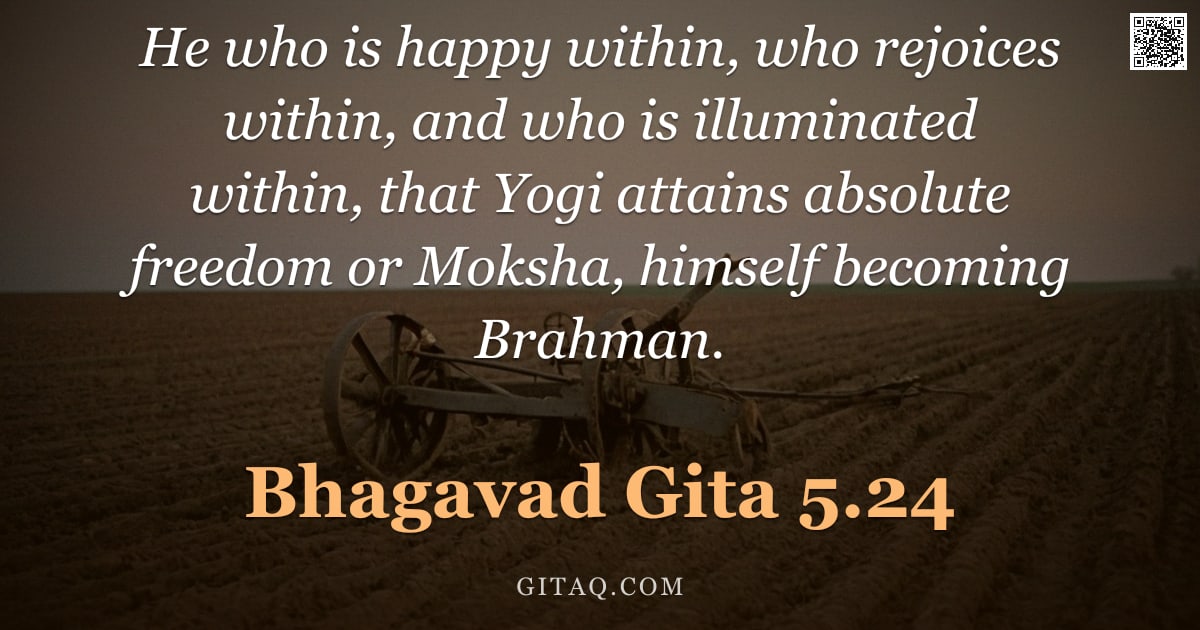
Bhagavad Gita 5.24
Karma Sanyasa Yoga · English Translation
योऽन्तःसुखोऽन्तरारामस्तथान्तर्ज्योतिरेव यः | स योगी ब्रह्मनिर्वाणं ब्रह्मभूतोऽधिगच्छति ||५-२४||
yo.antaḥsukho.antarārāmastathāntarjyotireva yaḥ . sa yogī brahmanirvāṇaṃ brahmabhūto.adhigacchati ||5-24||
What Does This Verse Mean?
In this verse, Lord Krishna describes the state of a perfected yogi who has found their source of happiness and inner light within themselves rather than seeking it in external objects or people. This person is described as finding joy (sukha) and satisfaction (arama) inside their own soul and glowing with spiritual wisdom (jyoti). Because they have conquered the need for outside validation, they attain 'Brahmanirvana,' a state of liberation where they realize their true identity as one with the ultimate reality. This teaching is delivered to Arjuna on the battlefield to show that true peace comes from self-realization.
The Teaching Behind It
This verse synthesizes Karma Yoga with Jnana Yoga (the path of knowledge), describing the ultimate fruit of selfless action which leads to deep meditation (Dhyana). It develops the concept that true liberation is not escaping the world but realizing one's identity as Brahman while still living in it, transforming the seeker into the sought.
Word by Word
Classical Commentary
Where This Happens
This verse occurs in the middle of a tense conversation on the battlefield of Kurukshetra during the Mahabharata war. Lord Krishna is speaking to Arjuna, who has dropped his bow in despair after seeing his own relatives ready to fight him. Having just explained the path of renouncing action without attachment (Karma Sanyasa), Krishna now shifts focus from external duty to internal transformation to reassure a confused and grieving warrior.
Living It Out Today
Consider a professional facing a sudden job loss or a major project failure; instead of spiraling into anxiety while waiting for validation from colleagues, they can tap into their inner resilience. By finding satisfaction in the process of learning and contributing rather than just the outcome, they maintain mental stability and clarity during the crisis. This shift allows them to make wise decisions without being clouded by fear or desperation.
Explained for Children
Imagine you have a special flashlight inside your heart that never runs out of batteries and shines no matter if it's sunny or raining outside. A yogi is like someone who has turned on this inner light; they don't need toys, treats, or praise from others to feel happy because their joy comes from within. When you learn to be content with just being yourself, you become super strong inside and can handle anything life throws at you.
Daily Reflection
Today, I invite you to pause and ask where you are currently looking for happiness—is it in the next achievement, approval from others, or changing circumstances? True peace is not something we acquire; it is the realization that your inner light has been burning steadily all along. When you shift your focus inward to this unshakeable joy, you find yourself becoming a vessel of absolute freedom.
A Practice for Today
Close your eyes and turn your awareness inward, searching for the quiet joy that exists independent of any external event or person. Rest your mind in this inner light, recognizing it as a source of infinite illumination rather than seeking comfort outside yourself.
Key Teachings
- The Source of Joy
The verse distinguishes the true Yogi by their ability to derive sustenance from within rather than relying on fleeting external stimuli. This internal happiness is self-sustaining and does not fluctuate with the changing tides of worldly success or failure. - Self-Illumination
The 'inner light' refers to the awakened consciousness that dispels the darkness of ignorance, revealing one's true nature. This illumination is not a physical glow but an intellectual and spiritual clarity that arises when the mind settles into its source. - Attainment through Being
The state of Brahmanirvana or becoming Brahman is described as a natural consequence of this inner realization rather than a distant goal to be chased. By abiding in one's true nature, the seeker automatically attains liberation without needing further external action.
Themes
Related Verses
Read This Next
- 2.57 — Read this to see the practical description of a person whose mind has withdrawn from sense objects, mirroring the 'inner withdrawal' described in verse 5.24.
- 3.19 — This verse complements the theme by explaining how one who acts without attachment naturally attains peace and inner stability.
- 6.27 — Read this to understand the specific state of meditation where a yogi finds supreme joy in the Self, aligning with the 'inner light' concept.
Recommended Reading
GitaQ earns from qualifying purchases as an Amazon Associate.