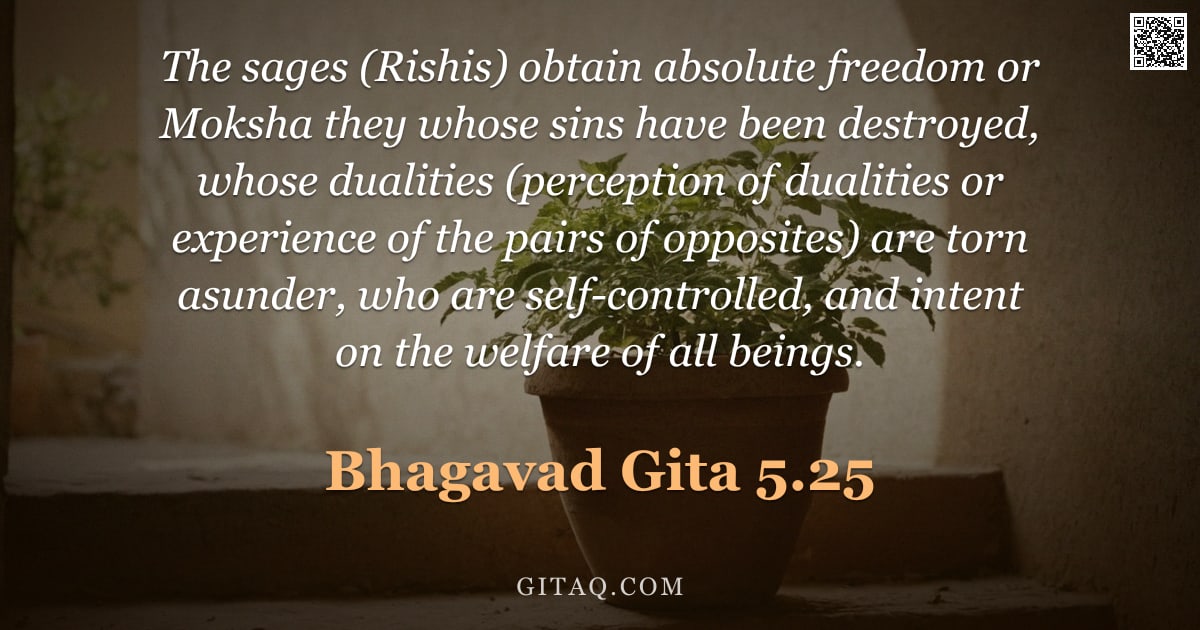
Bhagavad Gita 5.25
Karma Sanyasa Yoga · English Translation
लभन्ते ब्रह्मनिर्वाणमृषयः क्षीणकल्मषाः | छिन्नद्वैधा यतात्मानः सर्वभूतहिते रताः ||५-२५||
labhante brahmanirvāṇamṛṣayaḥ kṣīṇakalmaṣāḥ . chinnadvaidhā yatātmānaḥ sarvabhūtahite ratāḥ ||5-25||
What Does This Verse Mean?
This verse describes the state of a sage who has achieved spiritual liberation (Moksha). These individuals have purified their minds by removing past sins, overcome all mental dualities like pleasure and pain, mastered their own senses, and dedicate themselves to helping others. The teaching is that true freedom comes not from isolation, but from acting selflessly for the welfare of all beings while remaining internally balanced.
The Teaching Behind It
This verse synthesizes Karma Yoga (action without attachment) and Jnana Yoga (knowledge of the Self), describing the qualities of one who has realized their true nature. It develops the concept that self-realization is not an escape from the world, but a state where one acts for universal welfare while remaining untouched by the pairs of opposites.
Word by Word
Classical Commentary
Where This Happens
In Chapter 5 of the Bhagavad Gita, Lord Krishna is speaking to Arjuna on the battlefield of Kurukshetra, following his detailed explanation of Karma Sanyasa (renunciation through action). This verse serves as a concluding summary describing the ultimate result for those who practice this path. It addresses Arjuna's confusion about whether renunciation means giving up work or simply changing one's attitude while working.
Living It Out Today
Consider a manager facing a high-stakes project deadline where mistakes could lead to layoffs; instead of panicking over potential loss (duality), they maintain calm and focus on ensuring their team has the resources needed to succeed. By acting with self-control and prioritizing the well-being of colleagues rather than personal recognition, the manager experiences less anxiety and achieves a sense of inner peace regardless of the outcome.
Explained for Children
Imagine a person who has cleaned up all the messy thoughts in their head so they can feel happy no matter what happens outside, like if it rains or shines. This verse is about people who have learned to control themselves and only do kind things because they want everyone else to be safe and happy too. When you are this calm and helpful, you find a special kind of peace that never goes away.
Daily Reflection
You might feel overwhelmed by the constant push and pull of life's dualities—success and failure, praise and criticism—but this verse reminds you that true peace lies beyond these swings. When you cleanse your heart of past regrets and steady your senses through self-control, a profound clarity emerges where only compassion for others remains. Imagine yourself not as someone struggling against the world, but as a warm presence dedicated to its welfare.
A Practice for Today
Sit quietly and visualize the heavy weight of your past mistakes dissolving like mist under the morning sun, leaving you light and free from guilt. As you breathe, gently release any judgment between 'good' or 'bad,' allowing your mind to rest in a space where opposites no longer pull you apart.
Key Teachings
- Purification Through Action
The verse identifies 'kṣīṇakalmaṣāḥ' (those whose sins are destroyed) as the first prerequisite for liberation, suggesting that past actions and their karmic residues must be cleared. This purification is not a one-time event but a continuous process of aligning one's conduct with righteousness. - Transcending Duality
The state of 'chinnadvaidhā' describes the sage who has cut asunder the pairs of opposites like heat and cold, or pleasure and pain. This is not indifference to life's events, but an inner stability where external circumstances no longer disturb one's spiritual equilibrium. - Self-Control and Universal Welfare
True renunciation culminates in 'sarvabhūtahite ratāḥ,' a deep-rooted joy found only in the welfare of all beings. The verse teaches that self-mastery is not an end for personal gain, but the essential foundation for a life dedicated to serving others.
Themes
Related Verses
Read This Next
- 2.47 — To understand how performing duty without attachment is the practical method for destroying sins mentioned in this verse.
- 3.30 — This verse expands on surrendering actions to the Divine, a key step in achieving the self-control and purity described here.
- 12.15 — To see Krishna describing the qualities of a devotee who is dear because they are established in universal welfare and free from duality.
Recommended Reading
GitaQ earns from qualifying purchases as an Amazon Associate.