Bhagavad Gita 2.47
Sankhya Yoga · English Translation
कर्मण्येवाधिकारस्ते मा फलेषु कदाचन | मा कर्मफलहेतुर्भूर्मा ते सङ्गोऽस्त्वकर्मणि ||२-४७||
karmaṇyevādhikāraste mā phaleṣu kadācana . mā karmaphalaheturbhūrmā te saṅgo.astvakarmaṇi ||2-47||
What Does This Verse Mean?
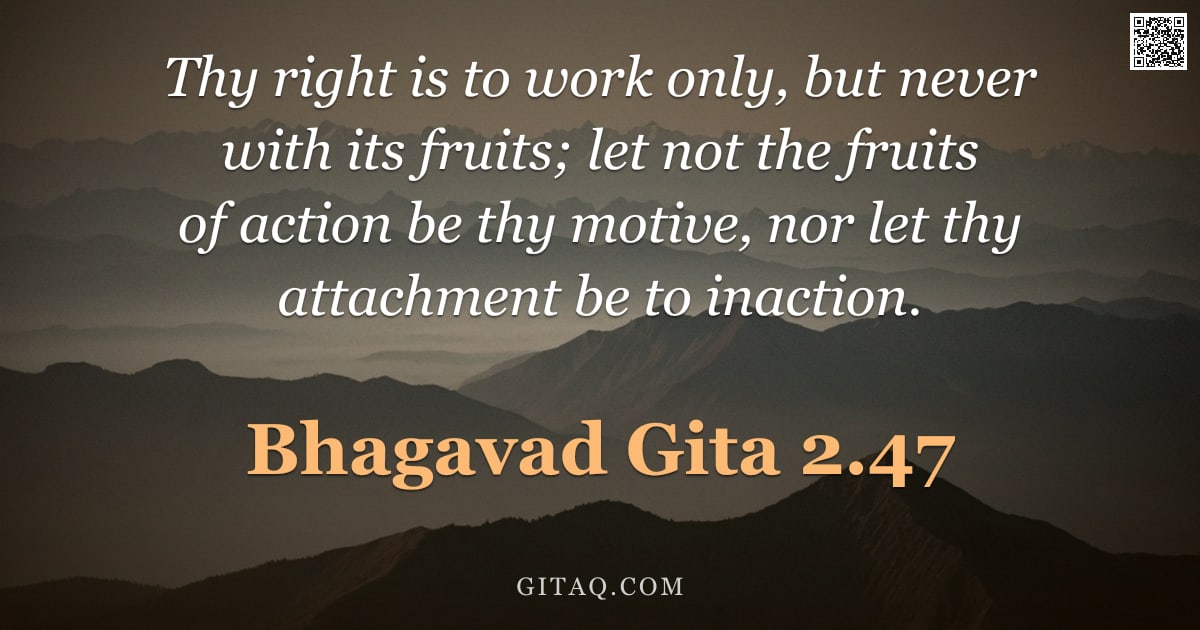
Lord Krishna is speaking to Prince Arjuna, who is overwhelmed by grief and refusing to fight his relatives on the battlefield of Kurukshetra. This verse teaches that your only right is to perform your prescribed duties without attachment to the results or outcomes. It warns against acting solely for personal gain while also cautioning against becoming lazy and avoiding action altogether due to fear of failure.
The Teaching Behind It
This verse is the cornerstone of Karma Yoga (the yoga of selfless action) within the broader framework of Sankhya philosophy presented in Chapter 2. It establishes that true freedom comes from performing one's duty as an offering rather than a transaction, thereby breaking the cycle of binding reactions to past actions.
Word by Word
Classical Commentary
Where This Happens
This teaching occurs in Chapter 2 on the battlefield of Kurukshetra, where Prince Arjuna has dropped his bow and is paralyzed by sorrow upon seeing his teachers, cousins, and friends arrayed against him. After a brief pause, Lord Krishna begins to address Arjuna's confusion by introducing Sankhya Yoga (the yoga of analysis) to distinguish the eternal self from the temporary body. Arjuna is currently in a state of delusion and despair, believing that fighting his own kin is adharma (unrighteous), while Krishna aims to shift his perspective toward duty.
Living It Out Today
Consider a software developer who has spent months working on a critical app update; instead of obsessing over whether the launch will lead to a massive promotion or bonus, they focus entirely on writing clean code and solving bugs effectively. If they become anxious about potential market rejection, they might hesitate to push for innovation, leading to stagnation in their career growth. By detaching from the outcome, they maintain clarity and perform at their peak, regardless of whether investors are happy with the launch.
Explained for Children
Imagine you are playing soccer, but instead of focusing on running fast and kicking the ball well, you keep worrying about whether your team will win or lose. Lord Krishna says that just like in a game, your job is to play your best with all your heart, not because you want the trophy, but because it is what you should do. If you only care about winning, you might get too scared to try anything new; if you give up because you are afraid of losing, you can't have any fun at all.
Daily Reflection
Today, I invite you to release the heavy burden of needing specific results from your efforts. When you work without attaching your self-worth to success or failure, you discover a profound freedom where action itself becomes its own reward. This shift transforms your daily tasks from sources of stress into sacred opportunities for growth and service.
A Practice for Today
Close your eyes and take three deep breaths, visualizing the action you are performing as a pure offering rather than a transaction for reward. Silently repeat 'I act because it is right,' allowing the anxiety about future outcomes to dissolve into the stillness of the present moment.
Key Teachings
- Sovereignty in Action
The verse establishes that our true domain is limited strictly to the act of doing, not the outcomes which are governed by cosmic laws. By focusing only on what lies within your control, you eliminate unnecessary anxiety and perform with clarity. - Detachment from Fruits
Making the fruit of action a motive binds the soul to desire and disappointment, whereas performing duty without this attachment liberates the mind. This detachment does not mean indifference but rather an active engagement free from selfish craving. - The Trap of Inaction
Krishna warns that avoiding work because one fears failure is a form of ignorance, as true spiritual practice requires engaged effort. One must avoid the inertia of inaction by understanding that renunciation happens through action performed with the right mindset.
Themes
Related Verses
Read This Next
Recommended Reading
GitaQ earns from qualifying purchases as an Amazon Associate.