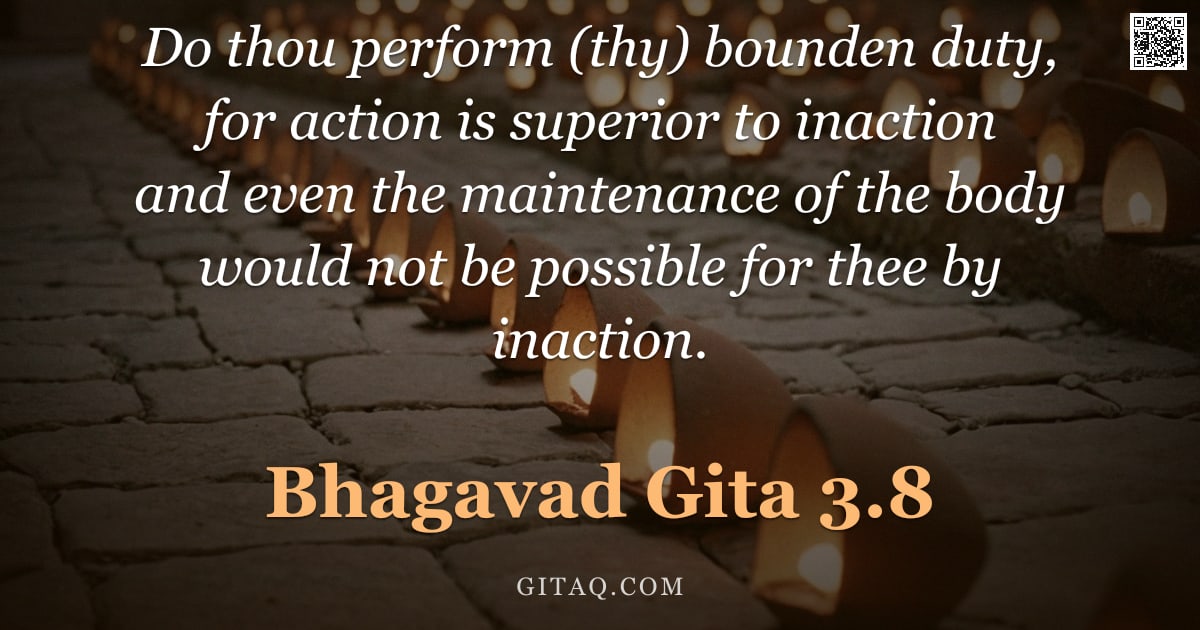
Bhagavad Gita 3.8
Karma Yoga · English Translation
नियतं कुरु कर्म त्वं कर्म ज्यायो ह्यकर्मणः | शरीरयात्रापि च ते न प्रसिद्ध्येदकर्मणः ||३-८||
niyataṃ kuru karma tvaṃ karma jyāyo hyakarmaṇaḥ . śarīrayātrāpi ca te na prasiddhyedakarmaṇaḥ ||3-8||
What Does This Verse Mean?
In this verse, Lord Krishna urges Arjuna to perform his prescribed duty without hesitation. He explains that action is inherently superior to complete inaction because even maintaining a physical body requires some form of activity. The core teaching is that one cannot escape the necessity of action; therefore, it is better to act with purpose and discipline than to remain passive.
The Teaching Behind It
This verse is foundational to Karma Yoga, the path of selfless action. It develops the concept that inaction (Akarma) is physically impossible for a living being bound by nature's modes, and thus one must transform obligatory duties into spiritual practice through disciplined engagement rather than avoidance.
Word by Word
Classical Commentary
Where This Happens
This verse occurs in Chapter 3 of the Bhagavad Gita during a conversation between Lord Krishna and Prince Arjuna on the battlefield of Kurukshetra. Just before this moment, Arjuna has expressed confusion about fighting his own relatives and suggests that it would be better to renounce action entirely by becoming an ascetic or simply refusing to fight. Krishna gently refutes this idea, pointing out that no one can remain inactive even for a moment, as the very act of breathing requires effort.
Living It Out Today
Consider a professional who is overwhelmed and tempted to quit their job immediately due to stress or burnout. This verse teaches them that doing nothing will not solve the problem; in fact, stopping work might lead to financial instability and loss of purpose. Instead, they should focus on performing their current responsibilities with dedication and detachment from the outcome, using action as a tool to stabilize their life rather than fleeing from it.
Explained for Children
Imagine you have a robot friend who never moves or plays. Even if they want to eat lunch or build a tower with blocks, they can't do any of those things because their hands won't work! In the same way, our bodies need us to move and act just to stay alive and healthy. Krishna is telling Arjuna that doing your job, like studying for school or helping at home, is actually better than sitting still forever.
Daily Reflection
You often feel that inaction might be an escape from pressure, yet Arjuna gently reminds you that true stillness is impossible when life demands motion. Even simply eating and breathing requires a chain of actions; without them, your physical form cannot endure for another moment. Instead of viewing duty as a heavy burden, try to see it as the essential rhythm that keeps your spirit connected to the world.
A Practice for Today
Close your eyes and visualize that every action you take today, no matter how small, is the very breath keeping your life alive. Silently affirm to yourself: 'I act not for a distant reward, but because movement itself sustains existence.' Let this realization dissolve any hesitation or desire to withdraw from the world.
Key Teachings
- The Necessity of Action
Krishna establishes that action is not merely an option but a biological and spiritual necessity for maintaining life. Without engagement in duty, even basic survival becomes impossible, proving that complete withdrawal from the world is unattainable. - Superiority of Bounden Duty
The verse highlights 'niyataṃ' (bounden or prescribed) action as superior to inaction because it aligns with cosmic order. Performing one's duty without attachment leads to clarity, whereas inaction creates stagnation and confusion. - Action Over Inaction
The core teaching is that a life of prescribed action yields greater spiritual fruit than a forced state of non-action. One cannot achieve liberation or even physical stability by refusing to act, as existence itself is dynamic.
Themes
Related Verses
Read This Next
- 2.47 — This verse immediately follows by clarifying that while action is necessary, it must be performed without attachment to results.
- 3.30 — Here Krishna deepens the concept of action by instructing you to dedicate all deeds to Him as a form of surrender.
- 12.15 — To balance this focus on active duty, read how one who is not disturbed and does not disturb others attains the highest peace.
Recommended Reading
GitaQ earns from qualifying purchases as an Amazon Associate.