Bhagavad Gita 4.18
Jnana Karma Sanyasa Yoga · English Translation
कर्मण्यकर्म यः पश्येदकर्मणि च कर्म यः | स बुद्धिमान्मनुष्येषु स युक्तः कृत्स्नकर्मकृत् ||४-१८||
karmaṇyakarma yaḥ paśyedakarmaṇi ca karma yaḥ . sa buddhimānmanuṣyeṣu sa yuktaḥ kṛtsnakarmakṛt ||4-18||
What Does This Verse Mean?
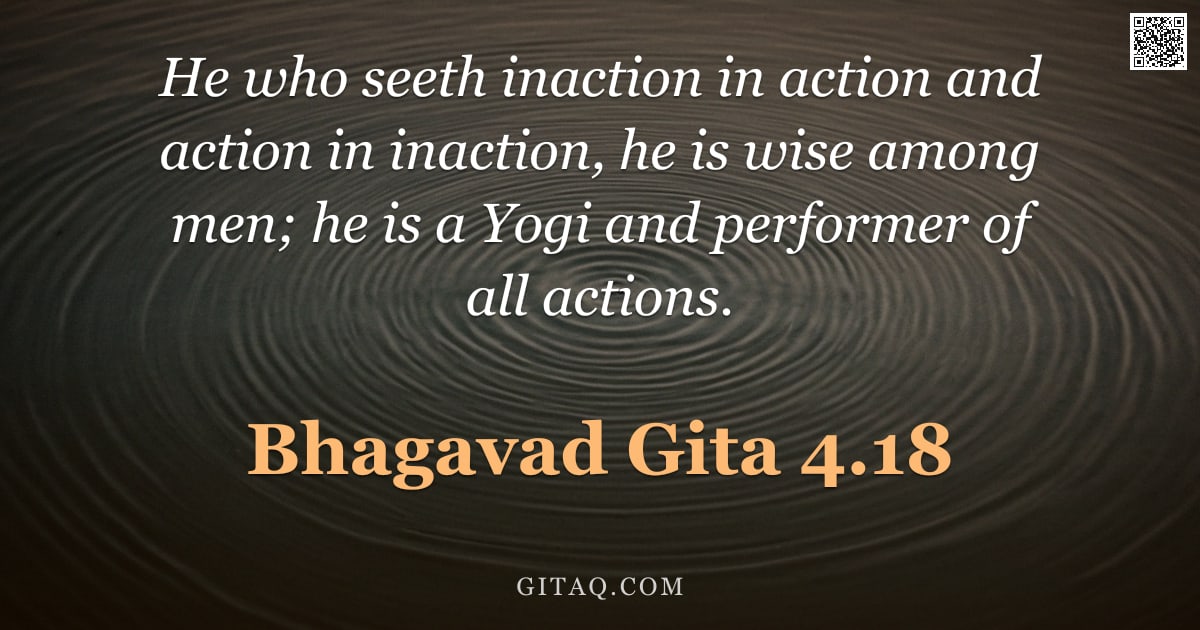
In this verse, Lord Krishna explains the paradox of true wisdom to Arjuna regarding action and inaction. He teaches that a wise person sees 'inaction' within their physical actions because they are not driven by personal desire or attachment to results. Conversely, they see 'action' even when seemingly inactive because their inner state is one of spiritual readiness and non-attachment. Such a person is considered a true Yogi who performs all duties without the burden of karma binding them.
The Teaching Behind It
This verse is central to Karma Yoga and Jnana Yoga (the yoga of knowledge), specifically developing the concept of 'Karmasannyasa'—renunciation in action. It articulates the non-dualistic realization that while the body acts, the true Self (Atman) remains untouched by these actions because it does not identify with them as a doer.
Word by Word
Classical Commentary
Where This Happens
This verse occurs in Chapter 4 of the Bhagavad Gita, set on the battlefield of Kurukshetra just as Arjuna is hesitating to fight his own relatives. Krishna has already begun explaining the nature of action and has started revealing how one can act without accumulating negative karma through ignorance. Speaking to a confused warrior overwhelmed by emotional conflict, Krishna offers this definition of true intelligence to shift Arjuna's perspective from fear of action to clarity in duty.
Living It Out Today
Consider a manager leading their team on a high-stakes project: they execute every task with maximum effort and precision (action) but remain emotionally detached from the final outcome or potential praise, accepting whatever result comes without stress. This mindset prevents burnout during crises because their sense of self-worth isn't tied to external validation. When facing a difficult decision like layoffs, they can make the necessary choice clearly, viewing it as a duty performed for the greater good rather than a personal failure.
Explained for Children
Imagine you are playing your favorite video game with total focus, but afterwards, you don't get upset if you win or lose; you just put the controller down and feel calm. That is what this verse means: doing something fully and well (action) without worrying about getting a trophy or being angry if it goes wrong (inaction). A wise person does their homework or chores completely but doesn't let their heart get heavy with worry afterwards, staying free like a bird that flies high.
Daily Reflection
Today, I invite you to look at your own busy life and ask: are you truly active only when moving physically? The Gita suggests that true wisdom lies in seeing how even stillness can be a form of deep spiritual action. When you realize that the Self remains untouched by your deeds or lack thereof, you find a profound peace amidst the chaos of daily duties.
A Practice for Today
Sit quietly and observe your hands as you type or rest them gently; notice the movement of action while simultaneously feeling the stillness of awareness that observes it without getting lost in the doing. Visualize yourself performing a task with full engagement, yet maintaining an inner silence where no sense of 'I am the doer' arises.
Key Teachings
- The Paradox of Action
True wisdom perceives inaction within action because the doer knows they are not the true agent of the deed. This understanding dissolves the burden of karma, allowing one to act without attachment. - Action Within Inaction
Even when seemingly doing nothing physically or sitting in meditation, a sage is engaged in the action of maintaining spiritual awareness and inner order. This reveals that external stillness does not guarantee internal stagnation if consciousness remains active. - The State of Yoga
One who grasps this subtle distinction becomes a 'Yogi'—a person established in unity with the Divine while fully participating in worldly life. Such an individual performs all necessary actions without generating new binding karmic reactions.
Themes
Related Verses
Read This Next
- 2.47 — To understand the foundational instruction to act without attachment, which makes 'inaction in action' possible.
- 3.30 — To see how surrendering all actions to the Divine is a practical method for becoming the wise person described here.
- 12.15 — To reflect on the qualities of one who has transcended duality and becomes dear to Krishna, embodying this state of wisdom.
Recommended Reading
GitaQ earns from qualifying purchases as an Amazon Associate.