Bhagavad Gita 18.49
Moksha Sanyasa Yoga · English Translation
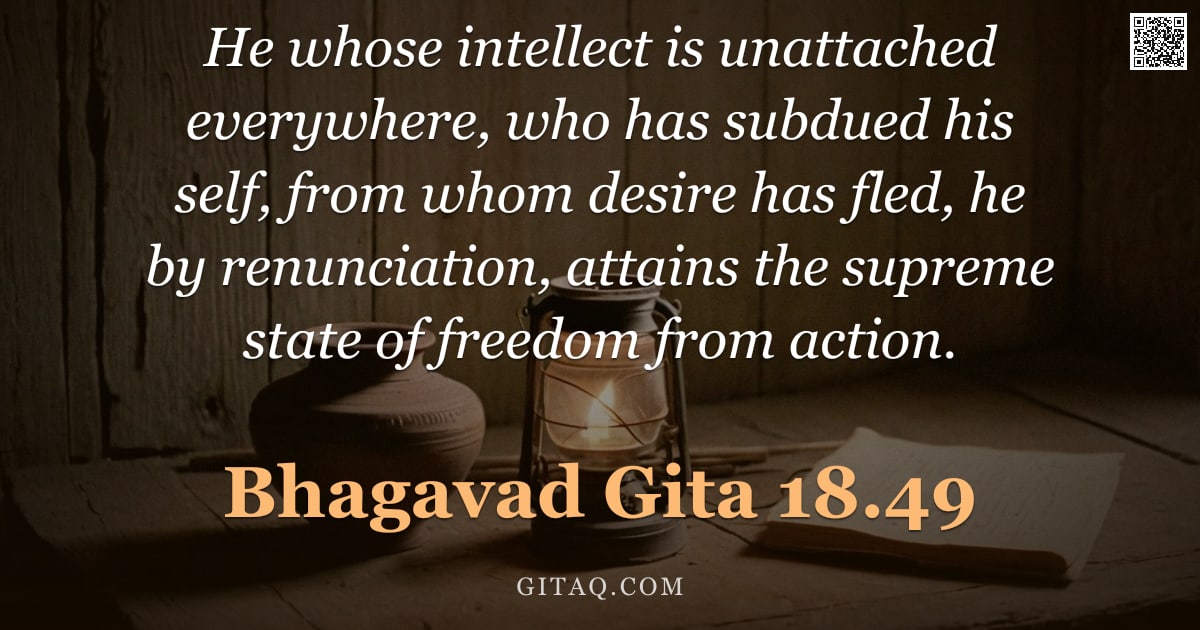
असक्तबुद्धिः सर्वत्र जितात्मा विगतस्पृहः | नैष्कर्म्यसिद्धिं परमां संन्यासेनाधिगच्छति ||१८-४९||
asaktabuddhiḥ sarvatra jitātmā vigataspṛhaḥ . naiṣkarmyasiddhiṃ paramāṃ saṃnyāsenādhigacchati ||18-49||
What Does This Verse Mean?
In this verse, Lord Krishna describes the ideal state of a person ready for liberation while explaining to Arjuna that true renunciation is about inner detachment rather than just leaving one's home. He teaches that when your mind remains unattached in all situations, you have mastered your emotions and eliminated selfish desires, you attain the highest peace known as freedom from the binding cycle of action and reaction. This state is achieved not by abandoning duties physically, but through a spiritual mindset where actions are performed without attachment to results.
The Teaching Behind It
This verse synthesizes the teachings of Karma Yoga (the path of selfless action) with Jnana Yoga (the path of knowledge), illustrating that true renunciation is an internal state of mind rather than external abandonment. It develops the concept of 'Naiskarmya Siddhi,' which means attaining perfection through freedom from the karmic reactions to one's actions, achieved by maintaining a detached intellect and subdued senses.
Word by Word
Classical Commentary
Where This Happens
This verse appears in Chapter 18, which serves as the concluding summary of Lord Krishna's teachings to Prince Arjuna on the battlefield of Kurukshetra. After explaining various paths including duty and devotion, Krishna now defines 'Sannyasa' (renunciation) not as abandoning one's home or family, but as a state of mind where desire has been conquered through wisdom. At this moment, Arjuna is still listening with deep attention after being overwhelmed by the prospect of fighting his own kinsmen; he seeks clarity on how to achieve spiritual perfection while remaining in society.
Living It Out Today
Consider a manager facing a high-stakes product launch where they have worked for months and fear failure could end their career. Instead of obsessing over the potential outcome or feeling anxious about losing credit, they focus entirely on executing each task with excellence, treating every step as an offering to be done well regardless of the result. By detaching from the specific outcome—whether success or failure—they maintain clarity in decision-making and experience a deep sense of peace even if the launch faces unexpected challenges.
Explained for Children
Imagine you are playing with LEGO bricks very carefully so they don't fall apart; once your toys are safe, you feel happy just because you built them, not because of any prize. This verse is like that: when you do good things and finish them well without worrying about winning or getting angry if something goes wrong, your mind becomes calm and free. It means doing what needs to be done with all your heart, but letting go of the worry about 'what happens next' so you can feel truly happy inside.
Daily Reflection
Today, I invite you to notice how often your intellect gets tangled in 'what if' scenarios or clings to specific outcomes. When desire fades and the mind remains unattached like a lotus leaf on water, true freedom emerges not from doing less, but from being fully present without internal resistance. You possess the inner strength to subdue these restlessnesses; trust that renouncing the grip of results is the direct path to your supreme peace.
A Practice for Today
Take three deep breaths and imagine your mind as a clear sky, allowing thoughts of attachment to drift away without grasping them. Silently affirm that you are the steady witness who has already conquered inner cravings, resting in the peace where no new action is needed.
Key Teachings
- The Unattached Intellect
True wisdom arises when the mind remains steady in all circumstances, free from being swayed by external gains or losses. This state of 'asakta-buddhi' means your decision-making is no longer clouded by personal bias or fear. - Conquest of the Self
Before one can attain liberation, they must first master their own senses and impulses through disciplined self-control. The 'jitatma' (conquered self) is a prerequisite for receiving divine grace without internal friction. - Freedom from Action
Paradoxically, the highest state of liberation ('naiṣkarmya') is achieved not by abandoning action, but by renouncing the attachment to its fruits. When desire flees, actions become spontaneous expressions of duty rather than burdensome obligations.
Themes
Related Verses
Read This Next
- 2.50 — This verse defines yoga as skill in action while maintaining equanimity, directly supporting the 'unattached intellect' mentioned today.
- 3.6 — It explains that restraining senses without renouncing desire is futile, highlighting why inner purification ('desire fled') is essential for true yoga.
- 12.15 — Krishna describes the qualities of a devotee who is free from agitation and selfishness, mirroring the 'unattached' state described in 18.49.
Recommended Reading
GitaQ earns from qualifying purchases as an Amazon Associate.