Bhagavad Gita 6.5
Dhyana Yoga · English Translation
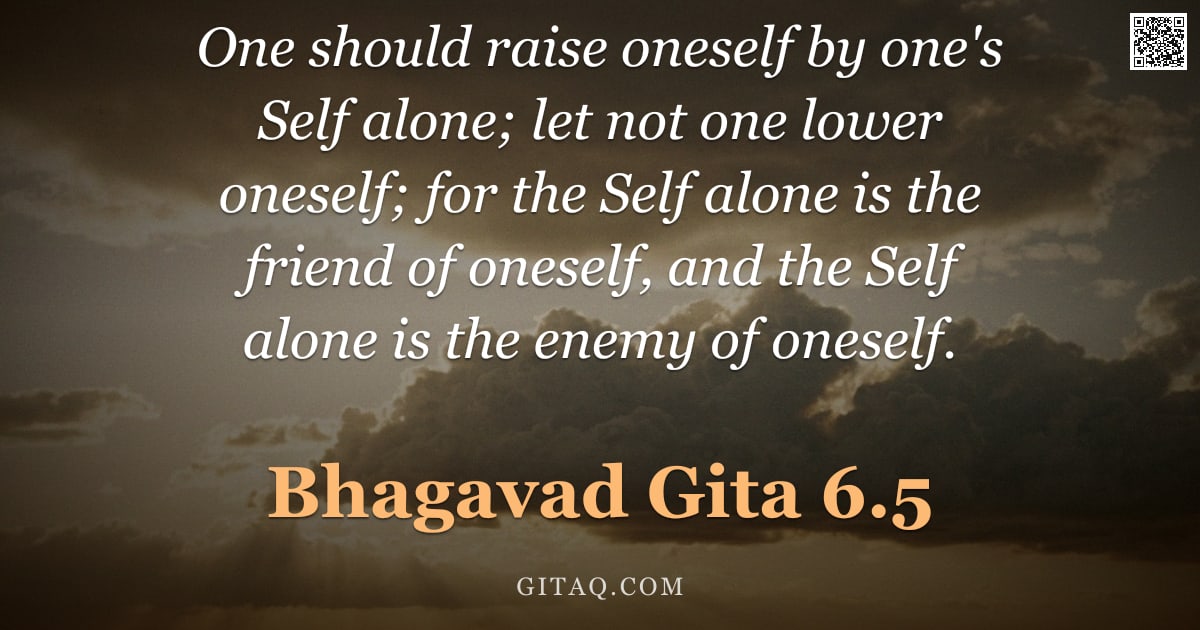
उद्धरेदात्मनात्मानं नात्मानमवसादयेत् | आत्मैव ह्यात्मनो बन्धुरात्मैव रिपुरात्मनः ||६-५||
uddharedātmanātmānaṃ nātmānamavasādayet . ātmaiva hyātmano bandhurātmaiva ripurātmanaḥ ||6-5||
What Does This Verse Mean?
In this verse, Lord Krishna instructs Arjuna that the responsibility for one's own spiritual progress lies entirely within oneself. The teaching emphasizes a dual nature of the self: when controlled through discipline and wisdom, it becomes our greatest friend; however, if left to unchecked desires and laziness, it becomes our worst enemy. Ultimately, no external force can save or destroy you except your own inner state.
The Teaching Behind It
This verse is central to Dhyana Yoga, which integrates concepts from Sankhya philosophy regarding the distinction between the mind and the true Self. It specifically develops the concept of Atma-bandhuha-Atma-ripu-ha (the self as friend/enemy), establishing that spiritual liberation or bondage is a result of one's internal mental state rather than external circumstances.
Word by Word
Classical Commentary
Where This Happens
This teaching occurs during Chapter 6 on the battlefield of Kurukshetra, where Lord Krishna is guiding Prince Arjuna through the stage of Dhyana Yoga (Meditation). After explaining that one who has conquered their mind can see the self in all beings and vice versa, Krishna addresses a potential confusion: how does this internal work happen? He clarifies that while God guides, the actual lifting or lowering of the soul depends on Arjuna's own effort. At this moment, Arjuna feels overwhelmed by the complexity of controlling his mind amidst emotional turmoil.
Living It Out Today
Consider a professional facing burnout after missing several deadlines due to procrastination and self-criticism. Instead of waiting for a manager or colleague to 'fix' their motivation, they apply this verse by recognizing that only their own daily choices—waking up early, focusing on one task at a time—can reverse the decline. If they continue to indulge in distractions (lowering themselves), stress and failure will compound; but if they discipline their habits (raising themselves), they rebuild confidence and competence.
Explained for Children
Imagine you have two sides inside your heart that are always playing games with each other: a 'Good Coach' side and a 'Lazy Side'. If the Good Coach pushes you to do homework, practice kindness, and stay calm, it helps you win in life. But if the Lazy Side makes you give up or be angry, it hurts your chances of winning. This verse teaches that you are both the coach and the player, so you must choose which side leads!
Daily Reflection
Today, ask yourself: who is driving this car? Is it the voice of doubt telling you that you are not enough, or is it the inner wisdom reminding you of your boundless potential. You hold both the key to your liberation and the chain of your limitations within your own hands; the power to change your day lies in deciding which master serves as your guide.
A Practice for Today
Sit quietly and observe your mind as either an ally or an adversary; notice where you are pulling yourself toward peace versus where fear is dragging you down. With every breath, choose to be the gentle hand that lifts your spirit rather than the heavy weight of self-criticism.
Key Teachings
- The Self is Both Judge and Jury
Krishna reveals that there is no external savior or enemy outside of our own consciousness. The quality of one's life depends entirely on whether the mind has been disciplined to serve higher ideals or indulged in lower impulses. - Self-Mastery Through Will
The verse commands an active effort: 'raise' oneself, implying that spiritual elevation is a dynamic act of will and discipline. It suggests that without conscious self-regulation, the natural tendency of the untrained mind is to descend into chaos. - Dual Nature of the Mind
The same faculty that binds us through attachment can also liberate us through detachment and wisdom. When controlled by reason, the Self becomes a friend; when ruled by impulse, it transforms into an enemy.
Themes
Related Verses
Read This Next
- 3.42 — This verse clarifies why the mind is so difficult to control and identifies it as a formidable enemy for those who have not yet subdued their senses, providing context for 6:5's challenge.
- 18.70 — Reading this final summary reinforces that understanding the self is the ultimate secret of life and leads to a state where one sees no difference between friend or foe.
Recommended Reading
GitaQ earns from qualifying purchases as an Amazon Associate.