Bhagavad Gita 3.41
Karma Yoga · English Translation
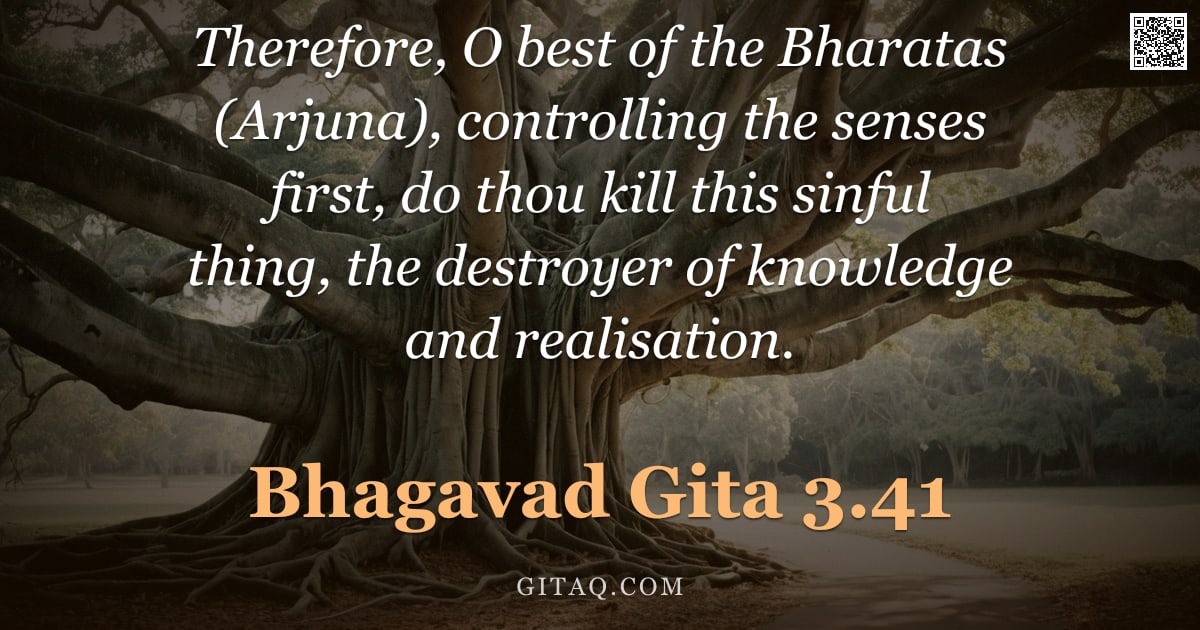
तस्मात्त्वमिन्द्रियाण्यादौ नियम्य भरतर्षभ | पाप्मानं प्रजहि ह्येनं ज्ञानविज्ञाननाशनम् ||३-४१||
tasmāttvamindriyāṇyādau niyamya bharatarṣabha . pāpmānaṃ prajahi hyenaṃ jñānavijñānanāśanam ||3-41||
What Does This Verse Mean?
Lord Krishna advises Arjuna to first gain control over his senses, as they are the gateway for negative influences that can destroy wisdom and spiritual realization. He calls this inner enemy 'pāpmāna' (the sinful one) because unchecked desires cloud judgment and lead to destructive actions. The teaching emphasizes a specific order of operations: regulate the physical senses before expecting higher knowledge or peace to take root.
The Teaching Behind It
This verse is central to Karma Yoga, specifically addressing the prerequisite for Jnana Yoga. It develops the concept of 'Indriya Nigraha' (restraint of senses), establishing that mental discipline must precede intellectual realization because uncontrolled desires act as a barrier to wisdom.
Word by Word
Classical Commentary
Where This Happens
This verse occurs in Chapter 3 of the Bhagavad Gita on the battlefield of Kurukshetra, where Prince Arjuna has just expressed deep confusion about whether to fight his own relatives. Krishna has been explaining that one must perform their duty without attachment to results, but he realizes Arjuna is still struggling with emotional turmoil and sensory distractions. This specific instruction comes after outlining how desire leads to anger and delusion; now Krishna gives the practical solution of 'samyama' (control) as a prerequisite for true knowledge.
Living It Out Today
Consider a professional facing a high-stakes negotiation where they feel overwhelmed by anxiety or an urge to react defensively. Before trying to make complex strategic decisions, this verse suggests pausing to regulate immediate physiological reactions—like deep breathing and stepping back from impulsive words—to calm the 'senses.' By mastering that initial emotional surge first, the person preserves their clarity of thought (knowledge) and avoids making a regrettable decision driven by fear or anger.
Explained for Children
Imagine your mind is a castle, but you have left all the front gates wide open; noisy visitors (your feelings like anger or greed) can rush in and make a mess. Krishna tells Arjuna that if he wants his smart thoughts and good heart to stay safe, he must be the guard who locks those gates first! It's not about being mean to your senses, but gently guiding them so they don't run wild and stop you from seeing what is truly important.
Daily Reflection
Notice how easily distraction can erode your clarity today; just as Arjuna was asked to master his senses first, you too must pause and steady yourself before tackling difficult tasks. This 'sinful thing' that destroys knowledge is often the impulse to react immediately rather than respond with awareness. By making a conscious effort to control your reactions at the very start of your day, you protect your inner peace from being scattered by external chaos.
A Practice for Today
Begin by silently acknowledging your senses as active but potentially unruly companions, and gently bring their focus back to the present moment without judgment. Visualize a quiet inner space where these senses are gathered under the governance of wisdom before you proceed with any action or thought.
Key Teachings
- Sensory Mastery as Priority
Krishna instructs that self-control must be established before any higher spiritual practice can take root. Without taming the senses first, they become obstacles rather than tools for your growth. - The Enemy of Wisdom
Unrestrained desire is identified as a destructive force that specifically targets knowledge and realization. It acts like an internal saboteur that clouds judgment and prevents the soul from seeing its true nature. - Active Elimination of Negativity
The verse commands us to actively 'kill' this destructive impulse rather than simply ignore it. This implies a courageous, decisive effort to cut off the root of negativity before it spreads further into one's life.
Themes
Related Verses
Read This Next
- 2.61 — This verse describes the state of a person whose senses have been successfully controlled and withdrawn from sense objects.
- 3.30 — It expands on how to offer all actions, including sensory engagements, to the Divine as part of Karma Yoga.
- 12.15 — This verse describes the qualities of a devotee who has transcended such destructive impulses and is dear to Krishna.
Recommended Reading
GitaQ earns from qualifying purchases as an Amazon Associate.