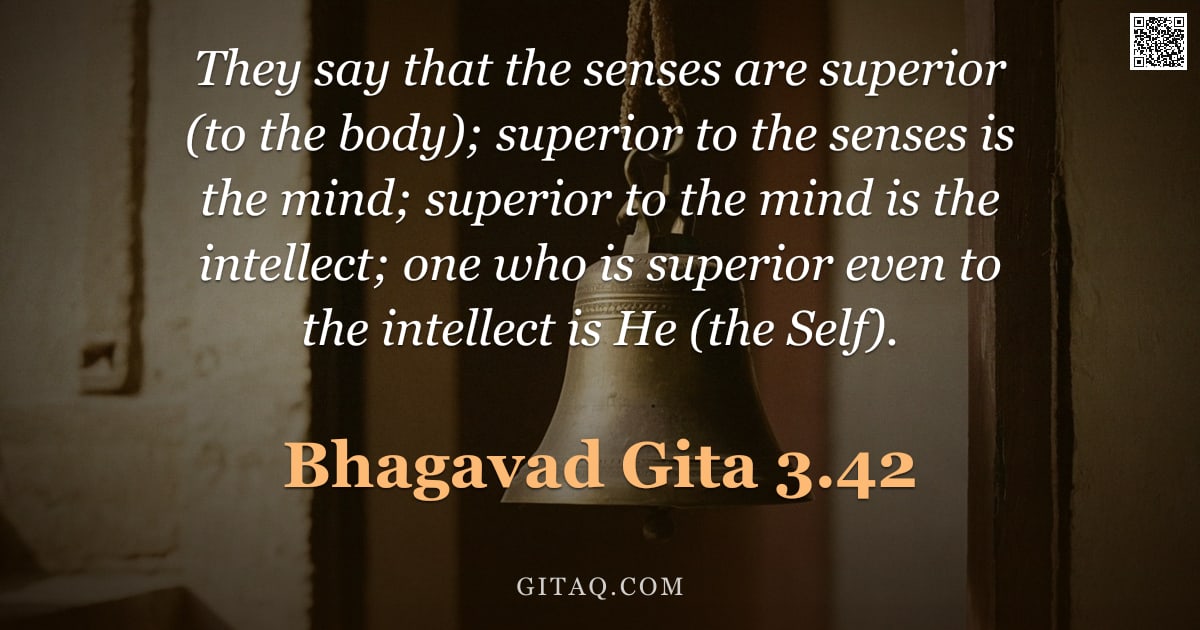
Bhagavad Gita 3.42
Karma Yoga · English Translation
इन्द्रियाणि पराण्याहुरिन्द्रियेभ्यः परं मनः | मनसस्तु परा बुद्धिर्यो बुद्धेः परतस्तु सः ||३-४२||
indriyāṇi parāṇyāhurindriyebhyaḥ paraṃ manaḥ . manasastu parā buddhiryo buddheḥ paratastu saḥ ||3-42||
What Does This Verse Mean?
Lord Krishna explains to Arjuna that there is a hierarchy of our internal faculties, where the senses are higher than the body, but the mind surpasses the senses. The intellect stands above the mind as its controller, yet the true Self (Atman) remains superior even to this powerful intellect. This verse teaches us that while we often get lost in sensory impulses or emotional fluctuations, our highest duty is to align with the eternal Self beyond all these layers.
The Teaching Behind It
This verse is foundational to Jnana Yoga (the path of knowledge) within the broader framework of Karma Yoga, as it provides the necessary discrimination between the observer and the observed. It develops the concept of 'Anubhava' or direct realization by establishing a hierarchy where the intellect must be mastered by realizing its own source in the eternal Self.
Word by Word
Classical Commentary
Where This Happens
This verse appears in Chapter 3 of the Bhagavad Gita, set on the battlefield of Kurukshetra just before Arjuna's paralysis lifts. Krishna has just finished explaining that simply giving up action is not a solution; one must act without attachment to achieve freedom. Hearing this, Arjuna remains confused about how to control his senses and mind to perform his duty as a warrior without being overwhelmed by fear or desire.
Living It Out Today
Consider a professional facing a high-stakes deadline who feels their anxiety (mind) spiraling after receiving negative feedback from the internet or social media (senses). Instead of reacting impulsively, they pause to engage their higher judgment (intellect) to analyze the situation objectively rather than emotionally. By connecting with their deeper sense of purpose and professional integrity (the Self), they can make a clear-headed decision that serves their long-term goals despite immediate stress.
Explained for Children
Imagine your body is like a car, and your senses are the wheels and steering wheel that let you see where you're going. But if the driver (your mind) gets distracted by pretty flowers on the side of the road, the car goes off track! The brain's 'brake pedal' or smart decision-maker (the intellect) helps control the driver to keep us safe. However, there is a special inner passenger inside every person—their true self—who watches over everything and knows exactly who they really are.
Daily Reflection
Today, notice where you feel most lost in the noise of immediate sensations or reactive emotions; this is often because we identify with our senses rather than who truly observes them. As you move your awareness inward to the mind, and then deeper still to that quiet intellect, remember there is a calmness within you even beyond these layers. That deepest layer is not just a part of you but is your true Self, waiting for you to rest in its superior peace.
A Practice for Today
Begin by observing how your senses pull you outward toward the world, then gently turn that attention inward to the mind that perceives them. From there, pause and recognize the intellect standing as a silent witness above the chatter of thoughts.
Key Teachings
- The Hierarchy of Perception
Krishna outlines a progressive ladder where the senses are controlled by the mind, which itself must be mastered by the intellect. This structure teaches that true freedom requires moving beyond reactive sensation to intentional understanding. - The Role of Buddhi (Intellect)
The verse elevates 'buddhi' as the critical faculty capable of distinguishing right from wrong and guiding action with discernment. It is the bridge that transforms raw sensory data into wise, deliberate choice. - Transcending to the Self
Even the intellect has a limit; it points toward 'Purusha' or the Supreme Self, which stands above all functional faculties. Realization of this eternal witness is the ultimate goal of Karma Yoga.
Themes
Related Verses
Read This Next
- 2.47 — This verse introduces the core practice of Karma Yoga by instructing action without attachment to results, building on the intellectual discernment found in Chapter 3.
- 3.30 — Following this discussion of hierarchy, you will find practical guidance on how to offer all actions and their fruits directly to the Divine.
- 12.15 — To see the result of mastering one's mind and senses in devotion, read about the qualities of a devotee who is dear to Krishna.
Recommended Reading
GitaQ earns from qualifying purchases as an Amazon Associate.