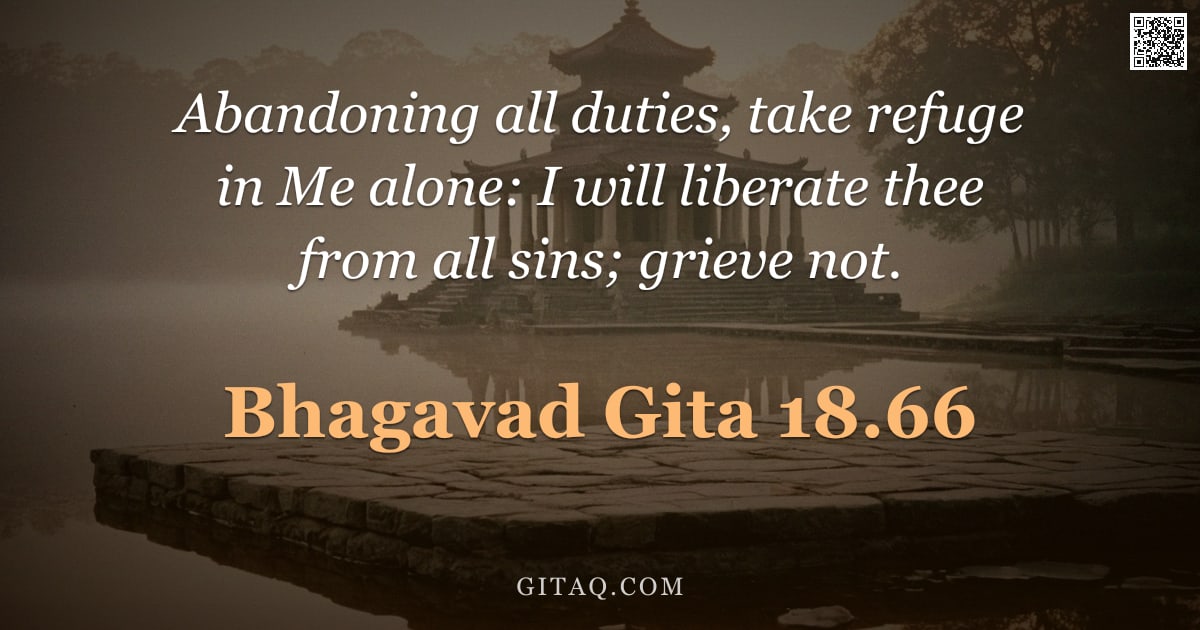
Bhagavad Gita 18.66
Moksha Sanyasa Yoga · English Translation
सर्वधर्मान्परित्यज्य मामेकं शरणं व्रज | अहं त्वा सर्वपापेभ्यो मोक्षयिष्यामि मा शुचः ||१८-६६||
sarvadharmānparityajya māmekaṃ śaraṇaṃ vraja . ahaṃ tvāṃ sarvapāpebhyo mokṣyayiṣyāmi mā śucaḥ ||18-66||
What Does This Verse Mean?
In this final verse of the Bhagavad Gita, Lord Krishna speaks directly to Arjuna, commanding him to surrender all forms of religious duty and personal ego completely to God's will. The core teaching is that by taking refuge in the Divine alone, one receives total protection from the consequences of past actions (sins) and fear. Krishna assures Arjuna not to grieve or worry about the outcome, promising liberation as a result of this ultimate trust.
The Teaching Behind It
This verse represents the culmination of Bhakti Yoga (the path of devotion) within the framework of Karma Sanyasa. It develops the concept that while one must perform their duty, ultimate liberation is not achieved through ritualistic perfection but through total surrender to the Divine Will, transcending individual agency.
Word by Word
Classical Commentary
Where This Happens
This is the concluding instruction (charama sloka) given by Lord Krishna on the battlefield of Kurukshetra just before the great war begins. Arjuna has listened to hours of philosophical discourse regarding duty, detachment, and devotion, yet he remains paralyzed by emotional confusion about fighting his own kin. Having established that true knowledge leads to action without attachment, Krishna now offers a final, unconditional promise of grace to remove Arjuna's remaining hesitation.
Living It Out Today
Consider a professional facing an impossible ethical dilemma at work where all choices seem risky and they are paralyzed by the fear of failure or making enemies. Instead of trying to control every outcome through endless planning or compromising their values, they can surrender the specific result to a higher principle while acting with integrity in the present moment. By releasing the anxiety about 'what if' scenarios, they find the clarity to make a bold decision and move forward without being crushed by the burden of potential consequences.
Explained for Children
Imagine you are carrying a very heavy backpack full of all your worries and mistakes, and it is too hard for you to carry alone. This verse tells us that God wants us to put down our heavy bags right now and say, 'Please hold me.' When we let God take care of everything with love, He promises to help us feel light again and not be afraid or sad about the future.
Daily Reflection
Today, feel free to release the exhausting weight of trying to control everything around you; there is no need for perfection or constant striving when you are held by grace. When anxiety whispers that you must do it alone, remember that surrendering your burden does not mean abandoning responsibility, but rather entrusting the outcome to a wisdom greater than your own. This moment invites you to trade fear for faith, knowing that liberation begins the instant you stop carrying the world on your shoulders.
A Practice for Today
Close your eyes and visualize laying down every burden, expectation, and self-reliance at the feet of the Divine. Breathe deeply as you affirm that true peace comes not from doing more, but from trusting completely in a higher power who holds all things.
Key Teachings
- The Necessity of Total Surrender
True spiritual progress requires abandoning attachment to all conventional duties and ego-driven identities as a foundation for divine connection. This verse establishes that only by making the Divine one's sole refuge can the cycle of karmic accumulation be broken. - Divine Assurance of Liberation
The Lord promises an active intervention to free the seeker from all past and future sins, removing the burden of guilt. This assurance is unconditional on human merit but dependent entirely on the sincerity of taking refuge in Him. - Freedom from Grief
The command 'grieve not' signifies that once trust is established, anxiety about consequences and future security naturally dissolves. This verse transforms grief into gratitude by shifting focus from human limitations to divine omnipotence.
Themes
Related Verses
Read This Next
- 2.47 — Read this next to understand how performing duty without attachment prepares the mind for total surrender.
- 3.30 — This verse explains dedicating all actions to Krishna, which is a practical step toward abandoning other duties in favor of divine will.
- 12.15 — Read this to see the characteristics of one who has surrendered and become dear to the Divine through selfless devotion.
Recommended Reading
GitaQ earns from qualifying purchases as an Amazon Associate.