Bhagavad Gita 3.43
Karma Yoga · English Translation
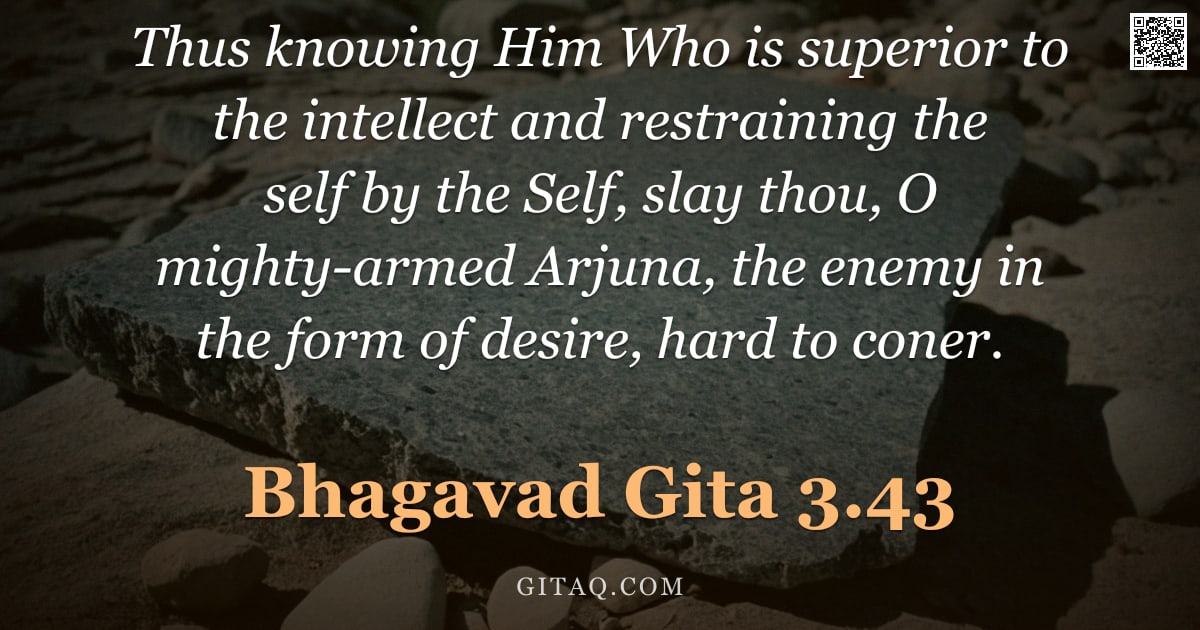
एवं बुद्धेः परं बुद्ध्वा संस्तभ्यात्मानमात्मना | जहि शत्रुं महाबाहो कामरूपं दुरासदम् ||३-४३||
evaṃ buddheḥ paraṃ buddhvā saṃstabhyātmānamātmanā . jahi śatruṃ mahābāho kāmarūpaṃ durāsadam ||3-43||
What Does This Verse Mean?
In this verse, Krishna urges Arjuna to conquer the inner enemy of desire by using a higher level of awareness than his intellect alone provides. He teaches that once you understand your true spiritual nature is superior to the mind and ego, you can use that deeper Self to restrain lower impulses. The key message is that desire is a powerful foe that must be actively defeated through self-discipline rooted in wisdom.
The Teaching Behind It
This verse is central to Karma Yoga (the yoga of action) as it integrates Jnana (wisdom), teaching that right action requires the intellect to be subordinate to higher spiritual awareness. It develops the concept that desire acts as a 'durasadam' (hard-to-conquer enemy) and must be subdued by using the Atman (Self) as the instrument of control.
Word by Word
Classical Commentary
Where This Happens
This verse occurs on the battlefield of Kurukshetra during the Mahabharata war, where Krishna is instructing Arjuna, who has just become overwhelmed by grief and hesitation to fight his own relatives. After explaining the nature of action without attachment in previous verses, Krishna now identifies desire as the root cause of Arjuna's paralysis and moral confusion. The listener, Arjuna, feels paralyzed not because he lacks strength, but because his intellect is clouded by emotional desires for peace over duty.
Living It Out Today
Consider a professional who wants to quit their stressful job immediately due to burnout, driven purely by an impulsive desire to escape discomfort rather than making a strategic plan. Instead of acting on that fleeting urge (the enemy), they can use their higher self-awareness to recognize the long-term value of resilience and patience in building a career. By restraining this immediate emotional reaction with wisdom, they make a conscious decision to stay focused or create a healthy exit strategy rather than reacting out of fear.
Explained for Children
Imagine your brain has two parts: a noisy part that always wants candy or video games right now (that's the mind), and a calm, wise part deep inside you that knows what is best. This verse tells us to listen to our quiet, wise inner self instead of the loud demands for fun things we don't need. Just like a captain steering a ship through stormy waves, your wisdom can steer your actions so you don't get lost in wanting too many toys or snacks.
Daily Reflection
Arjuna was told to slay a formidable enemy, yet that adversary is often our own uncontrolled desires disguised as urgent needs or fleeting impulses. Today, instead of fighting your thoughts with forceful willpower alone, pause to remember the Self that watches them; from this quiet distance, you find the strength to let desire lose its power over you.
A Practice for Today
Begin by recognizing that your true nature, the Atman, stands above even the fluctuating intellect; anchor yourself there first. From this stable ground of Self-knowledge, gently but firmly observe the arising desire and do not let it command you.
Key Teachings
- The Hierarchy of Consciousness
Krishna establishes that while we often struggle with our minds and intellects, there is a higher reality—the Self (Atman)—that transcends even the intellect. Recognizing this superior status provides the necessary foundation for spiritual victory. - Self-Restraint Through Self-Knowledge
The verse instructs us to 'restrain the self by the Self,' implying that our higher consciousness must govern our lower nature rather than being dragged down by it. This internal governance is not a struggle of two opposing forces, but the natural alignment of the individual with their divine source. - The Nature of Desire as an Enemy
Desire (Kama) is identified as 'hard to conquer' and an enemy because it clouds judgment and binds us to the cycle of action and reaction. Slaying this desire does not mean destroying life, but rather cutting the attachment that prevents inner peace. - The Call to Action
Despite the difficulty in conquering desire, Krishna commands Arjuna to 'slay' it immediately and decisively. This is a call for decisive spiritual action rooted in wisdom rather than hesitation or avoidance of life's challenges.
Themes
Related Verses
Read This Next
- 2.47 — This verse establishes the foundational principle of performing action without attachment to results, which is necessary before one can effectively slay desire.
- 3.30 — It continues the theme of Karma Yoga by instructing Arjuna to dedicate all actions to Krishna, further reducing the ego's grip that fuels desire.
- 12.15 — This verse describes the qualities of a devotee who is free from agitation and envy, showing the fruit of successfully conquering internal desires like Kama.
Recommended Reading
GitaQ earns from qualifying purchases as an Amazon Associate.