Bhagavad Gita 4.1
Jnana Karma Sanyasa Yoga · English Translation
श्रीभगवानुवाच | इमं विवस्वते योगं प्रोक्तवानहमव्ययम् | विवस्वान्मनवे प्राह मनुरिक्ष्वाकवेऽब्रवीत् ||४-१||
śrībhagavānuvāca . imaṃ vivasvate yogaṃ proktavānahamavyayam . vivasvānmanave prāha manurikṣvākave.abravīt ||4-1||
What Does This Verse Mean?
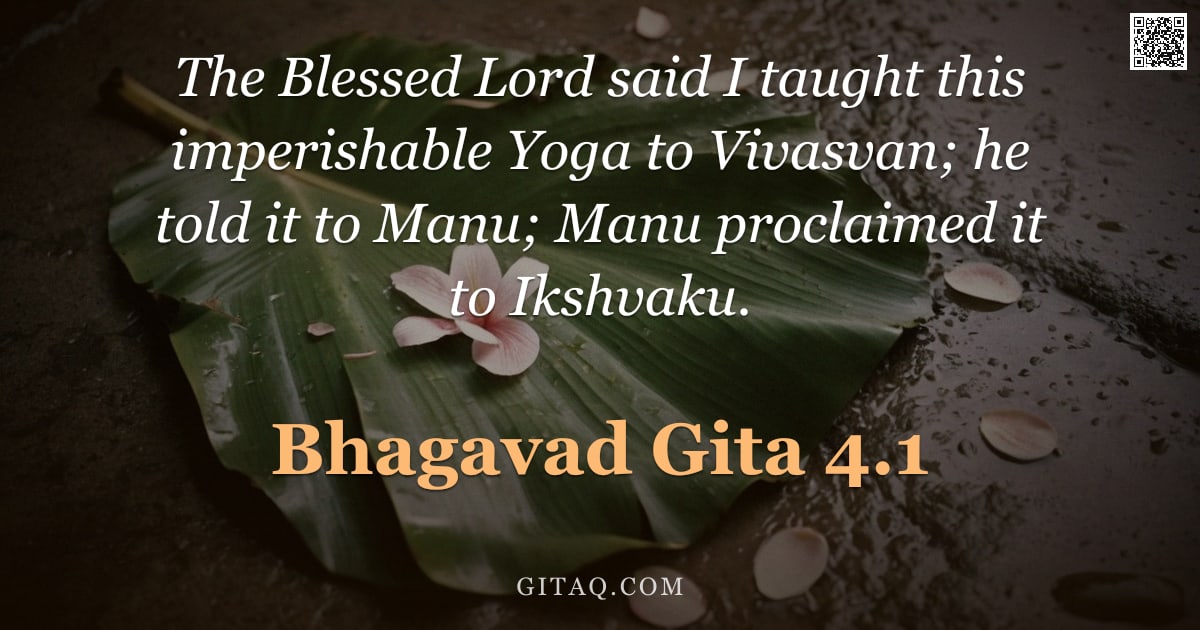
In this verse, Lord Krishna reveals that the spiritual path he is teaching Arjuna today was originally imparted by him to Vivasvan (the sun god) long ago. This ancient knowledge of Yoga has been passed down through a lineage: from Vivasvan to Manu, and then from Manu to King Ikshvaku. The key teaching here is that this wisdom regarding selfless action and spiritual practice is eternal ('imperishable') but was lost over time until now.
The Teaching Behind It
This verse belongs primarily to Jnana Yoga (the path of knowledge) and Karma Yoga (the yoga of selfless action), as it establishes the validity and continuity of spiritual practice. It introduces the concept of 'Parampara' (disciplic succession), emphasizing that true wisdom is preserved through a chain of teachers rather than being invented anew by individuals.
Word by Word
Classical Commentary
Where This Happens
This verse occurs in the fourth chapter of the Bhagavad Gita on the battlefield of Kurukshetra, where Prince Arjuna is filled with confusion and despair about fighting his relatives. After Krishna has briefly explained His divine nature (Chapter 4), He begins by establishing that this knowledge is not new but an ancient tradition. The listener, Arjuna, is overwhelmed because he believes such high spiritual wisdom could never have been lost or forgotten in the past.
Living It Out Today
Consider a family heirloom recipe for making your grandmother's famous soup; you know it exists and is valuable, yet no one remembers the exact steps anymore. In modern life, this mirrors how traditional values like patience, integrity, or conflict resolution are often known to exist but forgotten in our fast-paced world. Just as Krishna revived the lost 'Yoga' of action for Arjuna, we must actively seek out and revive these timeless principles when facing difficult decisions at work or family disputes.
Explained for Children
Imagine a secret recipe for happiness that your great-great-grandfather knew, wrote down in a notebook, and taught to his friend. That friend shared it with their child, who kept the tradition alive through generations. Lord Krishna is like a wise teacher telling Arjuna (and us) that this special 'recipe' for living well has been passed from person to person for thousands of years, but sometimes people forgot how to use it until now.
Daily Reflection
You may feel as though your struggles are entirely unique or that true wisdom belongs only to the past, yet this verse reminds us that divine guidance has always been available in its imperishable form. When you approach your duties today with a sense of connection to that ancient lineage, the weight of isolation lifts and is replaced by timeless confidence. Trust that the same clarity offered to Ikshvaku can illuminate your current path if you remain open to receiving it.
A Practice for Today
Sit quietly and visualize an unbroken golden thread of wisdom flowing from the divine, through ancient sages like Vivasvan and Manu, directly into your own heart today. Acknowledge that this knowledge is not a new discovery but an eternal truth waiting to be realized within you.
Key Teachings
- The Eternal Lineage
Krishna reveals that spiritual knowledge is not a new invention but an ancient, unbroken stream of transmission from teacher to student. This continuity assures the seeker that they are standing on the shoulders of giants who have already walked this path. - The Imperishable Nature
By describing the Yoga as 'avyayam' (imperishable), Krishna highlights that true spiritual truth transcends time and does not decay with eras. Unlike worldly knowledge which becomes obsolete, this wisdom remains valid for every generation. - The Responsibility to Preserve
Just as Vivasvan passed it to Manu and Manu to Ikshvaku, the verse implies a sacred duty for each student to keep the teaching alive. Receiving wisdom is not passive; it requires an active commitment to understand and eventually transmit this truth.
Themes
Related Verses
Read This Next
- 2.47 — Read this next to understand the practical application of Yoga in action (Karma Yoga) after establishing its eternal origin.
- 3.30 — This verse continues the discourse on performing actions as an offering, deepening the context of Krishna's teaching method here.
- 12.15 — Reading this later reveals how one who embodies these teachings becomes dear to everyone, showing the ultimate result of following this lineage.
Recommended Reading
GitaQ earns from qualifying purchases as an Amazon Associate.