Bhagavad Gita 4.2
Jnana Karma Sanyasa Yoga · English Translation
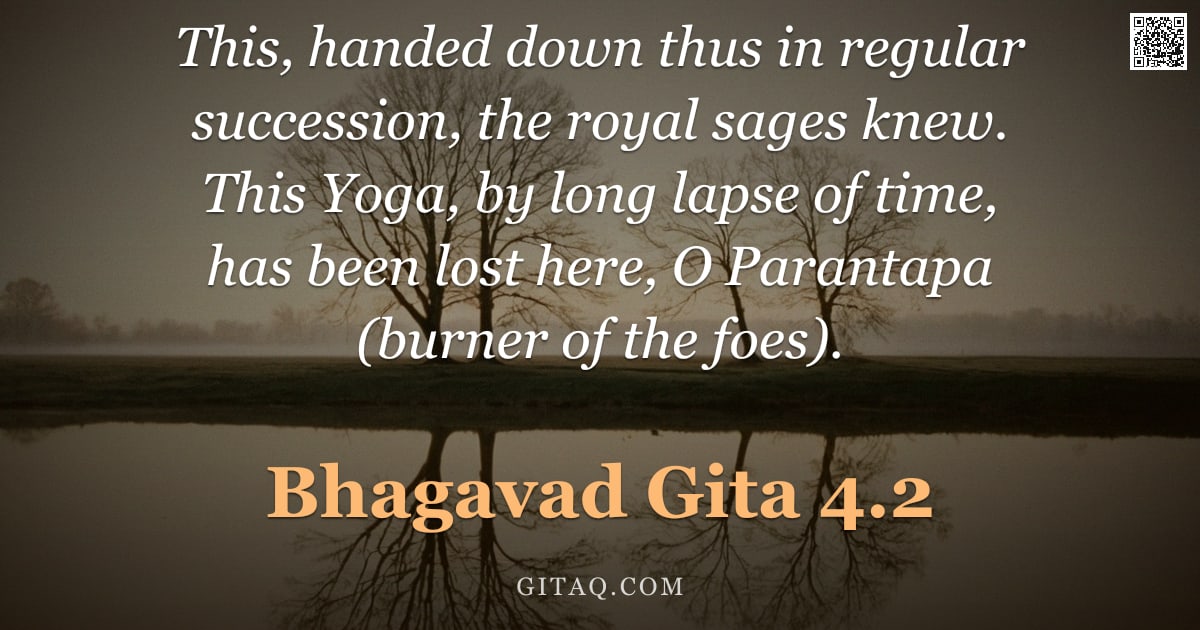
एवं परम्पराप्राप्तमिमं राजर्षयो विदुः | स कालेनेह महता योगो नष्टः परन्तप ||४-२||
evaṃ paramparāprāptamimaṃ rājarṣayo viduḥ . sa kāleneha mahatā yogo naṣṭaḥ parantapa ||4-2||
What Does This Verse Mean?
In this verse, Lord Krishna explains to Arjuna that the spiritual wisdom of Yoga was once a continuous tradition passed down from teacher to student by royal sages. However, over time due to long periods of neglect and lack of proper instruction, this knowledge has been lost in the world today. The key teaching is that while truth never truly disappears, it can become obscured if not actively preserved through disciplined succession.
The Teaching Behind It
This verse establishes the foundation of Parampara (the sacred lineage) essential to Jnana Yoga and Karma Yoga within Vedanta philosophy. It highlights the concept that spiritual knowledge is not merely intellectual but must be preserved through a living tradition of realization, bridging the gap between eternal truth and its practical transmission.
Word by Word
Classical Commentary
Where This Happens
This verse occurs in Chapter 4 on the battlefield of Kurukshetra during the Mahabharata war. Krishna is speaking directly to Arjuna (whom he addresses as Parantapa) immediately after explaining that He has revealed this ancient Yoga to Vivasvan, who passed it down through a lineage of sages. The context follows Arjuna's confusion about how Krishna could teach something that seems older than himself and the current age.
Living It Out Today
A modern professional might discover an innovative strategy or ethical framework used by industry leaders decades ago but forgotten in today's fast-paced corporate culture, leading to repeated mistakes. Just as the ancient Yoga was lost without consistent teaching, a family tradition of conflict resolution can vanish if parents do not intentionally model it for their children amidst busy schedules. The lesson is that valuable wisdom requires active, continuous effort to maintain; otherwise, society will repeat cycles of failure due to forgetfulness.
Explained for Children
Imagine a special game or secret handshake that your great-great-grandparents used to play perfectly every day, and they taught their children, who taught theirs. But for many years in between, nobody learned the rules carefully, so now most people have forgotten how to do it right. Krishna is telling Arjuna that even though this 'secret of life' was once known by wise kings, time made us forget it until he came back to teach it again.
Daily Reflection
You may feel that profound spiritual truths are reserved for the past or seem distant because time has worn them away, but this verse assures you otherwise. The Yoga of wisdom was never truly gone; it only waits in silence for a sincere heart like yours to rediscover its living presence today. By reconnecting with these ancient teachings now, you become part of that very chain of succession the sages spoke of.
A Practice for Today
Sit quietly and visualize an unbroken golden thread of wisdom flowing from the ancient sages directly into your heart, bridging thousands of years without a break. Ask yourself where this current has been interrupted in your own life by doubt or haste, and gently invite that lost clarity to return.
Key Teachings
- The Living Chain of Tradition
True knowledge is not static text but a living lineage passed from teacher to student without interruption. This 'paramparā' ensures that wisdom remains pure and effective, surviving the erosion of time through devoted transmission. - The Illusion of Loss
Time often creates an illusion that spiritual understanding has vanished or become inaccessible to modern seekers. However, this loss is only apparent; the potential for realization remains intact and available whenever one earnestly seeks it. - Restoring Lost Wisdom
The path forward involves actively recovering what was lost by aligning with the original source through sincere practice. The divine grace responds to this effort, restoring the Yoga that connects us directly to eternal truth.
Themes
Related Verses
Read This Next
- 2.47 — This verse establishes the foundation of duty without attachment, which is essential before one can understand how Yoga was preserved.
- 3.30 — Krishna elaborates on renunciation through action here, showing the practical application of the lost Yoga mentioned in 4.2.
- 12.15 — This verse describes the qualities of a devotee who embodies the very wisdom that was transmitted through the royal sages.
Recommended Reading
GitaQ earns from qualifying purchases as an Amazon Associate.