Bhagavad Gita 5.9
Karma Sanyasa Yoga · English Translation
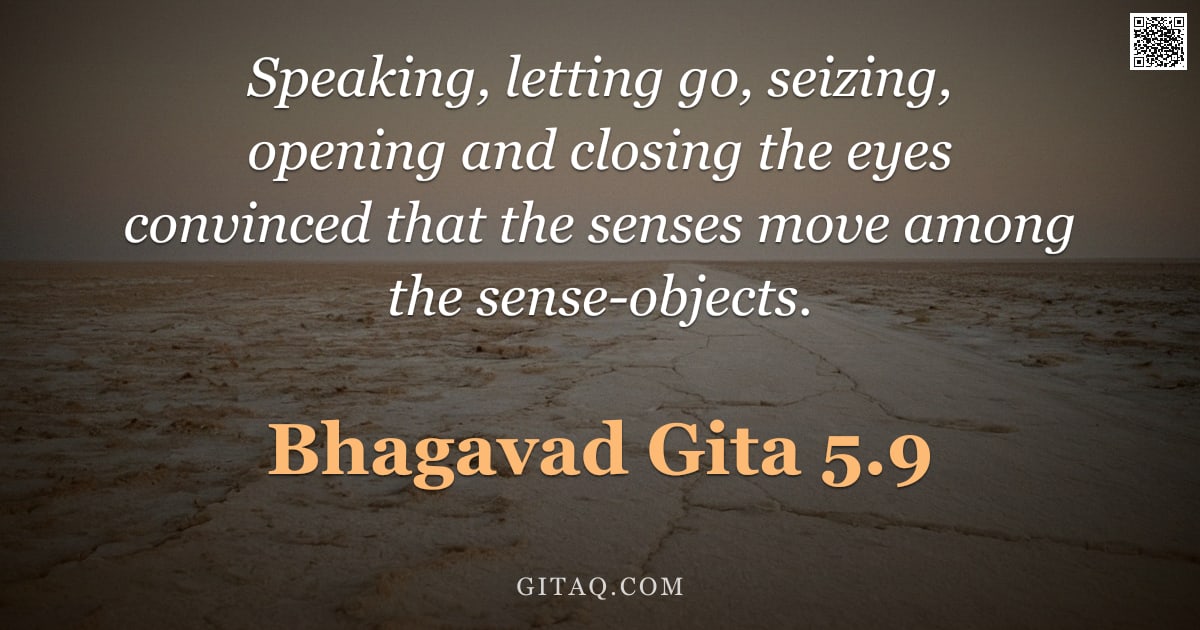
प्रलपन्विसृजन्गृह्णन्नुन्मिषन्निमिषन्नपि | इन्द्रियाणीन्द्रियार्थेषु वर्तन्त इति धारयन् ||५-९||
pralapanvisṛjangṛhṇannunmiṣannimiṣannapi . indriyāṇīndriyārtheṣu vartanta iti dhārayan ||5-9||
What Does This Verse Mean?
In this verse, Lord Krishna explains the state of a wise person who performs daily actions without attachment to the results. He describes how such an individual continues speaking, eating, and moving their eyes naturally, yet remains internally aware that these are merely senses interacting with objects. The key teaching is that one should not identify as the doer; instead, they observe life happening through them while maintaining a steady conviction of this truth.
The Teaching Behind It
This verse is a cornerstone of Karma Yoga (the yoga of selfless action) and integrates elements of Sankhya philosophy regarding the distinction between the observer (Atman) and the observed. It develops the concept that while the senses naturally interact with sense objects, the true Self remains detached and unchanged by these interactions.
Word by Word
Classical Commentary
Where This Happens
This teaching occurs on the battlefield of Kurukshetra during the Mahabharata war, where Arjuna has just laid down his weapons in despair over fighting his own relatives. Lord Krishna is responding to Arjuna's confusion about whether renunciation means stopping all actions or changing one's mindset while acting. At this specific moment, Arjuna is overwhelmed by emotional attachment and the fear of sinning from action; Krishna guides him toward Karma Yoga as a practical path that allows for daily duties without mental bondage.
Living It Out Today
Consider a project manager leading a high-stakes team launch who feels intense anxiety about potential failures. Instead of identifying with the stress or believing they are the sole cause of every outcome, they view their role as a functional process: speaking to the team, approving plans, and managing time while understanding that these are just actions flowing through them. By maintaining this mental distance, they can make clear-headed decisions without being paralyzed by fear of the result, acting with focus rather than attachment.
Explained for Children
Imagine you are playing a video game where your character walks around and talks to other players. You know it's just a game on a screen, right? Even though the character moves their eyes or picks up items in the story, you don't get scared or overly excited because deep down you know who is really controlling things: you! This verse teaches us that we are like the player behind the screen of our lives. We can speak, eat, and see just fine without getting confused into thinking 'I am' these actions themselves.
Daily Reflection
You often feel burdened by your own reactions to the world, thinking you must control every sight and sound you encounter today. This verse offers a gentle release: remember that your senses naturally interact with their objects just as breathing does; they move on their own while you remain the silent witness. By holding this conviction, you find freedom not in stopping life's flow, but in resting as the steady awareness behind it.
A Practice for Today
Sit quietly and observe your senses moving through their natural objects—sight, sound, touch—without identifying with them as 'your' actions or yours alone. Silently affirm that the eyes open and close, speech arises and ceases, simply because the instruments of perception are functioning in a world of phenomena.
Key Teachings
- The Witnessing Stance
Arjuna is instructed to maintain a mental attitude that observes sensory activity without claiming ownership of it. This creates an inner distance where one sees actions happening rather than feeling like the doer. - Inevitability of Sensory Function
The verse acknowledges that senses will naturally engage with sense objects, a process described through simple physical acts like opening eyes or speaking. Recognizing this as the natural mode of functioning removes unnecessary guilt over sensory engagement. - Detached Participation
True renunciation (Sanyasa) is not abandoning action but performing it with a fixed conviction that one's identity is distinct from the senses. One acts fully in the world while remaining mentally anchored as the uninvolved observer. - The Power of Conviction
The verse emphasizes 'iti dhārayan' (holding this thought), suggesting that intellectual understanding must become a steady mental resolve. This constant remembrance acts as an anchor against the pull of sensory attachment.
Themes
Related Verses
Read This Next
- 2.47 — This verse defines 'karma' as duty without attachment to results, providing the philosophical foundation for performing actions while remaining a witness.
- 3.30 — Here Krishna instructs Arjuna to dedicate all actions to Him, deepening the practice of detached action introduced in verse 5.9.
- 12.15 — It illustrates the character of one who has mastered this sensory detachment and lives in harmonious peace.
Recommended Reading
GitaQ earns from qualifying purchases as an Amazon Associate.