Bhagavad Gita 5.7
Karma Sanyasa Yoga · English Translation
योगयुक्तो विशुद्धात्मा विजितात्मा जितेन्द्रियः | सर्वभूतात्मभूतात्मा कुर्वन्नपि न लिप्यते ||५-७||
yogayukto viśuddhātmā vijitātmā jitendriyaḥ . sarvabhūtātmabhūtātmā kurvannapi na lipyate ||5-7||
What Does This Verse Mean?
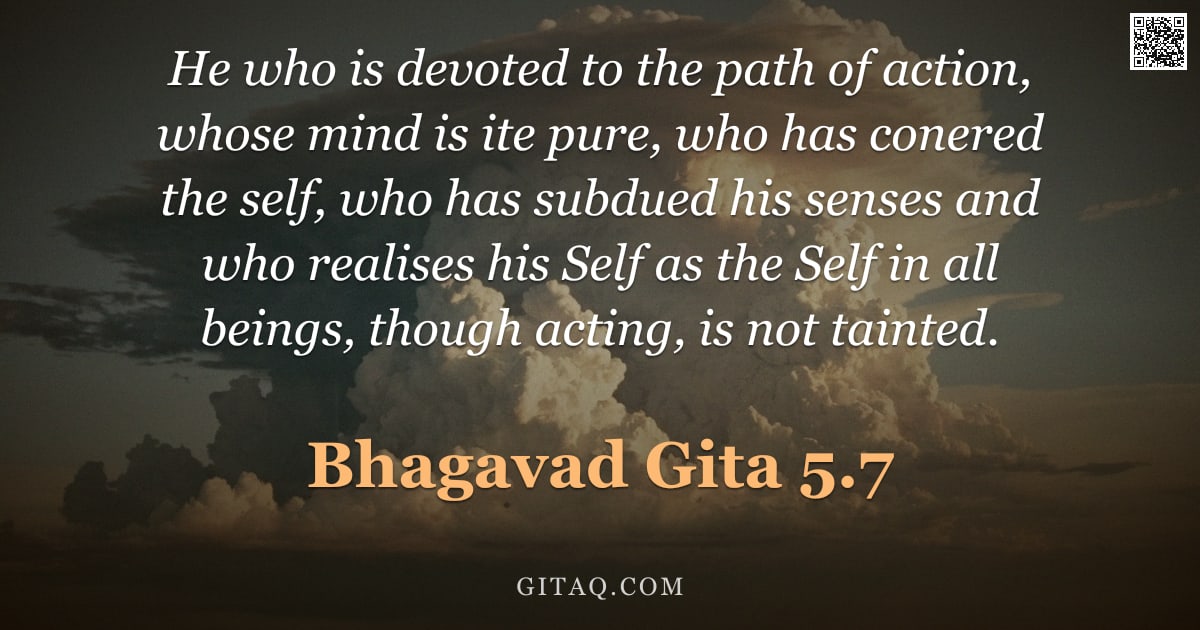
Lord Krishna describes the ideal state of a wise person who acts with full devotion while remaining internally pure and self-controlled. This individual has mastered their senses and realizes that the same divine consciousness exists within all living beings, regardless of external differences. Even though such a person continues to engage in daily duties and actions, they remain untouched by negative outcomes or guilt because their mind is anchored in truth.
The Teaching Behind It
This verse synthesizes Karma Yoga (the path of action) and Jnana Yoga (the path of knowledge), demonstrating that selfless action leads to spiritual purification. It develops the concept of 'Sarvabhutahitaya' (welfare for all beings) rooted in the realization of Atman, where the doer understands they are not the actor but a channel for divine will.
Word by Word
Classical Commentary
Where This Happens
This verse appears in Chapter 5 of the Bhagavad Gita during the dialogue between Lord Krishna and Prince Arjuna on the battlefield of Kurukshetra. Just before this, Arjuna was confused about whether to renounce all actions (sannyasa) or continue fighting as a warrior (karma). Krishna clarifies that true renunciation is not abandoning action, but performing duty with a purified mind while realizing the unity of existence in everyone.
Living It Out Today
Consider a project manager facing a high-pressure deadline where their team makes critical mistakes. Instead of reacting with anger or taking personal blame for every error, they maintain inner purity by focusing on solving the problem and supporting the team's growth. They realize that their own self-worth is not tied to the immediate outcome but remains steady because they see themselves as part of a larger purpose, allowing them to act decisively without being tainted by stress or failure.
Explained for Children
Imagine you are playing with toys but your heart isn't attached to winning; you just play for the joy of it. This verse describes someone like that: a person who does good things every day without getting angry when they don't get what they want, or sad when things go wrong. They understand that everyone is special and connected, so even if they are busy helping others, their heart stays calm and happy inside.
Daily Reflection
You carry a deep peace within you right now, even as life moves around with its constant demands and challenges. This verse reminds us that acting without attachment isn't about stopping our work, but rather changing how we relate to it from the inside out. When you realize your true nature is one with all beings, judgment fades and genuine compassion naturally arises in every interaction.
A Practice for Today
Sit quietly and visualize your consciousness expanding beyond your skin, recognizing the same divine spark residing within every person you meet today. As you perform your daily tasks, silently affirm that while your hands act in the world, your true Self remains untouched by success or failure.
Key Teachings
- Purification through Yoga
True action becomes a path to liberation when performed with the intention of cleansing the heart rather than gratifying the ego. This inner purity transforms ordinary duties into sacred offerings, preparing the mind for higher realization. - The Art of Inner Conquest
Before one can control external circumstances or senses, one must first master their own restless mind and desires. Victory over the self is not a suppression of nature but a harmonious alignment where the intellect governs impulse. - Seeing Unity in Diversity
The enlightened soul perceives the same Atman (Self) dwelling within all creatures, dissolving the illusion of separation. This vision ensures that even while engaging actively with the world, one remains rooted in a state of non-attachment.
Themes
Related Verses
Read This Next
- 2.47 — To understand the foundational principle of acting only on duty while renouncing attachment to results.
- 3.30 — To see how surrendering all actions to the Divine is another method for achieving this state of non-attachment.
- 12.15 — To learn about the qualities of a devotee who, like in verse 5.7, remains untouched by the distresses and desires of others.
Recommended Reading
GitaQ earns from qualifying purchases as an Amazon Associate.