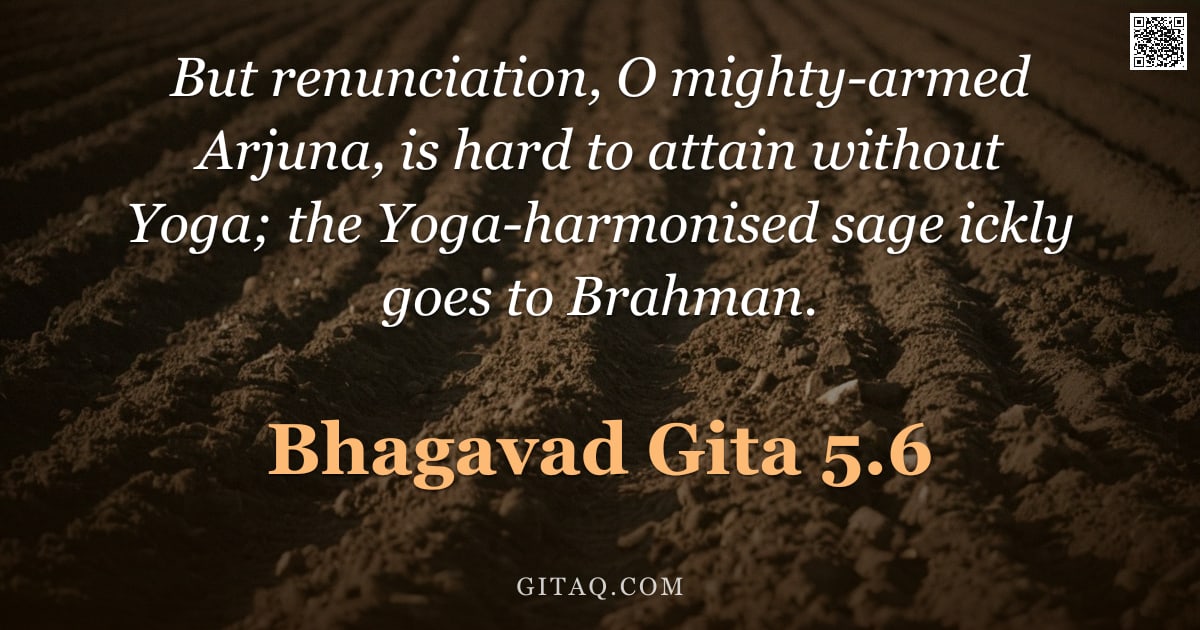
Bhagavad Gita 5.6
Karma Sanyasa Yoga · English Translation
संन्यासस्तु महाबाहो दुःखमाप्तुमयोगतः | योगयुक्तो मुनिर्ब्रह्म नचिरेणाधिगच्छति ||५-६||
saṃnyāsastu mahābāho duḥkhamāptumayogataḥ . yogayukto munirbrahma nacireṇādhigacchati ||5-6||
What Does This Verse Mean?
Lord Krishna tells Arjuna that trying to renounce the world without spiritual practice is incredibly difficult and often leads to suffering. However, a person who practices Karma Yoga—acting with detachment while staying connected to duty—finds it easy to attain liberation or union with Brahman. The verse emphasizes that true renunciation comes not from abandoning actions physically, but from mastering one's mind through disciplined action.
The Teaching Behind It
This verse synthesizes the teachings of Karma Yoga and Sankhya philosophy within the Gita's framework. It establishes that physical renunciation (abandoning actions) is insufficient without mental discipline; true freedom comes from performing duties with a steady mind, which naturally leads to Jnana or knowledge of Brahman.
Word by Word
Classical Commentary
Where This Happens
This verse occurs in Chapter 5 on the battlefield of Kurukshetra during the Mahabharata war. Krishna has just finished explaining that both the path of renunciation (Sannyasa) and the path of active duty (Karma Yoga) lead to liberation, but Arjuna is confused about which one he should choose given his role as a warrior. Feeling overwhelmed by the prospect of killing his kinsmen, Arjuna needs clarity on whether physical withdrawal from action or disciplined engagement in battle leads to better spiritual results.
Living It Out Today
Consider an employee facing burnout who decides they must quit their job immediately to find peace; this impulsive 'renunciation' often creates financial stress and anxiety. Instead, by practicing the principle of Yoga-harmonization, the person can continue working but changes their mindset to focus on duty without attachment to outcomes or praise. This approach allows them to maintain a career while finding inner calm, turning daily professional challenges into opportunities for spiritual growth rather than sources of suffering.
Explained for Children
Imagine you are trying to clean a messy room by just throwing all your toys out the window; that is like 'renouncing' without practice—it causes more trouble. But if you learn how to organize and put things away properly (which Krishna calls Yoga), cleaning becomes easy and fun, leading you straight to a tidy home. The lesson is: don't run away from problems; instead, face them with the right skills, and peace will come naturally.
Daily Reflection
You often feel overwhelmed trying to detach from the world by withdrawing completely, yet true freedom is found within action itself. Krishna gently reminds us that renunciation without spiritual discipline is a heavy burden we cannot carry alone today. When you align your efforts with devotion and inner focus, the path becomes light, leading naturally to lasting peace.
A Practice for Today
Take a moment to release your grip on the idea that renunciation means simply abandoning your duties or surroundings. Instead, visualize your actions as offerings made with an inner stillness, allowing you to find peace while actively engaged in life.
Key Teachings
- The Difficulty of Isolated Renunciation
Simply giving up external actions without an internal spiritual foundation is described as a source of suffering rather than liberation. True renunciation requires the strength and clarity that only come through dedicated practice. - Yoga as the Transformative Force
The verse establishes Yoga not just as physical postures, but as the harmonizing discipline that makes detachment possible for a living person. It transforms heavy renunciation into an effortless state of being through inner alignment. - Swift Attainment of Brahman
The sage who practices this integrated path does not struggle long; they quickly realize the ultimate reality of existence known as Brahman. This swift progress highlights the power of combining action with spiritual wisdom.
Themes
Related Verses
Read This Next
- 2.47 — This verse introduces the core principle of acting without attachment to results, which is the practical foundation for the Yoga described here.
- 3.30 — It expands on how one should dedicate all actions to the Divine, illustrating the method by which a sage harmonizes their life with God.
- 12.15 — This verse describes the qualities of those who have attained this state of peace and devotion, showing the character of the 'Yoga-harmonised sage' mentioned in 5.6.
Recommended Reading
GitaQ earns from qualifying purchases as an Amazon Associate.