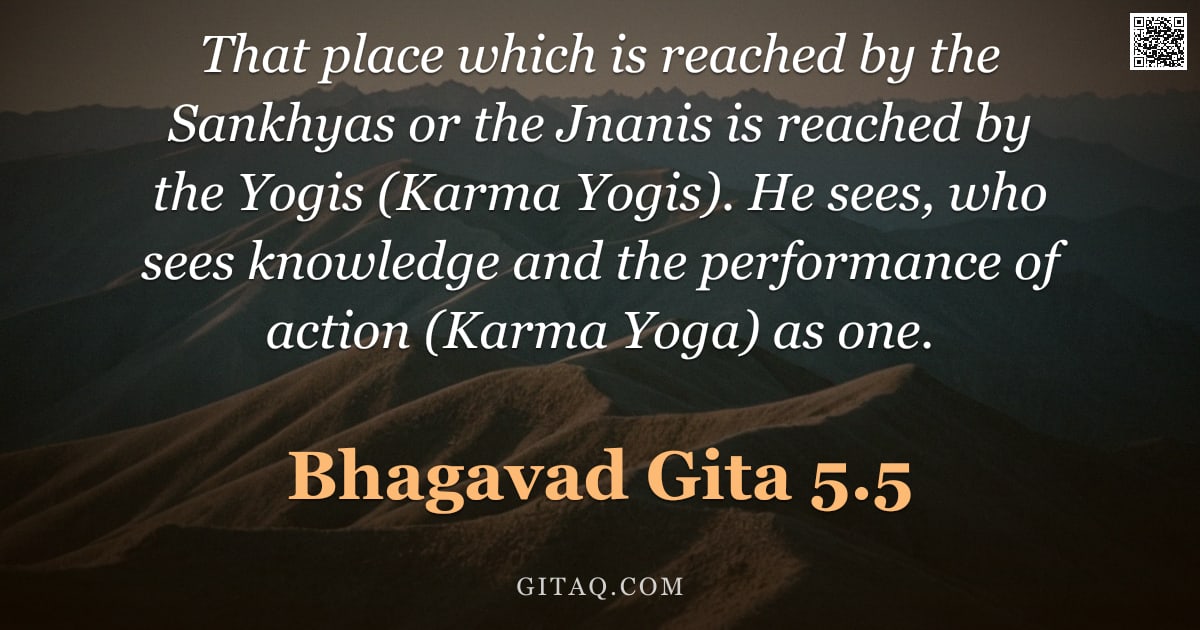
Bhagavad Gita 5.5
Karma Sanyasa Yoga · English Translation
यत्साङ्ख्यैः प्राप्यते स्थानं तद्योगैरपि गम्यते | एकं साङ्ख्यं च योगं च यः पश्यति स पश्यति ||५-५||
yatsāṅkhyaiḥ prāpyate sthānaṃ tadyogairapi gamyate . ekaṃ sāṅkhyaṃ ca yogaṃ ca yaḥ paśyati sa paśyati ||5-5||
What Does This Verse Mean?
In this verse, Lord Krishna tells Arjuna that the ultimate spiritual destination reached by those who follow the path of knowledge (Sankhya) is exactly the same as the one reached by those who perform selfless action without attachment (Yoga). He emphasizes that these two paths are not separate or contradictory but lead to a single goal. The true wisdom lies in realizing that studying philosophy and acting with dedication are actually different sides of the same coin.
The Teaching Behind It
This verse belongs to the synthesis of Karma Yoga and Jnana Yoga (the yoga of knowledge) found in Vedanta philosophy. It develops the concept that action performed without selfish desire is itself a form of spiritual wisdom, effectively bridging the gap between intellectual realization and practical engagement with the world.
Word by Word
Classical Commentary
Where This Happens
This teaching occurs in Chapter 5 of the Bhagavad Gita during the intense battlefield conversation between Prince Arjuna and Lord Krishna. Just before this verse, Arjuna expressed confusion about whether he should renounce all actions entirely (Sankhya) or continue fighting with devotion to action (Yoga). He felt that these two paths were mutually exclusive and asked for clarity on which was superior, prompting Krishna to reveal their fundamental unity.
Living It Out Today
Consider a professional facing burnout at work who feels torn between quitting their job entirely to meditate in silence or continuing their demanding career. This verse suggests they do not need to abandon their responsibilities; instead, they can transform their current role into a form of spiritual practice by performing duties without attachment to the outcome. By viewing their daily tasks as an act of service rather than just labor for personal gain, they find peace within the chaos of modern life.
Explained for Children
Imagine you want to reach the top of a big mountain where there is a beautiful view. One group climbs by using only their muscles, while another group studies maps and watches carefully before climbing. This verse says that both groups end up at exactly the same spot! Krishna teaches us that whether we learn about God through books or show our love for Him by doing good deeds with all our heart, we are on the same journey to happiness.
Daily Reflection
Today, I invite you to notice how often your mind creates a false divide between 'spiritual' activities like meditation and 'worldly' tasks like working. When you perform your duties with full presence, remember that this is not separate from the path of knowledge; it is simply wisdom in motion. By seeing action as an offering rather than a burden, you transform your daily routine into the very gateway to peace.
A Practice for Today
Close your eyes and visualize two paths converging into a single mountain peak: one paved with the stones of intellectual study, the other with the bricks of selfless action. Breathe deeply and release the thought that you must choose between thinking or doing; instead, affirm that true wisdom flows through sincere work.
Key Teachings
- The Unity of Paths
Krishna clarifies that the ultimate state of liberation (sthitaprajña) is identical whether approached through the path of knowledge or the path of action. There are not two different destinations, but one truth realized through different methods. - The Illusion of Separation
Many seekers mistakenly believe that Sankhya (philosophical analysis) and Yoga (devotional work) are mutually exclusive. Krishna teaches that this separation is an error; the wise person sees them as two sides of the same coin. - Seeing with Unity
The verse culminates in a profound declaration: only those who perceive knowledge and action as non-dual truly 'see' reality. This unified vision dissolves the ego's attachment to being merely an intellectual or merely a doer.
Themes
Related Verses
Read This Next
- 2.47 — This verse introduces Karma Yoga by urging action without attachment, providing the practical foundation for how knowledge is expressed through work.
- 3.30 — Following this chapter's theme of renunciation in action, reading about surrendering all works to Krishna reinforces that karma and devotion are one process.
- 12.15 — This verse describes the qualities of a devotee who is dear to Krishna, illustrating the character formed when knowledge and selfless action merge in harmony.
Recommended Reading
GitaQ earns from qualifying purchases as an Amazon Associate.