Bhagavad Gita 5.4
Karma Sanyasa Yoga · English Translation
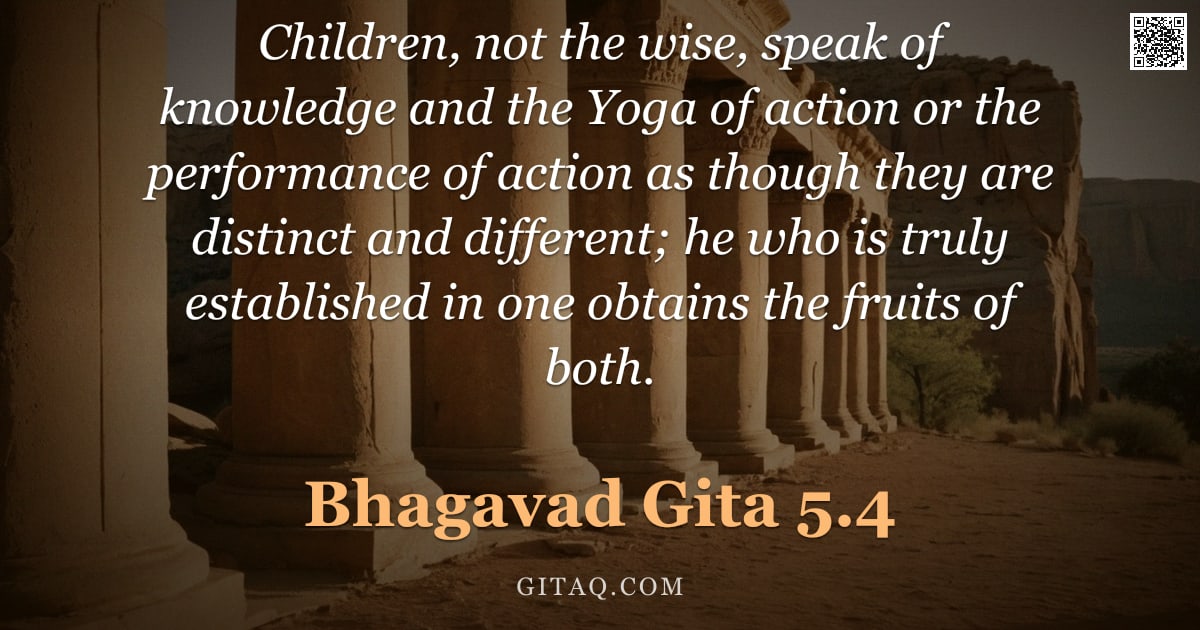
साङ्ख्ययोगौ पृथग्बालाः प्रवदन्ति न पण्डिताः | एकमप्यास्थितः सम्यगुभयोर्विन्दते फलम् ||५-४||
sāṅkhyayogau pṛthagbālāḥ pravadanti na paṇḍitāḥ . ekamapyāsthitaḥ samyagubhayorvindate phalam ||5-4||
What Does This Verse Mean?
Lord Krishna is addressing Arjuna to correct a common misunderstanding that spiritual knowledge and the path of action are separate, competing choices. He explains that this division is only spoken by those who lack deep wisdom or maturity. The core teaching is that when one sincerely practices either true knowledge or selfless action correctly, they inevitably lead to the same ultimate result: liberation and inner peace.
The Teaching Behind It
This teaching synthesizes Sankhya philosophy (the path of knowledge) and Karma Yoga (the path of action), asserting that they are not separate tracks but a unified approach to liberation. It develops the concept that true wisdom naturally manifests as selfless action, and perfect action is rooted in spiritual understanding.
Word by Word
Classical Commentary
Where This Happens
This verse occurs during Krishna's discourse to Arjuna on the battlefield of Kurukshetra, where the prince is paralyzed by confusion and grief. Prior to this, Arjuna had asked for clarity between two paths: renouncing all action (Sannyasa) or continuing his duty as a warrior while performing actions without attachment (Karma Yoga). Krishna speaks here to dispel Arjuna's hesitation, revealing that these are not contradictory options but complementary aspects of the same truth.
Living It Out Today
Consider a modern professional who feels torn between pursuing deep academic research and taking on demanding leadership roles in their company. Instead of seeing these as incompatible choices where they must quit one to do the other, they can view them through this verse: by doing either role with full dedication and selfless intent, both paths lead to career fulfillment and personal growth. This mindset removes the anxiety of 'choosing wrong' and encourages total engagement in their current duty.
Explained for Children
Imagine you are trying to reach a big treehouse; some people say you must climb up the left side of the trunk while others insist on the right side. Krishna tells us that this argument is for 'babies' who don't see the whole picture, because both paths actually lead you to the same top! If you focus really hard on climbing just one way with a good heart, you will end up in the treehouse anyway.
Daily Reflection
You often feel pulled between the need to be busy and the desire for inner peace, thinking you must choose one over the other today. Krishna reminds us that this division is a illusion created by those who have not yet seen the wholeness of spiritual life. When you act with your heart fixed on the Divine, your work itself becomes meditation, giving you the fruits of both wisdom and action simultaneously.
A Practice for Today
Close your eyes and visualize two paths diverging before you, only to realize they merge into a single road leading home; this is the unity of wisdom and action. Rest in the understanding that true devotion requires neither abandoning work nor being trapped by it, but performing every task as an offering with full awareness.
Key Teachings
- The Illusion of Duality
False teachers separate knowledge (jnana) from duty (karma), suggesting one must renounce work to find truth. The wise know that this separation is a childish misunderstanding, as the essence of both paths leads to the same realization. - The Power of Integration
One who firmly establishes themselves in either path with true understanding automatically masters the benefits of both. True mastery lies not in switching between methods but in seeing them as a single, unified practice of surrender. - Steadfastness Yields Results
The verse promises that deep commitment to one sincere approach unlocks the complete fruit of spiritual evolution. It is the depth and sincerity of your focus, not the specific label you give it, that determines your liberation.
Themes
Related Verses
Read This Next
- 2.47 — This verse establishes the foundational attitude of performing duty without attachment to results, which is essential for practicing Karma Yoga.
- 3.30 — It expands on offering all actions to the Divine, showing how work becomes a form of worship and meditation in practice.
- 12.15 — This verse describes the qualities of one who is established in this non-dual vision, providing a model for the 'wise' described here.
Recommended Reading
GitaQ earns from qualifying purchases as an Amazon Associate.