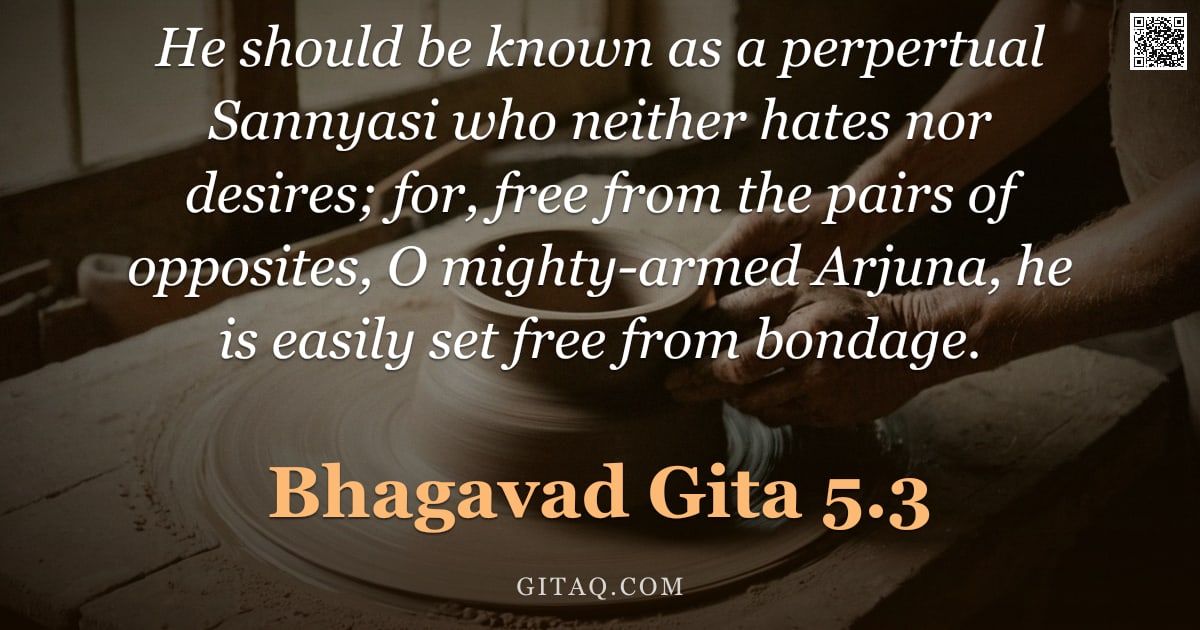
Bhagavad Gita 5.3
Karma Sanyasa Yoga · English Translation
ज्ञेयः स नित्यसंन्यासी यो न द्वेष्टि न काङ्क्षति | निर्द्वन्द्वो हि महाबाहो सुखं बन्धात्प्रमुच्यते ||५-३||
jñeyaḥ sa nityasaṃnyāsī yo na dveṣṭi na kāṅkṣati . nirdvandvo hi mahābāho sukhaṃ bandhātpramucyate ||5-3||
What Does This Verse Mean?
In this verse, Lord Krishna tells Arjuna that a true renunciate is someone who has let go of both hatred and excessive desire for things in the world. He explains that such a person remains balanced amidst life's ups and downs, known as being free from 'dualities' or pairs of opposites like pleasure and pain. Because they do not get dragged down by these emotional extremes, Krishna assures Arjuna that this state makes it easy to be liberated from the cycle of binding actions.
The Teaching Behind It
This verse sits at the intersection of Karma Yoga and Jnana Yoga, emphasizing that true renunciation (Sannyasa) is an internal state rather than just a physical one. It develops the concept of 'Nirdvandva' or freedom from dualities, teaching that liberation comes when the mind transcends the oscillating pulls of attraction and repulsion.
Word by Word
Classical Commentary
Where This Happens
This verse occurs in Chapter 5 of the Bhagavad Gita during the intense battle of Kurukshetra. Lord Krishna is speaking to Arjuna, who has just laid down his bow out of grief and confusion about fighting his relatives. After explaining that one can achieve renunciation through both action (Karma Yoga) and knowledge (Sannyasa), Krishna clarifies here that true spiritual freedom comes not from merely giving up work physically, but from mastering the mind's reactions to success and failure.
Living It Out Today
Consider a modern professional who receives critical feedback on a project they worked hard on; instead of spiraling into self-hatred or bitterness toward their boss (dvesha), they remain steady. Simultaneously, when that same person is offered a promotion with significant stress but high reward, they do not become frantic or overly attached to the title (kanksa). By maintaining this emotional balance during both professional setbacks and successes, they make clearer decisions without anxiety, effectively freeing themselves from the mental bondage of needing constant external validation.
Explained for Children
Imagine you are playing a game where sometimes you win big and feel super excited, but other times you lose and feel sad. If your happiness depends only on winning or losing, you will always be stressed out. Krishna says that being truly free is like having a calm heart no matter if you win the trophy or drop your ice cream; when you don't get too upset about bad things or too crazy excited about good things, you can play and learn without feeling trapped by the game.
Daily Reflection
Arjuna, you often feel pulled between what you dislike about this situation and what you desperately wish would happen instead; try to see how this tug-of-war keeps you bound even when the external world hasn't changed. True freedom isn't found in changing your circumstances but in cultivating a heart that neither hates the difficulty nor clings to an ideal outcome. When you release these dualities, you discover a profound ease within yourself that no external event can disturb.
A Practice for Today
Sit quietly and notice any fleeting moment of aversion or craving arising today without engaging with the thought. Simply acknowledge these impulses as passing clouds, allowing your awareness to rest in a space that is untouched by them.
Key Teachings
- The Inner Renunciate
A true Sannyasi is not defined by wearing robes but by an internal state where the mind does not harbor hatred or intense longing. This verse redefines renunciation as a quality of consciousness rather than merely a change in external lifestyle. - Freedom from Dualities
Krishna promises that those who master this balance find it 'easy' (sukhaṃ) to break free from karmic chains. This liberation is not a struggle but a natural result of aligning with the non-dual nature of reality.
Themes
Related Verses
Read This Next
- 2.47 — To understand the practical application of performing duty without attachment to results.
- 3.30 — For Krishna's instruction on surrendering actions as an offering, deepening the spirit of renunciation.
- 12.15 — To see how a devotee who is not disturbed by others and does not disturb them becomes dear to God.
Recommended Reading
GitaQ earns from qualifying purchases as an Amazon Associate.