Bhagavad Gita 5.2
Karma Sanyasa Yoga · English Translation
श्रीभगवानुवाच | संन्यासः कर्मयोगश्च निःश्रेयसकरावुभौ | तयोस्तु कर्मसंन्यासात्कर्मयोगो विशिष्यते ||५-२||
śrībhagavānuvāca . saṃnyāsaḥ karmayogaśca niḥśreyasakarāvubhau . tayostu karmasaṃnyāsātkarmayogo viśiṣyate ||5-2||
What Does This Verse Mean?
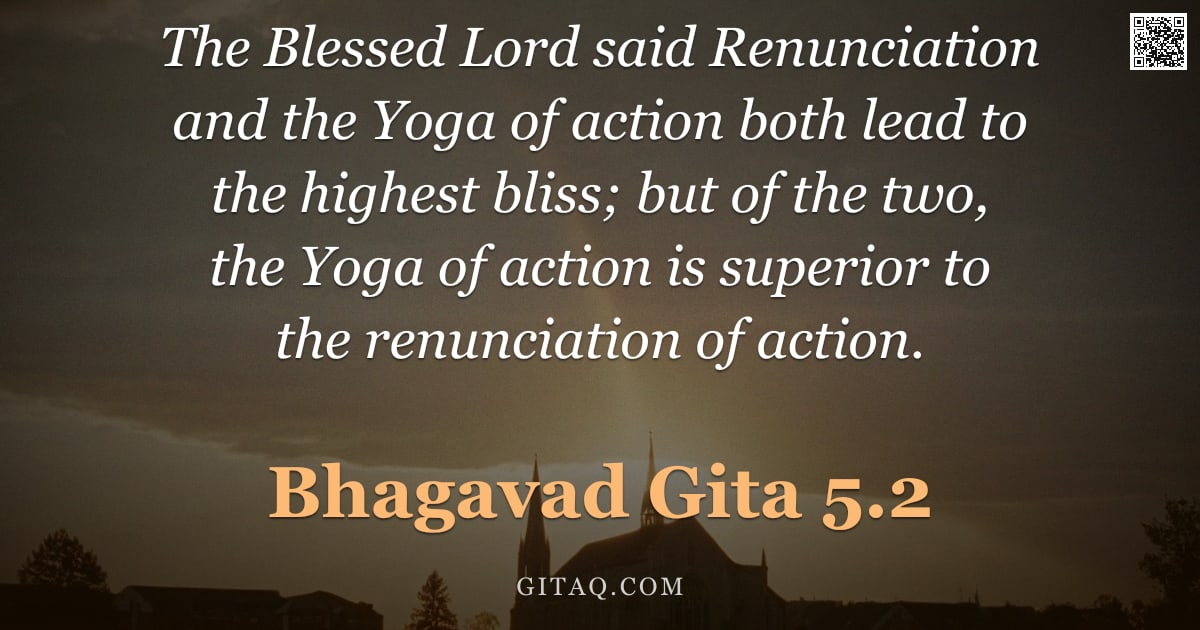
In this verse, Lord Krishna is speaking to Arjuna on the battlefield of Kurukshetra, clarifying a common misconception about spiritual paths. He explains that while both renouncing action (giving up duties) and performing actions with devotion lead to liberation, actively engaging in one's duty without attachment is actually superior. The key teaching is that true spirituality isn't found by escaping life's responsibilities but by transforming how we perform them.
The Teaching Behind It
This verse establishes the supremacy of Karma Yoga within Vedanta, bridging the gap between Sankhya philosophy (knowledge) and practical action. It teaches that renunciation of the ego's desire for results is more vital than the physical abandonment of duty, positioning Karma Yoga as an accessible path to Moksha (liberation).
Word by Word
Classical Commentary
Where This Happens
This verse occurs in Chapter 5 of the Bhagavad Gita, set on the battlefield of Kurukshetra where Prince Arjuna has just laid down his bow, overwhelmed by grief and confusion about fighting his own relatives. Arjuna had previously asked Krishna to guide him toward 'Sannyasa' (renunciation), believing that withdrawing from action was the only way to find peace after seeing the horror of war. Lord Krishna responds gently but firmly here to correct this misunderstanding before moving into deeper teachings on meditation and devotion.
Living It Out Today
Consider a professional who feels burned out by their demanding job and wants to quit immediately to travel or sit in silence, hoping that will solve their anxiety. Instead of resigning without notice (renunciation), they can practice Karma Yoga by doing the same work but with full focus on excellence and letting go of fear regarding promotions or failure. This approach reduces stress because it shifts energy from worrying about outcomes to dedicating effort to the task itself.
Explained for Children
Imagine you have two ways to become a hero: quitting your chores forever or doing your homework and cleaning your room while thinking happy thoughts about helping the world. Lord Krishna tells Arjuna that even though both sound good, actually finishing your tasks with a clean heart is better than just running away from them. It's like playing a game; you win more by following the rules well rather than leaving the field.
Daily Reflection
You might feel tempted to believe that waiting until life slows down before finding God is the only path to holiness. Yet Arjuna's confusion was cleared when Krishna revealed that true freedom isn't found in abandoning your responsibilities, but in performing them without attachment to the results. The beauty of this teaching is that it meets you exactly where you are; you do not need to be a monk or retreat to a cave to practice devotion.
A Practice for Today
Begin by noticing how your mind often seeks escape from duty, mistaking silence for true peace. Today, invite that same inner stillness into your work, realizing that the Yoga of Action is not about leaving the world behind, but carrying the divine within it while you act.
Key Teachings
- Unity of Paths
Both renunciation (Sannyasa) and the Yoga of Action lead to the same ultimate liberation, validating different temperaments as valid spiritual routes. The Lord acknowledges that while both are supreme in their ability to bring bliss, they converge at the destination rather than offering contradictory truths. - The Superiority of Karma
Karma Yoga is presented as superior because it integrates spirituality directly into daily life and social engagement. Unlike renunciation which requires a specific stage of life or isolation, action performed with detachment allows one to cultivate purity while actively serving the world. - Action without Attachment
The essence of this Yoga is performing necessary duties as an offering rather than for personal gain. This transforms ordinary work into a sacred practice that burns away karmic bondage, making it accessible to everyone regardless of their external circumstances.
Themes
Related Verses
Read This Next
- 2.47 — This verse establishes the foundational principle of acting without attachment to results that Krishna elaborates on in this chapter.
- 3.30 — It expands on how to dedicate all actions to the Divine, which is the practical application of Karma Yoga mentioned here.
- 12.15 — This verse describes the qualities of a devotee who has mastered this balance of action and renunciation, serving as an ideal model for the practitioner.
Recommended Reading
GitaQ earns from qualifying purchases as an Amazon Associate.