Bhagavad Gita 3.19
Karma Yoga · English Translation
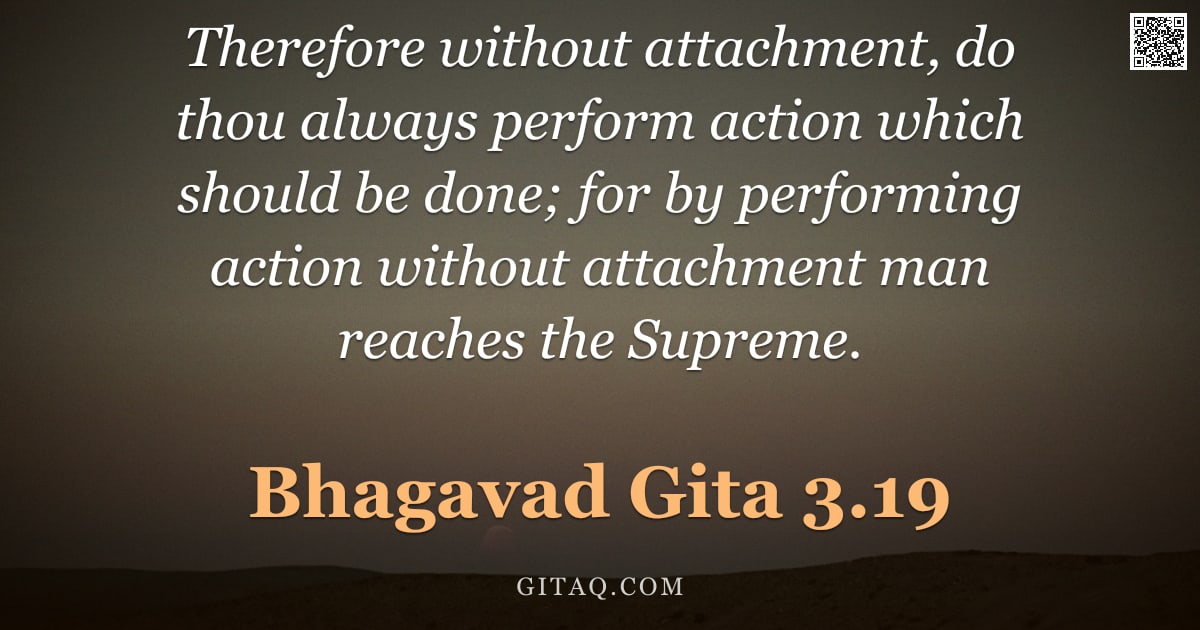
तस्मादसक्तः सततं कार्यं कर्म समाचर | असक्तो ह्याचरन्कर्म परमाप्नोति पूरुषः ||३-१९||
tasmādasaktaḥ satataṃ kāryaṃ karma samācara . asakto hyācarankarma paramāpnoti pūruṣaḥ ||3-19||
What Does This Verse Mean?
Lord Krishna is advising Arjuna to continue performing his necessary duties without any attachment to the results or personal gain. The core teaching here is that freedom and spiritual progress are achieved by doing what one must do while remaining mentally unbound from success, failure, or reward. By acting selflessly in this way, a person transcends egoistic limitations and moves toward the Supreme.
The Teaching Behind It
This verse is a foundational pillar of Karma Yoga (the yoga of selfless action) and integrates elements of Sankhya philosophy regarding the nature of work. It develops the concept that performing duty without attachment purifies the mind, which is essential for gaining knowledge of the Self and eventually attaining liberation.
Word by Word
Classical Commentary
Where This Happens
This verse appears in Chapter 3 during the intense dialogue between Lord Krishna and Prince Arjuna on the battlefield of Kurukshetra. Just prior to this, Krishna has explained that renouncing action entirely is not a solution for a warrior like Arjuna; instead, he must perform his duty as a protector. Arjuna was paralyzed by confusion and moral fear about fighting his own relatives, so Krishna instructs him on how to act without being trapped by the anxiety of outcomes.
Living It Out Today
Consider a project manager leading their team through a high-stakes deadline where failure could mean losing a major client. Instead of obsessing over whether they will get a bonus or be praised (attachment), they focus entirely on clearing each task, supporting their team members, and solving problems as they arise. By detaching from the fear of failure or greed for success, they maintain clarity and reduce stress, often leading to better results than if they were paralyzed by anxiety.
Explained for Children
Imagine you are playing your favorite game with friends. You play hard to win because it's fun and fair, but if you lose, you don't get angry or sad; you just cheer for your friend and try again next time. This verse teaches us to do our schoolwork, chores, or games like that: give it 100% of our effort without worrying too much about getting a perfect score or being the winner first. When we focus on doing good rather than winning, we feel happy and free inside.
Daily Reflection
Today, I invite you to look at your workload not as a burden of personal gain or failure, but as sacred duty performed with love. When you shift your focus from 'what will this bring me' to 'this is what needs doing,' the heavy chains of worry begin to loosen around your heart. By acting without attachment, you discover that true freedom lies precisely in the midst of your busiest moments.
A Practice for Today
Close your eyes and visualize yourself performing today's necessary tasks as an offering, letting the results dissolve like mist after sunrise. Silently repeat to yourself that you are a vessel for action, not its owner, allowing freedom from anxiety about outcomes.
Key Teachings
- Mandatory Duty
The verse commands us to perform 'karma' or action which must be done, establishing that engagement is non-negotiable for spiritual growth. This teaches that renunciation of the world means abandoning attachment, not abandoning one's responsibilities. - Action as Worship
Performing work without selfish desire transforms ordinary labor into a form of worship and purification of the mind. It is this specific quality of 'asakta' (unattached) action that leads the human soul toward the Supreme. - The Path to Liberation
Arjuna is assured that by consistently acting without attachment, one attains the highest spiritual goal. The mechanism for this attainment is not in stopping activity, but in changing the consciousness behind it from ego-driven to duty-bound.
Themes
Related Verses
Read This Next
- 2.47 — This foundational verse establishes your right to action alone without ever claiming attachment to its fruits.
- 3.30 — It expands on this teaching by instructing you to dedicate all actions directly to the Supreme Divine.
- 12.15 — This verse describes the qualities of a devotee who has mastered action without attachment and thus becomes dear to Krishna.
Recommended Reading
GitaQ earns from qualifying purchases as an Amazon Associate.