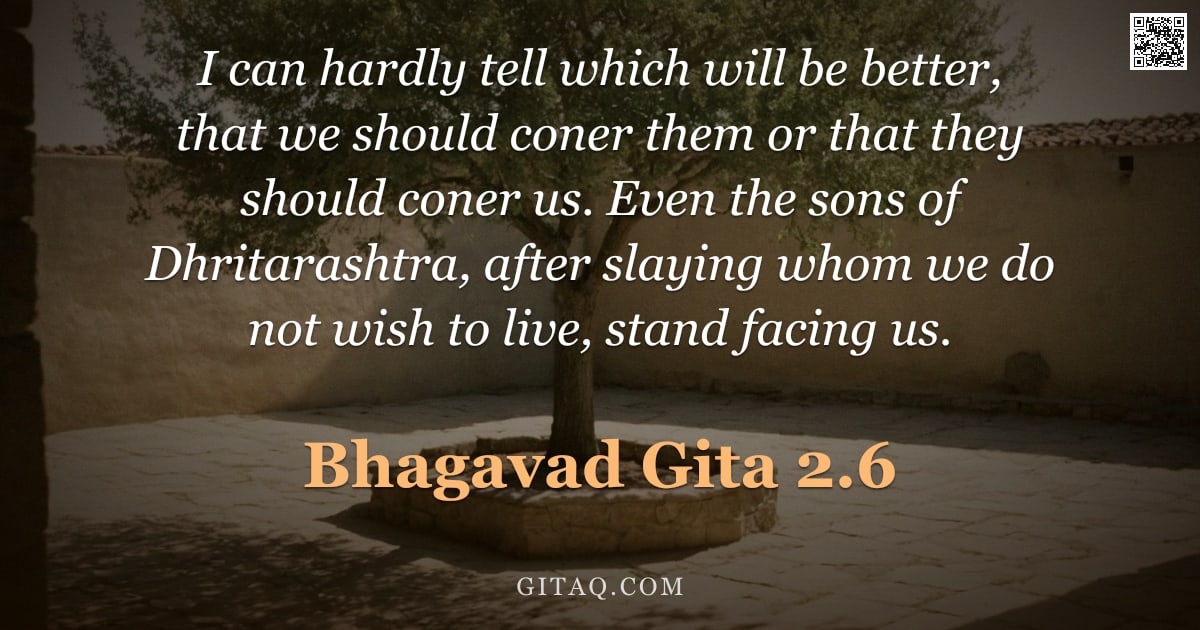
Bhagavad Gita 2.6
Sankhya Yoga · English Translation
न चैतद्विद्मः कतरन्नो गरीयो यद्वा जयेम यदि वा नो जयेयुः | यानेव हत्वा न जिजीविषामस्- तेऽवस्थिताः प्रमुखे धार्तराष्ट्राः ||२-६||
na caitadvidmaḥ kataranno garīyo yadvā jayema yadi vā no jayeyuḥ . yāneva hatvā na jijīviṣāmaḥ te.avasthitāḥ pramukhe dhārtarāṣṭrāḥ ||2-6||
What Does This Verse Mean?
In this verse, Arjuna expresses his deep confusion and despair on the battlefield of Kurukshetra while speaking to Lord Krishna. He admits he cannot decide which outcome is better: winning by killing his relatives or losing if they defeat him. Even though he believes that living without these specific enemies would be unbearable for a warrior like himself, their presence right in front of them has caused such paralysis that he does not know how to proceed.
The Teaching Behind It
This verse belongs to the Sankhya Yoga strand of the Gita, where Lord Krishna begins dismantling Arjuna's false identification with the body and mind. It develops the concept that confusion arises from attachment (moha) and a lack of spiritual knowledge about the true nature of the self versus the physical world.
Word by Word
Where This Happens
This verse occurs at the beginning of Chapter 2 on the battlefield of Kurukshetra, where Prince Arjuna is addressing his teacher and charioteer, Lord Krishna. Just moments prior in Chapter 1, after surveying both armies filled with relatives, teachers, and friends ready to fight, Arjuna was overcome by overwhelming grief and compassion. He has dropped his bow, fallen onto the seat of his chariot, and is now paralyzed by moral doubt about killing the sons of Dhritarashtra.
Living It Out Today
Consider a manager who must choose between firing two long-term employees to save their struggling company or risking bankruptcy to keep them employed out of loyalty. The decision creates intense anxiety because every outcome feels like a failure: cutting jobs hurts people, but keeping them might ruin the business and everyone's livelihoods. Like Arjuna standing before his enemies, this leader may feel frozen in indecision, unable to see which path is truly 'better' for the greater good.
Explained for Children
Imagine you are playing a very important game where your friends and cousins are on the other team. You have been told that if you win by knocking everyone out, it feels terrible because they are family you love. But if they knock you out, you lose too! Arjuna is like a player who has put down his toy sword in confusion, saying, 'I don't know what to do anymore: I can't beat my friends without hurting them, but I also can't let them win.' He just stands there frozen because the choice feels impossible.
Daily Reflection
You often find yourself paralyzed by indecision when faced with a choice where every path seems fraught with loss. Like Arjuna standing on the battlefield, you may fear making the wrong move and regretting it forever after. However, this verse reminds us that true clarity comes not from predicting the future outcome of victory or defeat, but from recognizing that life itself is precious regardless of who stands in our way.
A Practice for Today
Close your eyes and visualize standing before an opponent you cannot defeat, yet feel the heavy weight of not knowing which outcome brings true peace. Sit with that uncertainty, acknowledging that whether we conquer or are conquered, our attachment to the result is what clouds our vision.
Key Teachings
- The Paralysis of Uncertainty
Arjuna's dilemma highlights how fear of an unfavorable future can freeze the will to act. This teaching warns that when we are obsessed with controlling outcomes, our wisdom becomes clouded by anxiety and doubt. - The Gravity of Life Over Victory
Even those who seem like enemies or obstacles possess a right to life that makes their destruction feel morally ambiguous. The verse teaches us that the value of human life transcends any temporary gain from victory in conflict. - The Need for Higher Guidance
When our own intellect fails to determine what is 'better' (garīyo), we must admit our limitation and seek divine wisdom. This moment of confusion is not a failure, but the necessary starting point for receiving transcendental knowledge.
Themes
Related Verses
Read This Next
- 2.47 — Read this next for Krishna's direct solution to Arjuna's confusion regarding action and results, shifting focus from the outcome to duty.
- 3.30 — Follow with this verse which instructs on surrendering all actions to the Divine, removing the personal burden of deciding what is better or worse.
- 12.15 — Conclude this sequence by reading about how a devotee who causes no distress and remains peaceful in both success and failure becomes dear to Krishna.
Recommended Reading
GitaQ earns from qualifying purchases as an Amazon Associate.