Bhagavad Gita 6.6
Dhyana Yoga · English Translation
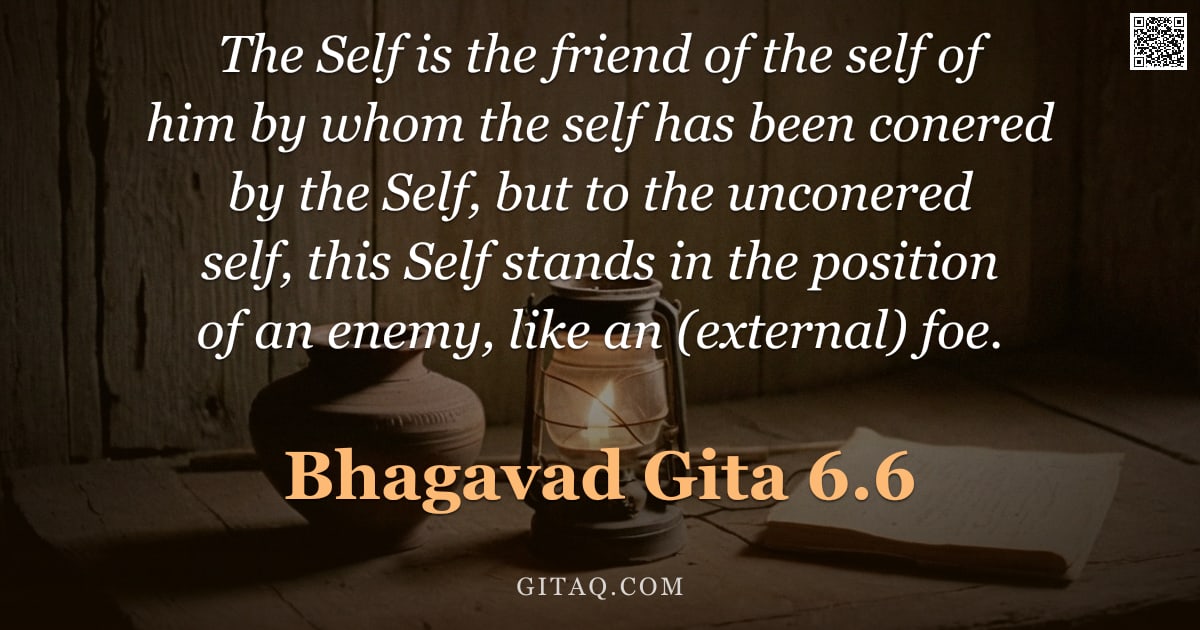
बन्धुरात्मात्मनस्तस्य येनात्मैवात्मना जितः | अनात्मनस्तु शत्रुत्वे वर्तेतात्मैव शत्रुवत् ||६-६||
bandhurātmātmanastasya yenātmaivātmanā jitaḥ . anātmanastu śatrutve vartetātmaiva śatruvat ||6-6||
What Does This Verse Mean?
Lord Krishna tells Arjuna that your own mind is the only true friend or enemy you have, depending on how well you control it. If a person masters their thoughts and emotions through discipline, they find inner peace because their self acts as a supportive ally. However, if someone cannot conquer their restless desires, their own uncontrolled nature becomes an adversary that leads to suffering. The verse teaches that ultimate victory in life comes from internal mastery rather than external conquest.
The Teaching Behind It
This verse is a cornerstone of Dhyana Yoga (The Path of Meditation) within the Vedantic framework, emphasizing self-mastery as the prerequisite for spiritual realization. It bridges Sankhya philosophy's distinction between the seer and seen by establishing that the mind itself must be subdued to realize the true Self (Atman). The teaching underscores Jnana Yoga principles where knowledge leads to action only when the instrument of perception is purified.
Word by Word
Classical Commentary
Where This Happens
This verse appears in Chapter 6 of the Bhagavad Gita during the critical dialogue on the battlefield of Kurukshetra between Lord Krishna and Prince Arjuna. At this point, Arjuna has just expressed deep confusion about how to practice meditation (Dhyana) while his mind is so restless due to grief and attachment. Krishna responds by clarifying that the very tool for success—the human mind—is a double-edged sword that determines whether one's spiritual journey succeeds or fails.
Living It Out Today
Consider an employee facing high-stakes layoffs who feels paralyzed by anxiety; their uncontrolled fear acts as an enemy, causing them to make poor decisions and lose confidence. By applying the discipline of Dhyana Yoga, they can train their mind to focus on actionable steps rather than catastrophic 'what-ifs,' turning that same mental energy into a source of resilience and clarity. This internal shift transforms the workplace crisis from a personal defeat into an opportunity for strategic problem-solving.
Explained for Children
Imagine your mind is like a puppy; it can be the best playmate or the naughtiest troublemaker depending on how you train it. If you teach yourself to focus and stay calm, this 'puppy' will run with you and keep you safe as your good friend. But if you let the puppy chase every butterfly without listening, it might trip you up and make things difficult for you. So, learning to be kind and strong in how you think is like having a superpower that turns trouble into help.
Daily Reflection
You carry within you two potential masters, and today determines which one takes charge of your day. When you act with discipline and self-awareness, your mind becomes your most trusted ally guiding you toward clarity. However, if you surrender to impulse or distraction, that same mind transforms into a hostile force working against your true good.
A Practice for Today
Sit quietly and ask yourself who rules your mind right now: the higher Self or the restless lower nature? Visualize this inner ruler as a loyal friend when you are disciplined, but an adversary that betrays your peace when you let desire take the wheel.
Key Teachings
- The Dual Nature of the Self
This verse reveals that our own consciousness is not neutral but acts as either an ally or an enemy based on how we train it. The same mind that can be a vehicle for divine connection becomes a source of suffering when left unchecked by discipline. - Conquest Through Self-Effort
The Gita emphasizes that the 'victory' over one's own nature is an internal achievement requiring active engagement, not passive waiting. By conquering oneself through conscious practice, we transform our potential for conflict into a source of inner strength. - Friendship with Mastery
True friendship begins when the higher Self governs the lower desires; in this state, every action and thought supports your spiritual growth. Without this mastery, even our own best intentions are undermined by a mind that acts as an unseen saboteur.
Themes
Related Verses
Read This Next
- 2.47 — This verse establishes the foundation of performing action without attachment, which is essential for the self-mastery described in Chapter 6.
- 3.30 — It complements this teaching by instructing one to dedicate all actions to the Divine, removing egoistic obstacles that make the mind an enemy.
- 12.15 — This verse describes the qualities of a devotee who has conquered the self and is beloved by all, showing the fruit of becoming one's own friend.
Recommended Reading
GitaQ earns from qualifying purchases as an Amazon Associate.