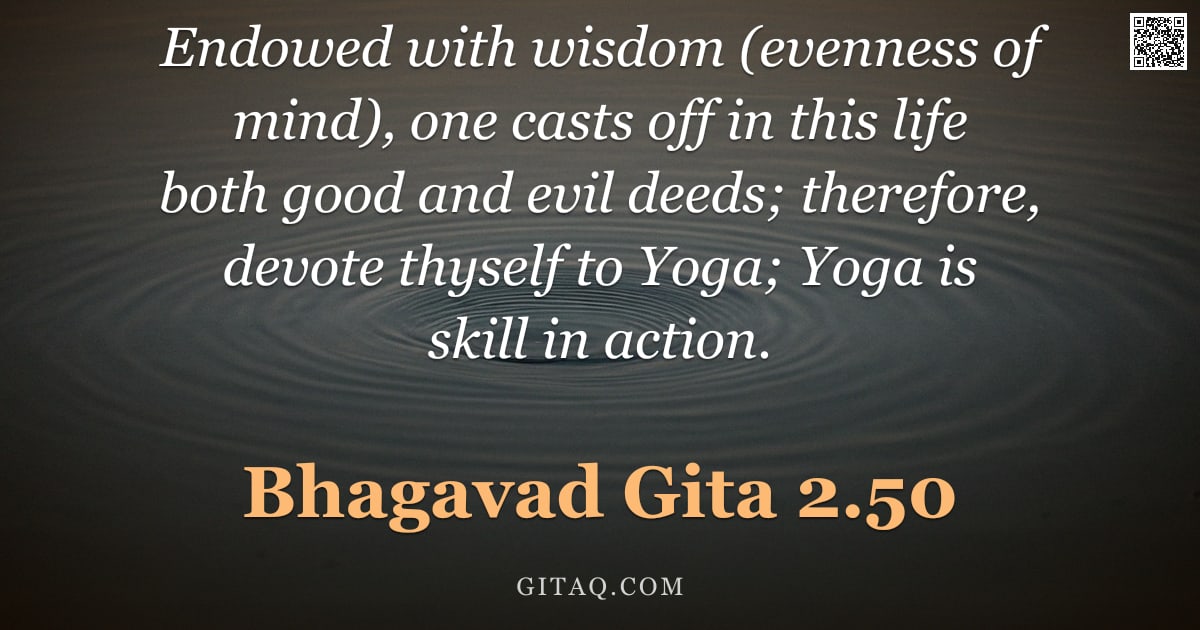
Bhagavad Gita 2.50
Sankhya Yoga · English Translation
बुद्धियुक्तो जहातीह उभे सुकृतदुष्कृते | तस्माद्योगाय युज्यस्व योगः कर्मसु कौशलम् ||२-५०||
buddhiyukto jahātīha ubhe sukṛtaduṣkṛte . tasmādyogāya yujyasva yogaḥ karmasu kauśalam ||2-50||
What Does This Verse Mean?
In this verse, Lord Krishna advises Arjuna that a person who acts with a steady and wise mind transcends the results of both good and bad actions during their lifetime. Instead of being trapped by the cycle of reward for virtue or punishment for mistakes, such a person remains free from attachment to outcomes. Therefore, Krishna urges one to dedicate themselves fully to Yoga, defining true skill in action as performing duties with this same detached wisdom.
The Teaching Behind It
This verse is a cornerstone of Karma Yoga (the yoga of selfless action) integrated with Sankhya philosophy. It develops the concept that true wisdom involves transcending the dualities of 'good' and 'evil' results (sukrta-dushkrte), which bind ordinary beings to the cycle of karma, allowing one to act as a neutral instrument of divine will.
Word by Word
Classical Commentary
Where This Happens
This verse appears in Chapter 2, known as Sankhya Yoga, where Krishna is speaking to Arjuna on the battlefield of Kurukshetra amidst a massive army. Just moments before this exchange, Arjuna had collapsed into despair, refusing to fight his own relatives and teachers due to overwhelming grief and attachment. Having just explained that the soul is eternal and indestructible, Krishna now pivots from philosophical theory to practical application, teaching Arjuna how to act without being paralyzed by fear or desire for specific results.
Living It Out Today
Consider a professional who has been working on a critical project for months but is anxious about whether they will get the promotion attached to it. By practicing 'buddhi-yukta' (wisdom of action), this person pours their full energy and skill into executing every task perfectly without obsessing over the outcome or fearing failure. This mindset allows them to perform at a higher level, reducing stress and anxiety while ensuring that whether they get promoted or not, they remain satisfied with their own integrity and effort.
Explained for Children
Imagine you are playing a game where your focus is on doing your best move rather than worrying about whether the scoreboard says 'win' or 'lose'. If you get too excited when winning or sad when losing, you might make mistakes. Krishna tells us that being really smart means focusing only on how well we play right now, not the score at the end. When we do this, our actions become perfect, and we stay happy no matter what happens in the game of life.
Daily Reflection
You often carry the weight of past mistakes or cling tightly to recent successes, believing these define your future. Today, Arjuna reminds you that true wisdom allows you to release both the burdens of bad deeds and the pride in good ones before they can bind you again. This freedom is not about becoming indifferent, but about acting with a steady heart so your work itself becomes an offering rather than a transaction for reward.
A Practice for Today
Begin by acknowledging that every action you take, whether perceived as good or bad, creates a ripple of reaction within your mind. Visualize placing these reactions into the vast sky of your inner wisdom, allowing them to dissolve without attaching to them. Rest in this space of evenness where the doer and the deed are seen clearly yet without entanglement.
Key Teachings
- The Transcendence of Duality
Wisdom enables the practitioner to stand above the dualities of merit and demerit, seeing them as transient fluctuations in consciousness. By refusing to identify with either outcome, one breaks the cycle that perpetuates bondage through reaction. - Yoga as Skillful Action
The verse redefines Yoga not merely as physical postures but as supreme competence and equanimity in performing any duty. This skill lies in acting without being swayed by the fear of failure or the intoxication of success. - Freedom Through Detachment
Casting off both good and evil deeds means transcending the karmic reactions that usually trap us in samsara. This detachment is the prerequisite for achieving liberation while still living an active life in the world.
Themes
Related Verses
Read This Next
- 2.47 — Read this next to understand the foundational instruction on performing duty without attachment to the fruits of action.
- 3.30 — Continue with this verse which elaborates on offering all actions to the Divine as a method for cleansing the mind.
- 12.15 — Conclude your study by reading how Krishna describes the qualities of those who have transcended duality and are dear to Him.
Recommended Reading
GitaQ earns from qualifying purchases as an Amazon Associate.