Bhagavad Gita 2.49
Sankhya Yoga · English Translation
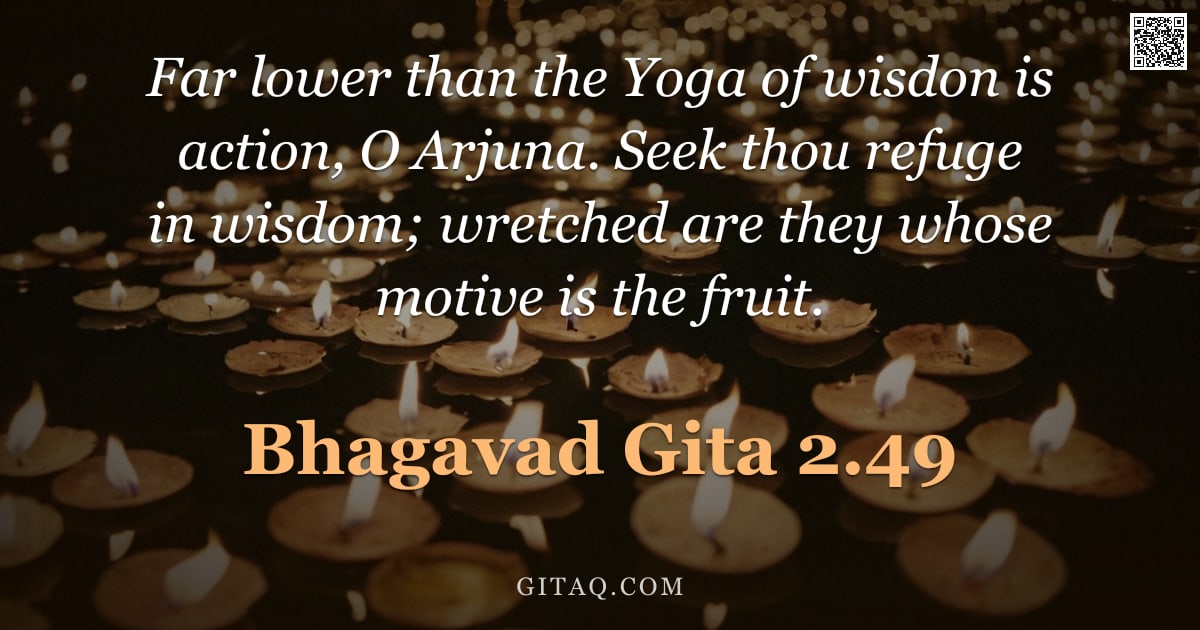
दूरेण ह्यवरं कर्म बुद्धियोगाद्धनञ्जय | बुद्धौ शरणमन्विच्छ कृपणाः फलहेतवः ||२-४९||
dūreṇa hyavaraṃ karma buddhiyogāddhanañjaya . buddhau śaraṇamanviccha kṛpaṇāḥ phalahetavaḥ ||2-49||
What Does This Verse Mean?
Lord Krishna tells Arjuna that performing actions without attachment to the results is far superior to acting merely for personal gain. He urges Arjuna to take refuge in 'buddhi-yoga,' or wisdom, which guides one to act with clarity and focus on duty rather than outcomes. The verse warns that those who are driven only by the desire for rewards remain trapped in a cycle of anxiety and limited vision.
The Teaching Behind It
This verse is a cornerstone of Karma Yoga, specifically introducing 'Buddhi-Yoga' as its practical engine within the Sankhya framework. It establishes that true action must be performed with intellectual discrimination (buddhi) to detach from the fruits of labor (phala), thereby purifying the mind for higher knowledge.
Word by Word
Classical Commentary
Where This Happens
This verse appears in Chapter 2 during the initial dialogues on the battlefield of Kurukshetra, where Lord Krishna is counseling his friend Arjuna just before the great war begins. Having heard Arjuna's emotional plea to avoid fighting due to grief for kinsmen and confusion about duty, Krishna has begun dismantling that attachment with logic and spiritual insight. He speaks this after explaining the nature of the eternal soul (Atman) and is now introducing 'buddhi-yoga' as the practical method to overcome Arjuna's paralysis.
Living It Out Today
Consider a software developer working on a critical project who spends their energy obsessing over whether they will get a promotion or bonus, rather than focusing on writing clean code. By shifting that focus from the 'fruit' of recognition to the quality of the work itself (buddhi-yoga), the anxiety dissipates and performance naturally improves. This approach transforms high-stress deadlines into opportunities for mastery, leading to better results without the burnout associated with outcome-dependent motivation.
Explained for Children
Imagine you are playing your favorite video game just because it is fun to play well, not because you want to win a trophy or get points. Krishna says this kind of playing with full focus is much better than trying hard only to get the prize at the end. If you worry too much about winning instead of enjoying the game, you will feel stressed and might even make mistakes.
Daily Reflection
Today, I invite you to examine where you might be working out of fear or greed for a specific reward rather than pure dedication. When we cling tightly to 'what comes next,' our actions become heavy and driven by anxiety; however, when we shift our focus to the quality of our engagement right now, that burden lifts. You are invited to find freedom in this very moment by offering your efforts as an act of wisdom rather than a transaction.
A Practice for Today
Close your eyes and visualize yourself detaching from the immediate outcome of any task you are currently undertaking. Breathe deeply, acknowledging that true peace arises not from securing a result, but from performing the duty itself with full awareness and skillful intelligence.
Key Teachings
- The Superiority of Wisdom Over Action
Krishna explicitly states that mere mechanical action, devoid of spiritual insight, is far inferior to the Yoga of intelligence. True success lies in acting from a place of inner clarity rather than external compulsion. - The Trap of Result-Oriented Living
Those who act solely for personal gain are described as 'wretched' because their lives remain trapped in the cycle of desire and disappointment. This mindset binds the soul to the material world rather than liberating it. - Refuge in Buddhi Yoga
The verse urges us to take shelter in 'Buddhi,' or discernment, which allows one to act without being shaken by success or failure. This is the foundation of a life lived with steady equanimity and divine purpose.
Themes
Related Verses
Read This Next
- 2.47 — This verse introduces the concept that you have a right to work only, not to its fruits, serving as the direct precursor to Krishna's statement on wisdom.
- 3.30 — Here Arjuna is instructed to surrender all actions to the Divine, illustrating how to practically apply the 'Yoga of Wisdom' in daily duties.
- 12.15 — It showcases the character traits of someone who has mastered the 'Yoga of Wisdom' by remaining untouched by dualities like pleasure and pain.
Recommended Reading
GitaQ earns from qualifying purchases as an Amazon Associate.