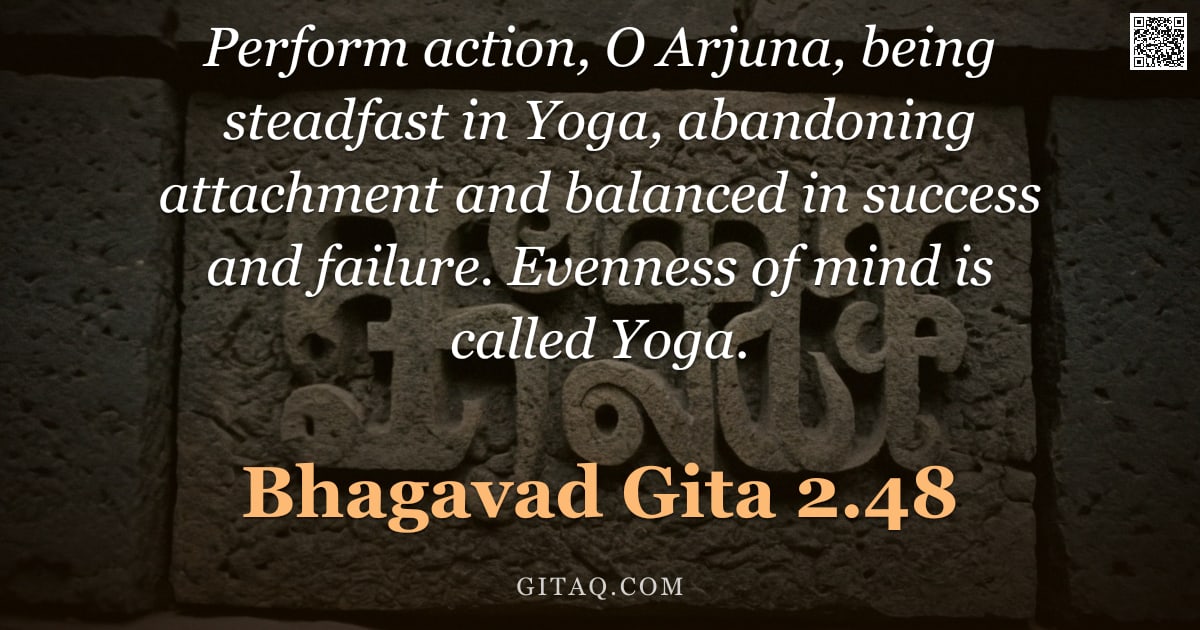
Bhagavad Gita 2.48
Sankhya Yoga · English Translation
योगस्थः कुरु कर्माणि सङ्गं त्यक्त्वा धनञ्जय | सिद्ध्यसिद्ध्योः समो भूत्वा समत्वं योग उच्यते ||२-४८||
yogasthaḥ kuru karmāṇi saṅgaṃ tyaktvā dhanañjaya . siddhyasiddhyoḥ samo bhūtvā samatvaṃ yoga ucyate ||2-48||
What Does This Verse Mean?
In this verse, Lord Krishna addresses Arjuna as Dhananjaya and instructs him to perform his duty with unwavering focus on the present moment. He teaches that true Yoga is not just physical postures but a state of mind where one acts without attachment to personal gain or loss. By maintaining an even balance in both success and failure, one achieves inner stability and freedom from anxiety.
The Teaching Behind It
This verse serves as the foundational definition of Karma Yoga (the yoga of action) within the Sankhya framework. It establishes that the essence of spiritual practice is performing prescribed duties without attachment to results, thereby cultivating Samatvam (mental equipoise), which is explicitly identified here as 'Yoga'.
Word by Word
Classical Commentary
Where This Happens
This verse appears in Chapter 2 of the Bhagavad Gita during the intense dialogue on the battlefield of Kurukshetra. Lord Krishna has just begun to instruct Arjuna after seeing him overcome by grief and moral confusion about fighting his own cousins. Having explained the eternal nature of the soul, Krishna now shifts to practical guidance for action, telling a paralyzed warrior how to find strength through equanimity.
Living It Out Today
Consider a professional preparing for a critical job interview or presenting a major project proposal where their career advancement hangs in the balance. The application of this verse means focusing completely on delivering high-quality work and speaking clearly during the presentation without obsessing over whether you will get hired or rejected. If the outcome is positive, do not become arrogant; if it fails, do not spiral into self-doubt but view it as a learning step while remaining ready for the next opportunity.
Explained for Children
Imagine you are playing your favorite video game or competing in a sports match with all your friends. Krishna says that the best way to play is to focus entirely on doing your very best right now, without worrying if you will win or lose at the end. If you get too upset about losing or feel too proud when winning, it can make you clumsy and sad; but if you stay calm and happy no matter what happens, you are playing with a 'Yoga mind.'
Daily Reflection
In our rush for results today, we often forget that true peace comes from how we perform an action rather than what happens afterward. When you face a challenge or celebrate a win later, try pausing to notice if your mind remains steady like the verse suggests. This evenness of spirit is not about indifference; it is about engaging fully in life without being tossed away by fear or pride.
A Practice for Today
Close your eyes and take three deep breaths, visualizing yourself standing firm like a mountain while the winds of success and failure blow around you. Silently repeat to yourself: 'I act with dedication but release my grip on the outcome,' allowing this balance to become your natural state.
Key Teachings
- Action as Worship
The verse commands us to perform our duties while remaining 'yogasthaḥ' (established in Yoga), turning every task into a spiritual practice. This means acting not for personal gain but with the awareness that action itself, when done without selfish desire, is an offering. - The Freedom of Detachment
Abandoning 'sanga' or attachment does not mean avoiding work; it means working without being mentally chained to a specific outcome. This detachment liberates the mind from anxiety and regret, allowing for clarity and effectiveness in our endeavors. - Equanimity as Yoga
The ultimate definition of Yoga presented here is 'samatvaṃ' or evenness of mind amidst success ('siddhi') and failure ('asiddhi'). By maintaining this balance, one transcends the duality of the world and finds a stable foundation for spiritual growth.
Themes
Related Verses
Read This Next
- 2.47 — Read this verse immediately before, as it explicitly commands Arjuna not to be attached to the fruits of action.
- 3.30 — This verse expands on the practice by instructing one to dedicate all actions and their results to the Divine.
- 12.15 — Read this later in Chapter 12, where Krishna describes how a devotee who is not disturbed by joy or sorrow becomes dear to Him.
Recommended Reading
GitaQ earns from qualifying purchases as an Amazon Associate.