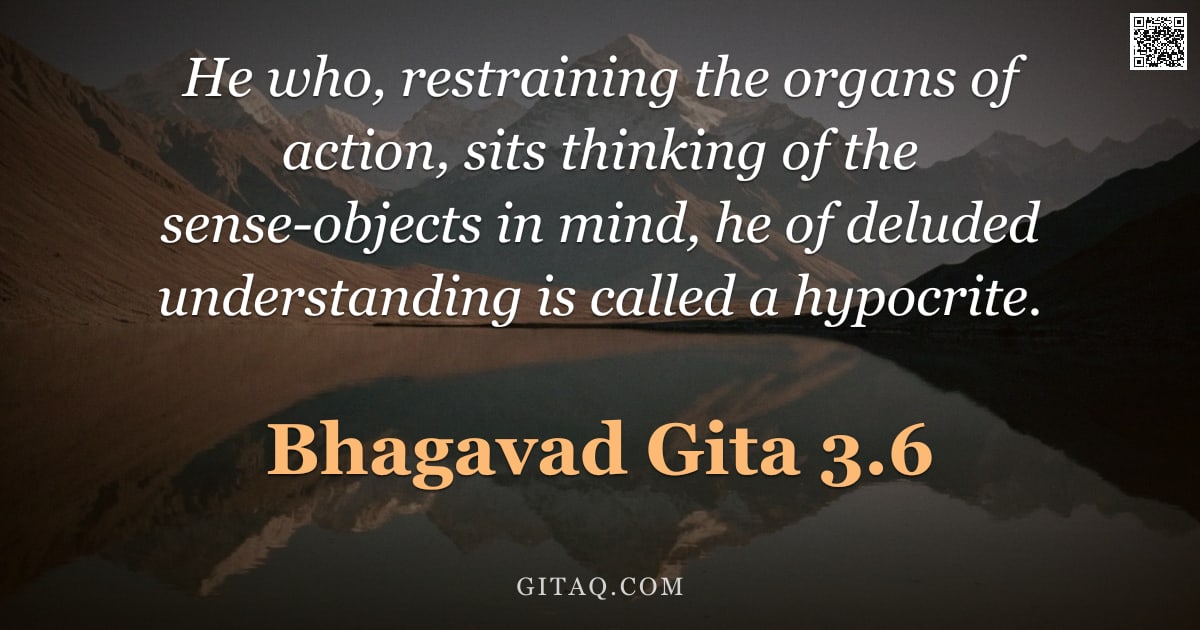
Bhagavad Gita 3.6
Karma Yoga · English Translation
कर्मेन्द्रियाणि संयम्य य आस्ते मनसा स्मरन् | इन्द्रियार्थान्विमूढात्मा मिथ्याचारः स उच्यते ||३-६||
karmendriyāṇi saṃyamya ya āste manasā smaran . indriyārthānvimūḍhātmā mithyācāraḥ sa ucyate ||3-6||
What Does This Verse Mean?
In this verse, Lord Krishna warns Arjuna against the hypocrisy of trying to control one's physical actions while secretly indulging in desires for sense objects with the mind. He identifies such a person as 'deluded' because true restraint requires inner alignment, not just external suppression. The core teaching is that pretending to be spiritual or disciplined while internally craving worldly pleasures is ineffective and leads to further confusion.
The Teaching Behind It
This verse is a foundational concept in Karma Yoga (the path of action) and Sankhya philosophy, emphasizing that true renunciation (sannyasa) requires the unification of mind and body. It develops the critical distinction between 'external restraint' (simulating non-action) and 'internal purification,' asserting that delusion arises when there is a gap between one's actions and thoughts.
Word by Word
Classical Commentary
Where This Happens
This verse occurs in Chapter 3 of the Bhagavad Gita, set amidst the battlefield of Kurukshetra where Prince Arjuna has refused to fight his own relatives. After explaining that everyone must act according to their nature and cannot simply stop working by force (karma-sannyasa), Krishna addresses a specific misunderstanding: thinking one can physically withdraw from action while mentally dwelling on past or future pleasures. He is speaking directly to the hesitant warrior Arjuna, challenging him to realize that true renunciation happens in the mind as well as the body.
Living It Out Today
Consider an employee who attends every meditation class and claims to be 'detached' at work, yet spends their entire day obsessively checking emails after hours or worrying about office politics. This internal conflict creates high anxiety because they are trying to force a calm exterior while feeding stress internally. To apply this verse's teaching, one should practice mindfulness: if you cannot stop the thought of a specific worry right now, acknowledge it honestly rather than pretending it doesn't exist, then gently return focus to your current task without self-judgment.
Explained for Children
Imagine if you pretended your hands were very still so no one would see them move, but inside your head, you were constantly daydreaming about eating a giant ice cream cake. That kind of pretending makes people confused because they are acting like they don't want the cake while their mind is screaming for it. Krishna teaches us that being honest with ourselves and our hearts is better than just putting on a show; real peace comes when what we do matches what we truly think.
Daily Reflection
Have you ever felt like an actor on stage who has stopped moving but hasn't truly left the scene? It is easy to pretend we are disciplined by simply holding our bodies still, only for our minds to be lost in fantasies or worries about what could have been. True peace comes not from suppressing our desires while secretly indulging them, but from aligning our inner thoughts with our outer actions.
A Practice for Today
Sit quietly and observe your hands resting gently, acknowledging their capacity for action without forcing them to move or grasp anything today. Turn your attention inward to the mind's tendency to wander toward sensory desires while maintaining a calm awareness of that very restlessness.
Key Teachings
- The Illusion of Restraint
Merely controlling the body's movements while the mind wanders is a superficial form of discipline that Krishna calls hypocrisy. True yoga requires an internal transformation where the senses and thoughts are unified, not just externally silenced. - The Trap of Mental Dwelling
Delusion arises when one sits in silence but continues to mentally dwell on sense objects they claim to have renounced. This creates a split between the physical self and the mental state, preventing genuine spiritual progress. - Authenticity Over Appearance
The verse warns against performing an external show of asceticism without internal purification. A sincere practitioner integrates action with detachment rather than pretending to be detached while secretly attached to outcomes.
Themes
Related Verses
Read This Next
- 2.47 — To understand Krishna's instruction on performing action without attachment to results as a superior alternative to forced inaction.
- 3.30 — To learn the practical method of offering all actions to the Divine, which cleanses the mind and resolves inner conflict.
- 12.15 — To see how a devotee who is free from hypocrisy becomes pleasing to Krishna through genuine detachment and equanimity.
Recommended Reading
GitaQ earns from qualifying purchases as an Amazon Associate.