Bhagavad Gita 3.5
Karma Yoga · English Translation
न हि कश्चित्क्षणमपि जातु तिष्ठत्यकर्मकृत् | कार्यते ह्यवशः कर्म सर्वः प्रकृतिजैर्गुणैः ||३-५||
na hi kaścitkṣaṇamapi jātu tiṣṭhatyakarmakṛt . kāryate hyavaśaḥ karma sarvaḥ prakṛtijairguṇaiḥ ||3-5||
What Does This Verse Mean?
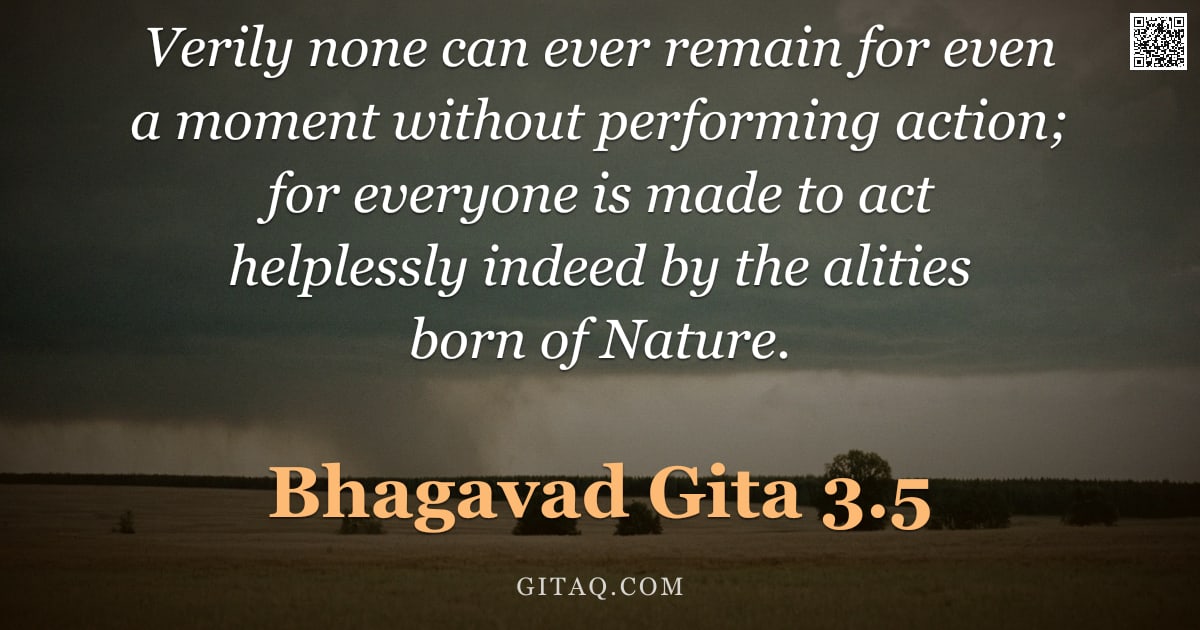
In this verse, Lord Krishna explains to Arjuna that it is impossible for anyone to remain inactive even for a single moment. He clarifies that all beings are driven to act by the three qualities of nature (gunas) such as passion and ignorance. The key teaching is that action is an inherent part of life's fabric; we cannot escape doing something, so the choice lies in how we perform those actions rather than whether we do them at all.
The Teaching Behind It
This verse forms the foundation of Karma Yoga, the path of selfless action, by establishing that total cessation of activity is impossible. It introduces the Sankhya concept that all beings are compelled by the three gunas (modes of material nature), meaning we must focus on purifying our actions rather than suppressing them.
Word by Word
Classical Commentary
Where This Happens
This verse appears on the battlefield of Kurukshetra during a moment of deep crisis when Arjuna has dropped his bow and refused to fight. After hearing Lord Krishna's initial teachings on the eternal nature of the soul, Arjuna attempts to flee from duty by claiming he will renounce all action entirely. Krishna responds with this verse to correct that misunderstanding, pointing out that true renunciation is not physical inaction but a state of mind where one acts without attachment.
Living It Out Today
Consider a manager facing a sudden crisis at work who feels overwhelmed and tempted to freeze or quit rather than make difficult decisions. This verse reminds us that we cannot simply pause our lives; the situation will force us to react, so it is better to consciously choose to engage with clear intent instead of reacting out of panic or avoidance. By acknowledging that inaction is not an option, you can shift your focus from 'should I do something?' to 'how can I act wisely right now?', turning anxiety into purposeful movement.
Explained for Children
Imagine your body has a tiny engine inside it that never stops running, even when you try to sit still. Just like a tree constantly growing leaves or your heart beating without you thinking about it, our minds and bodies are always busy because of the natural world around us. You can't just freeze in place forever; instead, Krishna teaches us to be like good drivers who choose where to go with that engine powerfully moving them forward.
Daily Reflection
Today, try to release the exhausting burden of thinking you must force everything into existence on your own terms. You are not separate from the flow of life; even your stillness is part of the cosmic dance orchestrated by Nature's qualities. When you stop resisting this current and allow yourself to act in alignment with it, a profound sense of relief replaces the struggle.
A Practice for Today
Close your eyes and notice how even as you sit still, the breath moves through you without permission; this is action happening naturally. Acknowledge that every thought arises from a deeper current of nature within you, rather than being forced by an egoic will.
Key Teachings
- The Impossibility of Inaction
No being can ever truly remain without performing action for even a single moment. Even attempting to abstain from work is, paradoxically, an active choice driven by the mind's nature. - Nature as the True Doer
Every individual acts helplessly under the compulsion of the three modes (guṇas) born of material Nature. The senses and qualities are constantly interacting, making total stillness impossible for embodied souls. - The Path of Renunciation through Action
Since we cannot stop acting, the spiritual solution is not inactivity but a shift in consciousness during action. We must perform our duties without attachment to results, knowing that Nature drives the machinery while we observe.
Themes
Related Verses
Read This Next
- 2.47 — To learn how to perform the actions compelled by Nature without attachment to their fruits.
- 3.30 — To discover the specific practice of dedicating all actions and results to the Divine while acting.
- 12.15 — To understand how one who is not disturbed by others becomes dear to Krishna after mastering this understanding.
Recommended Reading
GitaQ earns from qualifying purchases as an Amazon Associate.