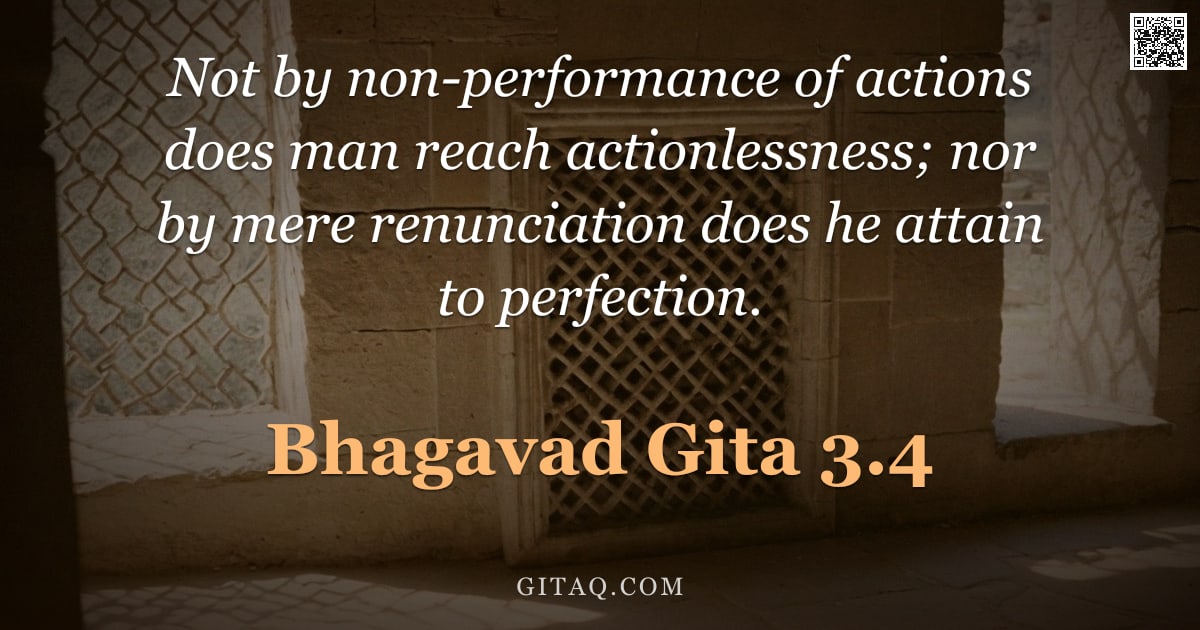
Bhagavad Gita 3.4
Karma Yoga · English Translation
न कर्मणामनारम्भान्नैष्कर्म्यं पुरुषोऽश्नुते | न च संन्यसनादेव सिद्धिं समधिगच्छति ||३-४||
na karmaṇāmanārambhānnaiṣkarmyaṃ puruṣo.aśnute . na ca saṃnyasanādeva siddhiṃ samadhigacchati ||3-4||
What Does This Verse Mean?
Lord Krishna is explaining to Arjuna that true peace and spiritual success cannot be achieved simply by avoiding work or pretending to renounce one's duties. He clarifies that no human being can remain without action even for a moment, as the body and mind are constantly engaged in activity. The key teaching here is that perfection comes not from stopping actions, but from performing them with the right attitude of detachment.
The Teaching Behind It
This verse is foundational to Karma Yoga (the path of selfless action) and refutes the Sankhya misconception that mere inaction leads to liberation. It develops the concept that true renunciation (Naiskarmya) is an internal state of detachment performed while actively engaging with the world, rather than a physical abandonment of duties.
Word by Word
Classical Commentary
Where This Happens
This verse occurs early in Chapter 3 on the battlefield of Kurukshetra during the Mahabharata war. Arjuna has just become overwhelmed by despair and suggests that he should abandon his duty as a warrior to fight, believing that spiritual renunciation is superior to violence. Krishna gently corrects this misunderstanding before Arjuna's confusion leads him away from his righteous path (dharma). The speaker is Lord Krishna acting as the divine charioteer and guide for Prince Arjuna.
Living It Out Today
Consider a professional who feels burnt out by their corporate job and decides to quit immediately without a plan, hoping that 'retiring' or becoming unemployed will bring them inner peace. This verse teaches that simply leaving the workplace does not resolve internal stress; one must learn to perform their current duties skillfully while letting go of attachment to promotions or praise. The solution is to continue working with full dedication but without anxiety about the outcome, transforming a stressful routine into a meaningful practice.
Explained for Children
Imagine you try to stop breathing or make your heart stop beating just because someone told you it's 'better'; you can't do it for long! Similarly, Krishna tells Arjuna that we cannot become perfect by simply refusing to work. Just like a student must study and play games to grow up strong, everyone has things they need to do in life. The secret is not stopping the doing, but enjoying the act of helping without worrying too much about getting rewards.
Daily Reflection
You may have heard that true peace comes from stopping all activity or retreating completely from the world, but this verse gently corrects that misconception. You cannot reach a state of inner freedom simply by avoiding your duties or pretending to be inactive; perfection is found in how you act, not whether you do so. Embrace your daily responsibilities as the very ground where your spiritual growth takes root.
A Practice for Today
Rest your awareness on the hands you use to work today, recognizing that action itself is not a chain but an offering. Let go of the desire for silence through stillness and instead find tranquility within the movement of life.
Key Teachings
- The Illusion of Inaction
Attempting to achieve a state of actionlessness merely by refraining from work is an impossible path, for no one can stop the body and mind entirely while living. True renunciation is not physical inactivity but mental detachment performed through engagement. - The Necessity of Engagement
Perfection or spiritual success cannot be attained solely by formally giving up actions; one must actively participate in the world to purify the heart. The path requires doing, but with a spirit free from attachment to results. - Karma Yoga Defined
This verse establishes that the yoga of action is superior to mere isolation or forced inactivity for those still bound by their nature. It teaches that one must transcend the bondage of karma through selfless service rather than avoiding it.
Themes
Related Verses
Read This Next
- 2.47 — This verse immediately follows by defining the true method of performing actions without attachment to results.
- 3.8 — It clarifies why one is forced to act and cannot remain inactive, even for a moment.
- 12.15 — This verse describes the qualities of one who has successfully mastered this path of actionless-action in practice.
Recommended Reading
GitaQ earns from qualifying purchases as an Amazon Associate.