Bhagavad Gita 4.17
Jnana Karma Sanyasa Yoga · English Translation
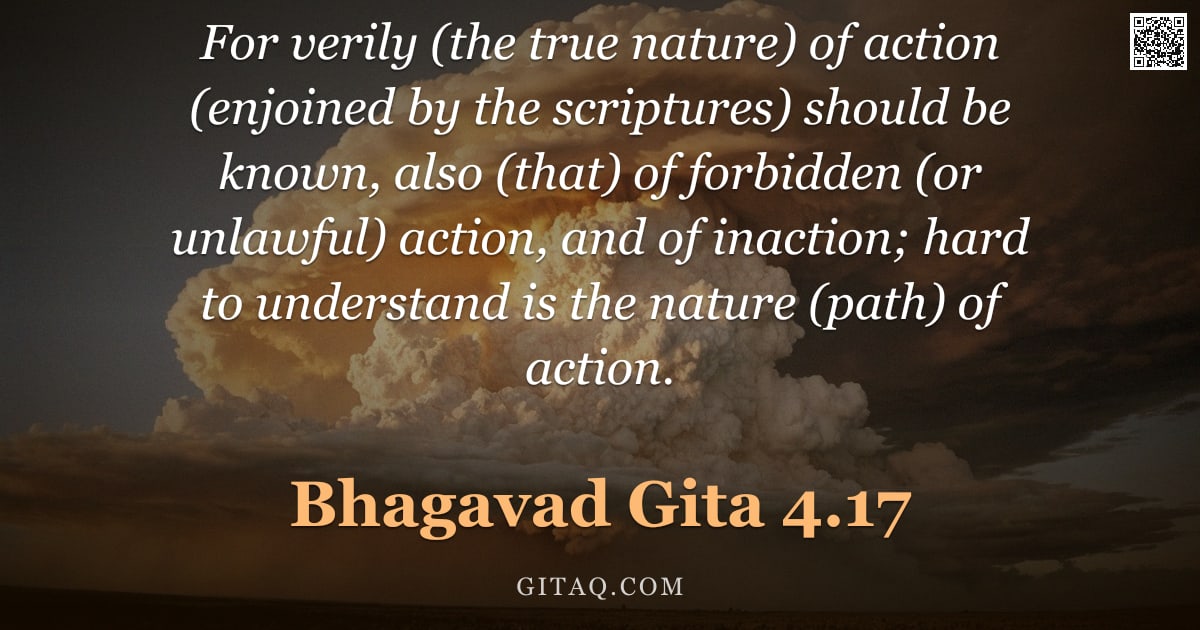
कर्मणो ह्यपि बोद्धव्यं बोद्धव्यं च विकर्मणः | अकर्मणश्च बोद्धव्यं गहना कर्मणो गतिः ||४-१७||
karmaṇo hyapi boddhavyaṃ boddhavyaṃ ca vikarmaṇaḥ . akarmaṇaśca boddhavyaṃ gahanā karmaṇo gatiḥ ||4-17||
What Does This Verse Mean?
In this verse, Lord Krishna warns Arjuna that understanding the true nature of action is incredibly difficult because it requires distinguishing between right action (karma), forbidden actions (vikarma), and inaction (akarma). Many people mistake doing nothing for spiritual renunciation or engage in wrong deeds thinking they are fulfilling their duty. The key teaching is that one must deeply study these distinctions to avoid confusion, as the path of action itself is subtle and complex.
The Teaching Behind It
This verse belongs to the synthesis of Karma Yoga (the yoga of action) and Jnana Yoga (the yoga of knowledge), emphasizing that true renunciation is not physical withdrawal but mental detachment while acting. It develops the critical concept of 'Gahana' (depth/subtlety), teaching that the spiritual significance of an act depends on the intention, context, and adherence to Dharma rather than just the external movement.
Word by Word
Where This Happens
This verse occurs on the battlefield of Kurukshetra during the Mahabharata war, where Lord Krishna is acting as Arjuna's charioteer and spiritual guide. Just after explaining the concept of renunciation in action (Jnana Karma Sanyasa), Krishna sees that his words have created confusion rather than clarity for a warrior who is overwhelmed by doubt. He pauses to address the complexity of 'action' directly, acknowledging that Arjuna might mistake physical stillness or avoidance of battle as spiritual liberation.
Living It Out Today
Consider a manager facing an ethical dilemma where they must choose between firing underperforming employees (right action for the company's survival) versus keeping them out of fear of conflict (forbidden inaction due to personal attachment). The challenge is recognizing that staying silent or avoiding the hard conversation feels like 'inaction' but actually creates more harm, while taking the difficult step aligns with duty. Understanding this prevents paralysis and ensures decisions are made based on what serves the greater good rather than temporary comfort.
Explained for Children
Imagine you have a very important rulebook for games at school. Krishna tells us we need to learn which moves are allowed (doing your homework), which ones break the rules (cheating or fighting), and when it's actually better to just pause and think instead of running around. It can be tricky because sometimes doing nothing looks like playing, but really, you have to know exactly what is right before you act.
Daily Reflection
Today, I invite you to pause before making a decision and ask not just 'what should I do?' but 'why am I feeling compelled to act?'. The path of life often feels tangled because we struggle to distinguish between necessary duty and the inertia that keeps us stuck. When you realize that even inaction has its own nature, you can move through your day with a lighter heart, knowing that true wisdom lies in seeing clearly rather than just doing more.
A Practice for Today
Sit quietly and observe your own actions today, asking yourself if you are acting out of duty, fear, or confusion. Notice the subtle difference between doing what is right, avoiding harm, and the stillness that exists when action ceases to be driven by ego.
Key Teachings
- The Paradox of Action
Krishna reveals that the line between action and non-action is not always clear to the untrained mind. What appears as a simple act can have complex karmic consequences, while what looks like inaction might be deep spiritual engagement. - The Threefold Classification
True wisdom requires understanding three distinct categories: prescribed action (karma), forbidden action (vikarma), and the mysterious state of non-action (akarma). Without this distinction, one may inadvertently bind themselves to further suffering. - The Profundity of Karma
The nature of action is described as 'gahanā' or profound because it involves the intricate interplay of intent, result, and spiritual law. It demands a depth of insight that goes beyond surface-level logic to understand how our deeds shape our destiny. - Inaction vs. Passivity
The verse challenges us to recognize 'akarma' not as laziness, but as the state where one acts without attachment or desire for personal gain. This is a higher form of engagement that transcends the cycle of reaction and reward.
Themes
Related Verses
Read This Next
- 2.47 — This verse establishes the foundational principle of performing one's prescribed duties without attachment to results, which is essential for distinguishing true karma from inaction.
- 3.30 — Here Krishna instructs on offering all actions to Him, a practical method to transform ordinary action into the spiritual state of non-action described in verse 4.17.
- 12.15 — Reading this will show you the character of one who has mastered these distinctions and acts with equanimity, free from the confusion of karma's complex nature.
Recommended Reading
GitaQ earns from qualifying purchases as an Amazon Associate.