Bhagavad Gita 3.9
Karma Yoga · English Translation
यज्ञार्थात्कर्मणोऽन्यत्र लोकोऽयं कर्मबन्धनः | तदर्थं कर्म कौन्तेय मुक्तसङ्गः समाचर ||३-९||
yajñārthātkarmaṇo.anyatra loko.ayaṃ karmabandhanaḥ . tadarthaṃ karma kaunteya muktasaṅgaḥ samācara ||3-9||
What Does This Verse Mean?
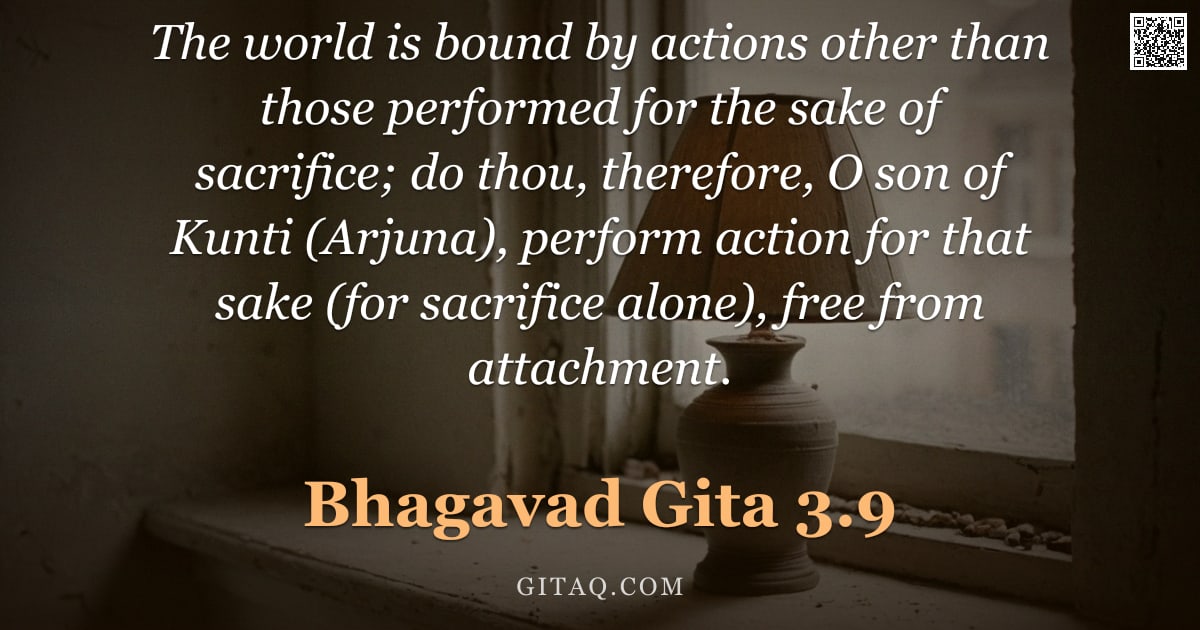
Lord Krishna is speaking to Arjuna, telling him that the world becomes trapped by a cycle of cause and effect when actions are performed only for personal gain or selfish desires. He teaches that if we act as an offering (sacrifice) rather than for our own benefit, we break this binding chain of karma. The key instruction is to perform one's duty with total freedom from attachment to the results.
The Teaching Behind It
This verse is a cornerstone of Karma Yoga, which teaches that action itself is not binding; it is attachment (sanga) and selfish desire that creates bondage. It integrates Jnana (knowledge of the self's true nature) with Bhakti (devotion or offering), showing how one can remain in the world while transcending its limitations through selfless service.
Word by Word
Classical Commentary
Where This Happens
This verse occurs on the battlefield of Kurukshetra during the Mahabharata war, where Prince Arjuna is hesitating to fight his own relatives and teachers. After Krishna has just explained the nature of the soul and duty in Chapter 2, Arjuna remains confused about how action can be spiritual if it involves violence. In this verse (3:9), Krishna clarifies that not all action leads to bondage; only selfish action does, offering a path for warriors to fight without accumulating negative karma.
Living It Out Today
Consider an employee who is frustrated with a project they feel stuck in because their boss isn't giving them credit or a promotion. Instead of slacking off or complaining (which creates stress and binds the mind), they can choose to perform that specific task as 'yajna' by viewing it as perfecting their own craft for the sake of quality itself, not just the reward. By shifting focus from 'what will I get?' to 'how well can I do this?', the anxiety vanishes, work becomes easier, and the feeling of being trapped dissolves.
Explained for Children
Imagine you are playing a game where you help your friends or clean up because it makes everyone happy and keeps things running well; that feels good and free! But if you only do those helpful things so someone gives you candy, you might feel stuck or upset when they don't. Krishna teaches us to be like the first kind of player: doing our best for the right reasons without worrying about getting a reward.
Daily Reflection
Today, I invite you to look at the work in front of you through a different lens; see if you can transform a routine task into an act of devotion rather than just labor. When we strip away our selfish desires and perform actions for a higher purpose, the heavy chains that bind us to worry begin to loosen naturally. You have the power today to turn your daily chores into a sacred practice by doing them without clinging to the results.
A Practice for Today
Pause for a moment and visualize your current tasks not as burdens, but as offerings made to the divine presence within you. Ask yourself where attachment clouds your action, and gently release that grip by performing each step simply because it is required of you now.
Key Teachings
- The Trap of Self-Interest
Actions driven solely by personal gain or desire create invisible chains that bind the soul to the cycle of birth and death. The verse warns that any work done without a higher purpose becomes a source of continued bondage rather than liberation. - Yajna as Sacred Offering
The term 'yajnartha' suggests performing every action as an offering or sacrifice, aligning our will with the cosmic order. When work is dedicated to something greater than oneself, it ceases to be a transaction and becomes a spiritual discipline. - Freedom in Detachment
True freedom arises not from stopping action, but from acting without attachment to the fruits of that labor. By serving with this spirit of detachment, one remains unbound by success or failure, achieving a state of inner peace.
Themes
Related Verses
Read This Next
- 2.47 — This foundational verse establishes your right to action while explicitly forbidding attachment to results, setting the stage for understanding sacrifice.
- 3.30 — Here Krishna instructs Arjuna to mentally dedicate all actions and their fruits specifically to Him, completing the instruction on how to perform sacrificial action.
- 12.15 — This verse describes the qualities of a devotee who is dear to Krishna because they are free from attachment and envy, showing the result of this practice.
Recommended Reading
GitaQ earns from qualifying purchases as an Amazon Associate.