Bhagavad Gita 4.19
Jnana Karma Sanyasa Yoga · English Translation
यस्य सर्वे समारम्भाः कामसङ्कल्पवर्जिताः | ज्ञानाग्निदग्धकर्माणं तमाहुः पण्डितं बुधाः ||४-१९||
yasya sarve samārambhāḥ kāmasaṅkalpavarjitāḥ . jñānāgnidagdhakarmāṇaṃ tamāhuḥ paṇḍitaṃ budhāḥ ||4-19||
What Does This Verse Mean?
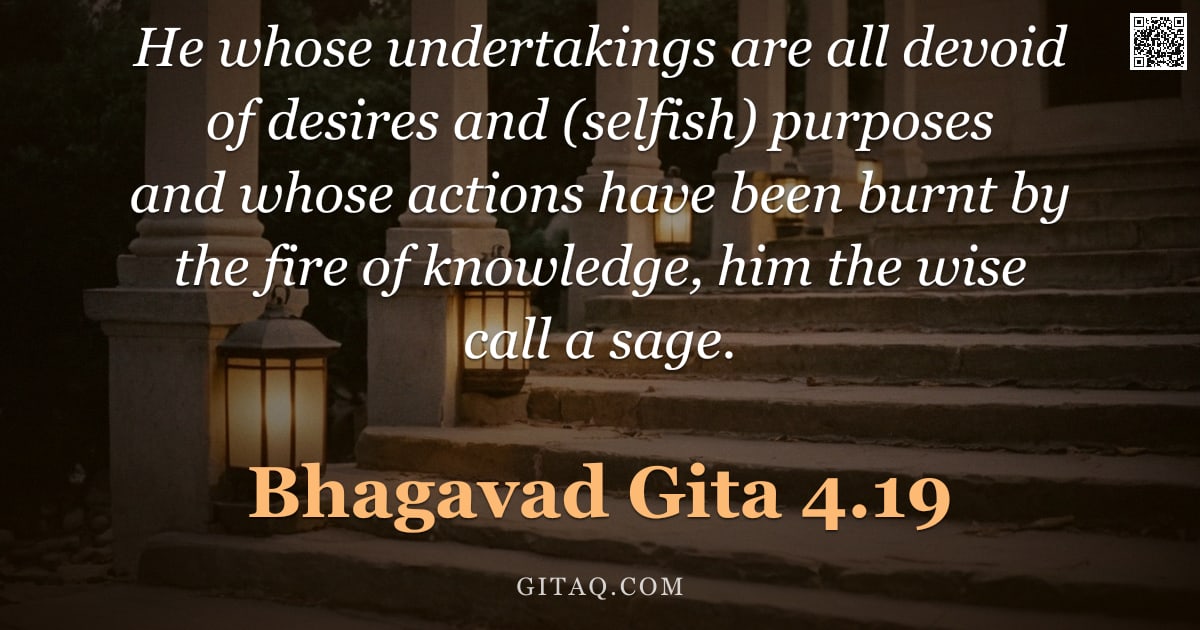
In this verse, Lord Krishna explains to Arjuna the true mark of a wise person or sage. A truly learned individual acts without selfish desires and has their past actions purified by the fire of spiritual knowledge. When one performs duty purely for its own sake rather than for personal gain, they transcend the bondage of karma.
The Teaching Behind It
This verse sits at the intersection of Karma Yoga (the yoga of action) and Jnana Yoga (the yoga of knowledge), specifically developing the concept that true renunciation comes from internal detachment rather than external inaction. It teaches that when actions are performed without desire, they do not generate new karmic reactions, effectively burning away past karma through wisdom.
Word by Word
Classical Commentary
Where This Happens
This verse occurs during a critical moment on the battlefield of Kurukshetra where Prince Arjuna is paralyzed by grief and confusion over fighting his own relatives. Lord Krishna has just begun explaining the eternal nature of the soul to counteract Arjuna's despair, shifting the conversation from emotional attachment to spiritual duty. As the discourse deepens into the Yoga of Knowledge (Jnana), Krishna defines the ideal state of a sage who is ready for liberation.
Living It Out Today
Consider a project manager facing a difficult decision where two options yield different personal rewards; instead of calculating which choice brings more promotion or bonus, they choose the path that best serves their team and ethical standards. By acting without attachment to the specific outcome or credit, the stress of 'what if I fail' vanishes, allowing for clearer thinking and better results.
Explained for Children
Imagine you are helping to clean your room not because you want a reward or praise, but just because it is the right thing to do and makes everyone happy; that is like acting without selfish desires. When we learn more about how the world works (like knowing why sharing is good), our bad habits of wanting things for ourselves start to disappear, similar to ice melting in sunlight. People who act this way are considered truly wise because their hearts become light and free from worry.
Daily Reflection
Today, I invite you to examine the hidden motivations behind your daily tasks; are they driven by a deep desire for recognition, or simply by the need to act with integrity? When we release our grip on specific results and offer our actions as an offering of pure consciousness, the heavy burden of anxiety begins to dissolve. You possess the wisdom within to burn away these selfish cravings through awareness, revealing a path where true peace resides.
A Practice for Today
Sit quietly and visualize your current goals, gently setting aside any expectation of the outcome or personal gain associated with them. Imagine a golden fire illuminating these intentions, transforming their selfish edges into pure acts of service while you remain steady in stillness.
Key Teachings
- Action Without Desiring Results
This verse defines true renunciation not as abandoning work, but as performing duties without attachment to personal gain or specific outcomes. When the mind is free from selfish motives (kama-sankalpa), every action becomes a sacred offering rather than a transaction for reward. - The Fire of Spiritual Knowledge
Self-realization acts as an all-consuming fire that burns away the karmic seeds attached to past actions, leaving no residue for future suffering. This inner transformation means one is no longer bound by the cycle of cause and effect because their motivations have been purified. - The Mark of a True Sage
The wise recognize a sage not by external asceticism, but by this internal state where all undertakings are free from self-centered calculation. Such individuals move through the world with lightness and clarity, recognized as enlightened because their actions flow spontaneously from wisdom.
Themes
Related Verses
Read This Next
- 2.47 — Read this next to understand Krishna's foundational instruction on performing duty without attachment to results.
- 3.30 — This verse complements 4.19 by instructing the devotee to dedicate all actions and their fruits to the Divine, reinforcing the theme of renunciation in action.
- 12.15 — Read this final selection to see how a person who is free from selfish desire becomes dear to others and finds peace through equanimity.
Recommended Reading
GitaQ earns from qualifying purchases as an Amazon Associate.