Bhagavad Gita 4.20
Jnana Karma Sanyasa Yoga · English Translation
त्यक्त्वा कर्मफलासङ्गं नित्यतृप्तो निराश्रयः | कर्मण्यभिप्रवृत्तोऽपि नैव किञ्चित्करोति सः ||४-२०||
tyaktvā karmaphalāsaṅgaṃ nityatṛpto nirāśrayaḥ . karmaṇyabhipravṛtto.api naiva kiñcitkaroti saḥ ||4-20||
What Does This Verse Mean?
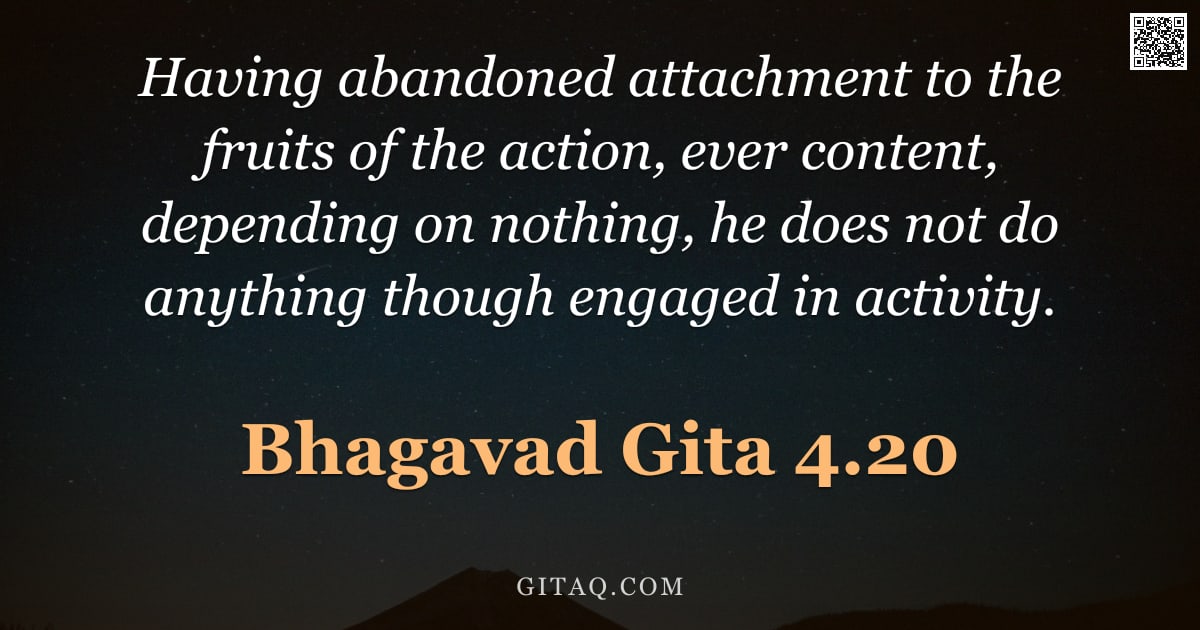
In this verse, Lord Krishna describes the state of a wise person who performs their duties without any attachment to the results. Such a person is always satisfied within themselves and does not rely on external sources for happiness or validation. Although they are fully engaged in active work, internally they feel as though they have done nothing because there is no sense of 'I am the doer' attached to it.
The Teaching Behind It
This verse is a cornerstone of Karma Yoga, which integrates action with spiritual wisdom by teaching that true renunciation occurs internally through detachment from results. It also reflects the Advaita Vedanta concept of 'Sthitaprajna' (the person of steady wisdom), where the self realizes it does not truly act because all actions are performed by nature's modes.
Word by Word
Classical Commentary
Where This Happens
This teaching occurs on the battlefield of Kurukshetra during a moment of deep crisis for Prince Arjuna, who has laid down his bow in despair. Krishna is explaining how one can transcend the confusion caused by fear and duty-bound action through the discipline of selfless work. This specific verse follows verses describing those who have renounced actions based on their results, clarifying that true renunciation happens within the mind while still engaging with worldly duties.
Living It Out Today
Consider a project manager facing a high-stakes deadline where they must make a difficult decision that could anger some team members. Instead of acting out of fear for how it will affect their reputation or hoping for immediate praise, they focus solely on doing what is right and effective in the moment. By releasing attachment to the outcome (promotion vs. criticism), they remain calm under pressure and execute the task with clarity rather than anxiety.
Explained for Children
Imagine you play a game with your friends just for the fun of playing, not because you want to win a trophy or get applause. You try your very best and run around (that's being active), but if you lose or win, your heart stays calm and happy either way. This verse teaches us that when we do things happily without worrying about prizes or praise, our minds stay peaceful even while we are busy playing.
Daily Reflection
Have you ever felt paralyzed because you were too focused on how things should turn out? Today, I invite you to try doing something useful just for the sake of doing it well, letting go of any need for praise or reward. When you act from a place of total contentment rather than lack, your work becomes a quiet offering that brings peace instead of stress.
A Practice for Today
Close your eyes and visualize yourself performing today's most pressing task while consciously releasing the image of its outcome from your mind. Feel a deep sense of sufficiency within you, knowing that by simply offering this action to the Divine without demanding a specific result, you are free in every moment.
Key Teachings
- Renunciation of Fruits
True action requires performing duties without clinging to the results they produce. This detachment frees the mind from anxiety about success or failure, allowing for pure engagement in the present moment. - Inner Contentment
The wise person is described as 'ever content' because their satisfaction comes from within rather than external achievements. This self-sufficiency means one's happiness remains stable regardless of changing circumstances. - Paradox of Action
Though the body may be fully engaged in activities, a liberated soul is not bound by them because they act without personal desire or ego. Thus, while appearing to do everything, such a person remains untouched and free.
Themes
Related Verses
Read This Next
- 2.47 — This verse establishes the foundational principle of focusing on duty while renouncing attachment to results.
- 3.30 — It expands on this by instructing one to dedicate all actions to the Divine, deepening the practice of surrender.
- 12.15 — This verse describes how such a detached and content person becomes dear to Krishna, completing the devotional circle.
Recommended Reading
GitaQ earns from qualifying purchases as an Amazon Associate.