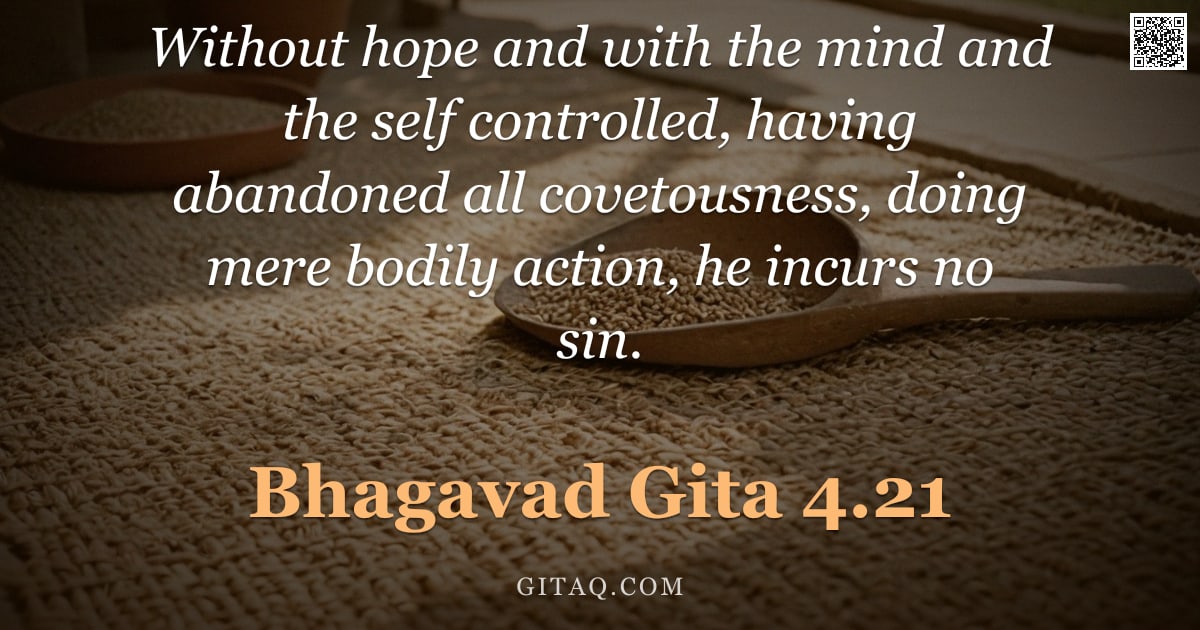
Bhagavad Gita 4.21
Jnana Karma Sanyasa Yoga · English Translation
निराशीर्यतचित्तात्मा त्यक्तसर्वपरिग्रहः | शारीरं केवलं कर्म कुर्वन्नाप्नोति किल्बिषम् ||४-२१||
nirāśīryatacittātmā tyaktasarvaparigrahaḥ . śārīraṃ kevalaṃ karma kurvannāpnoti kilbiṣam ||4-21||
What Does This Verse Mean?
In this verse, Lord Krishna explains the state of a person who has mastered their mind and desires while performing necessary duties. He teaches that when one acts without selfish expectations, controls their thoughts, and gives up greed for material possessions, they do not accumulate negative karma or sin from their actions. This is spoken by Krishna to Arjuna on the battlefield to show him how to act with a pure heart even in difficult circumstances.
The Teaching Behind It
This verse is a cornerstone of Karma Yoga, specifically illustrating the concept of 'Nishkama Karma' (action without desire). It develops the teaching that sin arises not from action itself, but from the egoistic attachment and expectation of results attached to that action. By surrendering these attachments, one transcends the karmic cycle.
Word by Word
Classical Commentary
Where This Happens
This verse appears in Chapter 4 during a critical moment on the battlefield of Kurukshetra, where Arjuna is paralyzed by grief and moral confusion. Krishna has just been teaching him about ancient wisdom and the nature of action; now he describes the ideal state of a sage who performs duty without attachment. Arjuna, feeling overwhelmed by his role as a warrior, needs to understand that fighting with a pure heart does not make one sinful.
Living It Out Today
Consider a manager leading their team through a major restructuring project where layoffs are unavoidable. Instead of focusing on personal gain or fearing the emotional fallout, they execute necessary decisions calmly and compassionately without attachment to praise or blame. By acting solely for the welfare of the organization and letting go of anxiety about outcomes, they perform their duty effectively without accumulating mental burden.
Explained for Children
Imagine you are helping your friends clean the park because it's the right thing to do, not so they will give you candy or praise later. If you only care about doing the job well and don't worry about getting anything for yourself, your hands stay clean even after playing in the dirt. Krishna says that when we work without asking 'what do I get out of this?', our hearts stay happy and free from guilt.
Daily Reflection
Today, notice how often you rush through your duties with eyes fixed on what comes next, hoping for praise or fearing failure. True freedom isn't found by stopping work, but by doing it fully while keeping your mind anchored in peace rather than craving a specific outcome. When you act without the heavy weight of expectation, even mundane tasks become a clean offering that leaves no karmic residue.
A Practice for Today
Close your eyes and visualize releasing one specific worry or desire that binds you to a future outcome, letting it dissolve into the space of pure awareness. Rest in the stillness where only the simple act of living happens now, without the need for result or reward.
Key Teachings
- Freedom from Expectation
The verse identifies 'nirāśī' (without hope) as the root of liberation, teaching us to detach our actions from specific desired results. This shift transforms labor into a pure offering rather than a transaction for personal gain. - Total Renunciation of Possession
By abandoning 'sarvaparigraha' (all covetousness), one stops viewing life as something to be hoarded or controlled. This mental letting go allows the body to function naturally without the soul becoming entangled in ownership. - The Power of Self-Control
With a 'cittātmā' (mind and self) that is fully regulated, action ceases to generate sin or karma. The controlled senses ensure that movement remains mechanical and pure, leaving the doer untouched by the consequences.
Themes
Related Verses
Read This Next
- 2.47 — This foundational verse on 'karmanye vadhikaraste' establishes the core principle of acting only on duty without claiming rights over results, directly supporting the concept of being nirāśī.
- 3.30 — Here Krishna instructs to dedicate all actions to Him while relinquishing attachment and desire for fruits, offering a practical method for achieving the state described in verse 4.21.
- 12.15 — This verse describes the qualities of an ideal devotee who is not disturbed by others' actions nor agitated by them, illustrating the serene stability of a mind free from covetousness.
Recommended Reading
GitaQ earns from qualifying purchases as an Amazon Associate.