Bhagavad Gita 4.22
Jnana Karma Sanyasa Yoga · English Translation
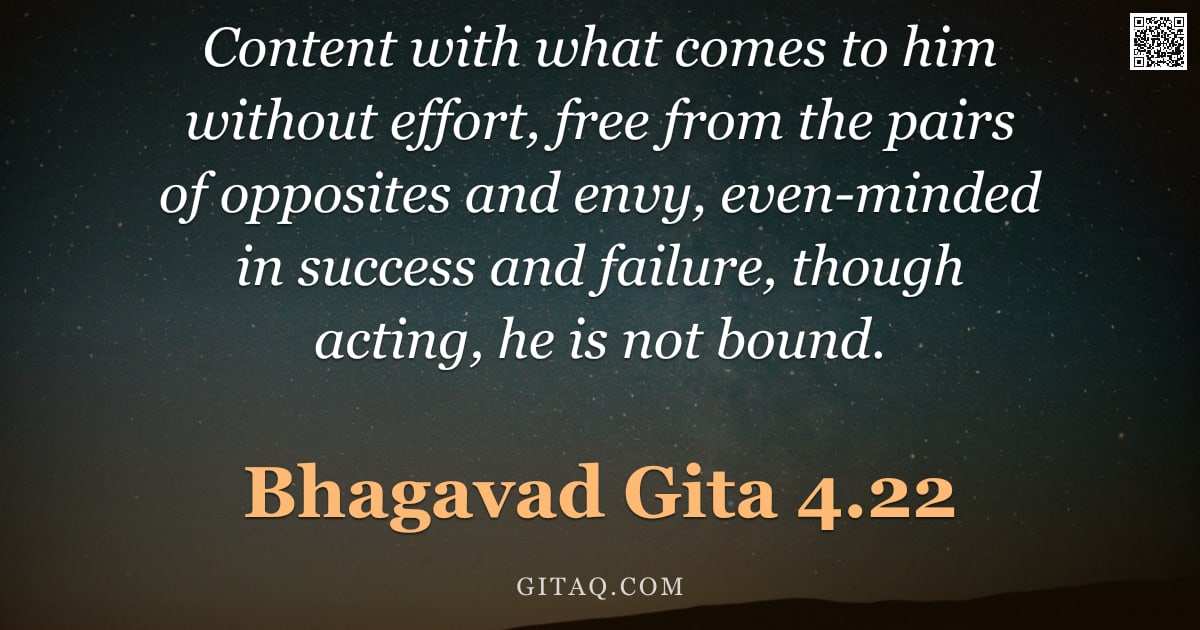
यदृच्छालाभसन्तुष्टो द्वन्द्वातीतो विमत्सरः | समः सिद्धावसिद्धौ च कृत्वापि न निबध्यते ||४-२२||
yadṛcchālābhasantuṣṭo dvandvātīto vimatsaraḥ . samaḥ siddhāvasiddhau ca kṛtvāpi na nibadhyate ||4-22||
What Does This Verse Mean?
In this verse, Lord Krishna describes the mindset of a wise person who remains happy with whatever they receive without forcing it to happen and stays calm regardless of success or failure. Speaking to Arjuna on the battlefield of Kurukshetra, Krishna explains that true freedom comes from acting without attachment to results or envy toward others. The core teaching is that one can perform all necessary duties while remaining internally unbound by the dualities of life like pleasure and pain.
The Teaching Behind It
This verse is the practical culmination of Karma Yoga (the yoga of selfless action) within the framework of Jnana Yoga (knowledge). It develops the concept that attachment arises not from actions themselves, but from our desire for specific outcomes and our reaction to the dualities of pleasure and pain.
Word by Word
Classical Commentary
Where This Happens
This teaching occurs during Arjuna's moment of deepest despair on the battlefield of Kurukshetra, where he has just refused to fight his own relatives. Lord Krishna has been guiding him through various spiritual concepts and is now describing the specific qualities of a 'sthitaprajna' or one who stands in steady wisdom. At this point, Arjuna feels overwhelmed by fear, confusion, and emotional attachment, needing reassurance that action does not require suffering.
Living It Out Today
Consider a professional facing an unexpected job loss; instead of spiraling into anxiety or blaming others for the failure, they accept the situation without resentment while continuing to seek new opportunities with calm focus. They do not envy colleagues who seem more successful nor feel defeated by their own lack of immediate success, maintaining balance in both good and bad outcomes. This approach allows them to act decisively on finding a new path without being paralyzed by fear or ego.
Explained for Children
Imagine you are playing a game where you try your hardest but don't know if you will win; even if you lose, you stay happy because you gave it your best. This verse teaches us to be like that player who doesn't get angry when things go wrong or feel too proud when they do well. Just as the wind blows without asking for permission and is not upset by obstacles, a wise person stays calm inside no matter what happens outside.
Daily Reflection
You often feel compelled to force every outcome to be perfect before you can find joy, but today invites you to try a different path: accepting what arrives without resistance. When life presents success or failure with equal calmness, you discover that your inner worth is never diminished by the world's fluctuations. This freedom from envy and anxiety allows your actions to flow like water, clearing the way for genuine happiness.
A Practice for Today
Take a moment to recall an event from today where you received something without actively striving for it—perhaps a kind word, a sunny day, or a solved problem—and let gratitude arise naturally in your heart. As the mind settles on this effortless gift, consciously release any attachment to outcomes, resting instead in the peace of being whole regardless of external results.
Key Teachings
- Contentment Without Striving
The verse describes a state of 'yadṛcchālābha-santuṣṭa', meaning deep satisfaction with whatever comes without one's own calculated effort. This is not passive resignation but an active trust that the divine order provides exactly what is needed at every moment. - Transcending Dualities
True spiritual maturity involves becoming 'dvandvātīta', or transcendent over pairs of opposites like heat and cold, praise and blame. By refusing to be pulled by the pendulum of external circumstances, one maintains an unshakeable inner equilibrium. - Action Without Binding
Paradoxically, this verse teaches that even while performing duties ('kṛtvāpi'), a person remains 'na nibadhyate' or unbound by karma. This liberation comes from acting without the ego's demand for specific results, freeing the soul from the cycle of cause and effect.
Themes
Related Verses
Read This Next
- 2.47 — This verse establishes the foundational principle of acting without attachment to results (karma-phala-tyaga), which is necessary for understanding how one can act while remaining unbound.
- 3.30 — It expands on the previous point by instructing one to dedicate all actions to the Divine, removing personal ego and envy from the equation of action.
- 12.15 — This verse describes the qualities of a devotee who is dear to Krishna because they are free from agitation and equally disposed toward all beings, mirroring the equanimity described in 4.22.
Recommended Reading
GitaQ earns from qualifying purchases as an Amazon Associate.