Bhagavad Gita 4.23
Jnana Karma Sanyasa Yoga · English Translation
गतसङ्गस्य मुक्तस्य ज्ञानावस्थितचेतसः | यज्ञायाचरतः कर्म समग्रं प्रविलीयते ||४-२३||
gatasaṅgasya muktasya jñānāvasthitacetasaḥ . yajñāyācarataḥ karma samagraṃ pravilīyate ||4-23||
What Does This Verse Mean?
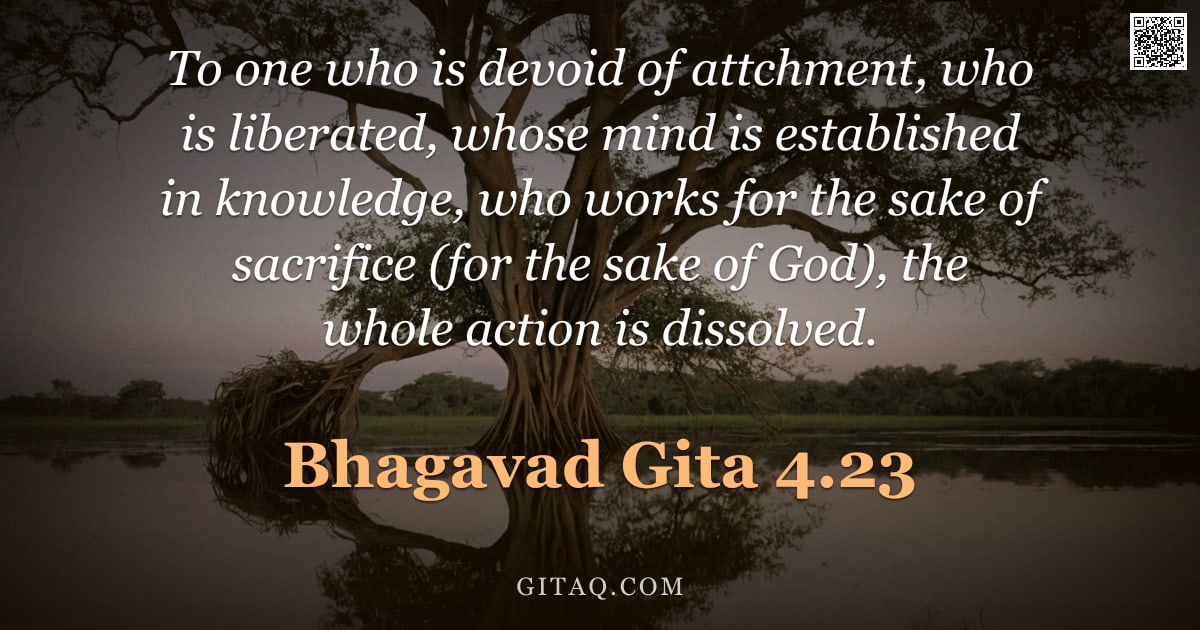
Lord Krishna tells Arjuna that for a person free from attachment and whose mind is firmly rooted in spiritual knowledge, all actions performed as an offering to the Divine are completely dissolved. This means such work leaves no karmic residue or future consequences binding the individual. The verse teaches that when action is done without selfish desire but with devotion, it transforms into liberation rather than a cause for rebirth.
The Teaching Behind It
This verse synthesizes Karma Yoga and Jnana Yoga, demonstrating how selfless action (Karma) performed with wisdom leads directly to liberation (Moksha). It develops the concept that work becomes a form of sacrifice (Yajna), transforming ordinary activity into spiritual practice when detached from ego. The ultimate goal described is 'pravilīyate'—the total melting away of karmic bonds through this purified state of consciousness.
Word by Word
Classical Commentary
Where This Happens
This verse occurs on the battlefield of Kurukshetra during a critical moment where Arjuna is overwhelmed by grief and confusion about fighting his own relatives. Krishna has been explaining the nature of the eternal soul (Atman) to dispel Arjuna's sorrow, leading into the discussion of Karma Yoga—the path of selfless action. Having just described how one should act without attachment in Chapter 3, Krishna now deepens this teaching by showing that perfect detachment leads to the complete dissolution of all karmic results.
Living It Out Today
Consider a project manager facing an impossible deadline with high stakes; instead of working out of fear of failure or greed for promotion, they dedicate their effort entirely to serving the team and delivering quality. By shifting focus from personal outcomes (like bonuses or status) to the act of service itself, the anxiety about 'what if I fail' disappears. The work gets done more effectively because it is free from the mental burden of attachment to specific results.
Explained for Children
Imagine you clean your room not because someone told you to, and not just to get a reward, but because you love keeping things neat and helping the family. When you do that happily, without worrying about praise or punishment afterwards, it feels light and easy. In the same way, when we help others out of pure kindness rather than for our own gain, those good deeds don't weigh us down; they just make us feel free.
Daily Reflection
You often carry the weight of outcomes on your shoulders, but this verse invites you to lay that down completely. When you act with your mind established in knowledge and without clinging to results, the very nature of your work transforms from a source of stress into a path of liberation. Today, try performing one task simply as an offering, noticing how the tension of 'must' dissolves when the motive shifts to pure service.
A Practice for Today
Rest your awareness in the quiet space between action and reaction, imagining your work as an offering rather than a burden. Visualize every task you perform today dissolving like sugar in warm water, leaving no trace of attachment or ego behind.
Key Teachings
- Freedom in Action
True liberation (mukti) is not found by fleeing from action but by performing it without attachment. The liberated soul acts naturally, unbound by the chains of desire or fear that trap ordinary minds. - The Power of Yajna
When actions are performed as a sacrifice (yajña) for the sake of the Divine rather than personal gain, they lose their binding power. This shift in intention transforms karma from a chain that binds to fire that burns away impurities. - Dissolution of Karma
For one whose mind rests firmly in spiritual knowledge (jnana), the accumulated results of past actions are completely dissolved. Such action does not generate new karmic debt, allowing the individual to remain free while fully engaged in life.
Themes
Related Verses
Read This Next
- 2.47 — This verse establishes the fundamental principle of performing one's duty without being attached to the fruits of action.
- 3.9 — It explicitly defines work done as a sacrifice (yajña) and explains how this prevents bondage from karma.
- 12.15 — This verse describes the qualities of one who is dear to Krishna, including being undisturbed by joy or grief and free from attachment.
Recommended Reading
GitaQ earns from qualifying purchases as an Amazon Associate.