Bhagavad Gita 4.24
Jnana Karma Sanyasa Yoga · English Translation
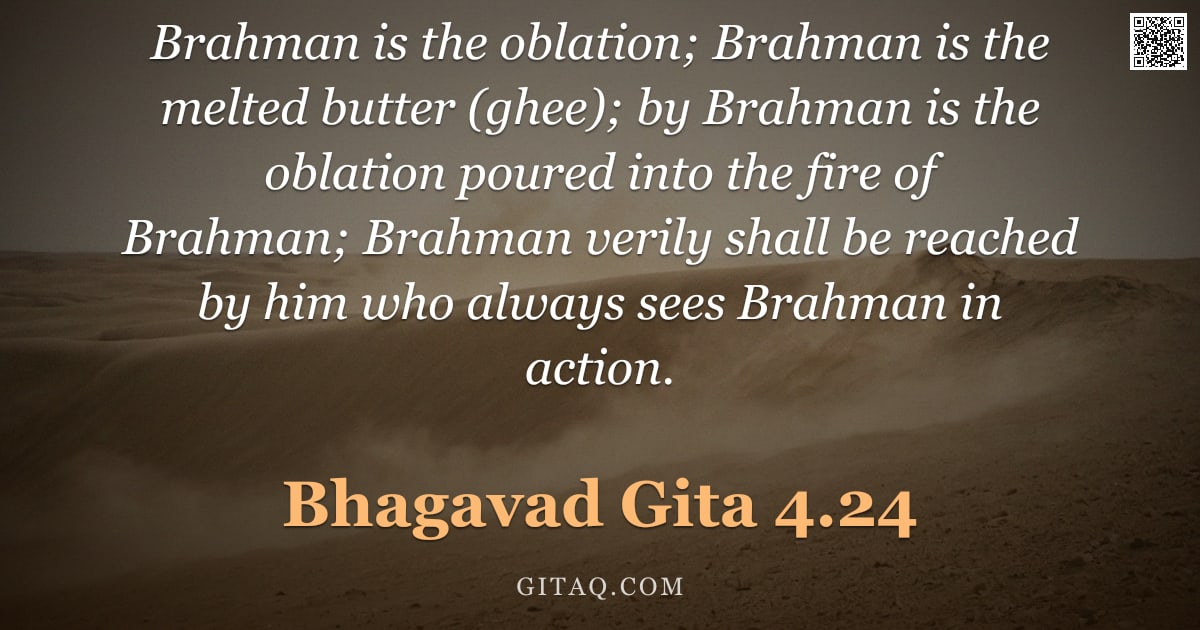
ब्रह्मार्पणं ब्रह्म हविर्ब्रह्माग्नौ ब्रह्मणा हुतम् | ब्रह्मैव तेन गन्तव्यं ब्रह्मकर्मसमाधिना ||४-२४||
brahmārpaṇaṃ brahma havirbrahmāgnau brahmaṇā hutam . brahmaiva tena gantavyaṃ brahmakarmasamādhinā ||4-24||
What Does This Verse Mean?
In this verse, Lord Krishna explains to Arjuna that the entire process of sacrifice is ultimately one with Brahman (the Ultimate Reality). He teaches that when a person performs actions without attachment, seeing themselves as the instrument and God as the recipient, every part of the act becomes sacred. The core message is that by realizing the divine presence in all aspects of action—the doer, the offering, and the fire—one attains liberation.
The Teaching Behind It
This verse is a cornerstone of Karma Yoga and Advaita Vedanta (non-dualism), illustrating that there is no separation between the sacred act and the Divine. It develops the concept of 'Brahma-karma-samadhana,' where one's consciousness merges with Brahman through selfless action, dissolving the duality of doer and deed.
Word by Word
Classical Commentary
Where This Happens
This verse appears during Lord Krishna's discourse to Arjuna on the battlefield of Kurukshetra, where the warrior is paralyzed by moral confusion and sorrow over fighting his relatives. After explaining the nature of the soul and the different paths of yoga in previous chapters, Krishna now addresses how one should perform their prescribed duty (Karma Yoga). He speaks directly to a confused Arjuna who feels that renouncing action means abandoning his role as a warrior, so Krishna redefines 'action' itself as an act of spiritual worship.
Living It Out Today
Consider a software developer working late on a critical project deadline. Instead of viewing the coding, meetings, and stress merely as job obligations or sources of anxiety, they perform every task with full awareness that their effort is a service to humanity (Brahman). By seeing themselves not as the sole achiever but as an instrument through which work gets done for the greater good, the developer eliminates burnout. This shift in perspective transforms mundane stress into a meditative practice where the outcome becomes secondary to the quality of conscious action.
Explained for Children
Imagine you are baking a special cake for your best friend's birthday party to show how much you love them. You mix the ingredients (the butter), use your oven (the fire), and put it in there with all your heart. When Krishna talks about this, he says if you do that same thing but know that God is inside you, inside the cake, and even inside the hot oven itself, then making that cake becomes a special prayer! If you always see God's love in everything you do, like cooking or studying, you will eventually become one with that perfect love.
Daily Reflection
Today, try to see every action you take—from washing dishes to speaking with colleagues—as an offering made directly to the Divine within yourself. When you shift your perspective from 'I am doing this' to 'Brahman is acting through me,' the burden of ego dissolves into a sense of sacred flow. This simple change in awareness transforms ordinary moments into opportunities for union, guiding you toward the very source you seek.
A Practice for Today
Sit quietly and visualize your daily actions not as separate tasks, but as offerings of butter being poured into a sacred fire. As you breathe, affirm that the doer, the act, and the result are all manifestations of the same Divine presence.
Key Teachings
- The Non-Duality of Action
This verse teaches that there is no separation between the offerer and the offered; every element of a ritual or action is ultimately Brahman. By recognizing this unity, we understand that all actions are inherently spiritual when performed with full awareness. - The Fire of Transformation
Just as ghee burns away in fire to become light and heat, our ego-centric desires burn up when offered into the fire of knowledge. This process converts selfish action into a pure sacrifice that nourishes the soul rather than binding it. - The Path of Brahman-Karma-Samadhi
True liberation is not found by abandoning work, but by entering a state where one sees only Brahman in every action. This constant vision of the Divine as the actor leads inevitably to merging with that same reality.
Themes
Related Verses
Read This Next
- 2.47 — Read this next for Krishna's instruction on performing duty without attachment to results.
- 3.30 — This verse expands the concept by explicitly commanding the surrender of all actions and their fruits to God.
- 12.15 — Conclude this study section with a description of how one who sees Brahman in all beings is dear to Krishna.
Recommended Reading
GitaQ earns from qualifying purchases as an Amazon Associate.