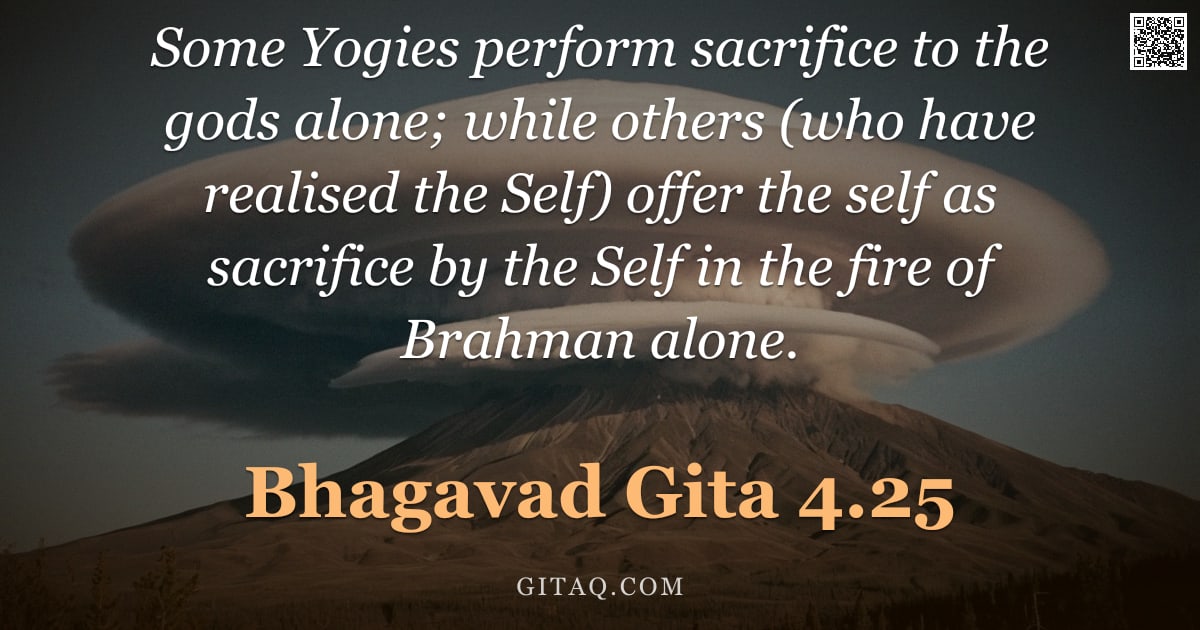
Bhagavad Gita 4.25
Jnana Karma Sanyasa Yoga · English Translation
दैवमेवापरे यज्ञं योगिनः पर्युपासते | ब्रह्माग्नावपरे यज्ञं यज्ञेनैवोपजुह्वति ||४-२५||
daivamevāpare yajñaṃ yoginaḥ paryupāsate . brahmāgnāvapare yajñaṃ yajñenaivopajuhvati ||4-25||
What Does This Verse Mean?
In this verse, Lord Krishna describes two distinct paths taken by spiritual seekers during the Vedic era: those who perform rituals dedicated to external deities and those who turn inward to worship the Supreme Reality itself. While some yogis offer sacrifices to gods outside of themselves, advanced practitioners realize that their own consciousness is the ultimate fire where they offer their ego as a sacrifice in the form of self-knowledge. The key teaching is that true spiritual progress involves shifting focus from external ritualistic forms to internal transformation and realizing the unity of the individual soul with Brahman.
The Teaching Behind It
This verse sits at the intersection of Karma Yoga and Jnana (Knowledge) Yoga, bridging external ritualistic action with internal philosophical realization. It develops the concept that all forms of sacrifice are valid only when they lead to the ultimate truth: that the individual self (Atman) is non-different from Brahman (the Absolute). This marks a transition from performing rituals for results to offering one's very ego in the fire of wisdom.
Word by Word
Classical Commentary
Where This Happens
This verse occurs in Chapter 4, where Lord Krishna is explaining the secret history and science of yoga to Arjuna on the battlefield of Kurukshetra. After outlining how this knowledge was once lost and then revealed to Vivasvan (the sun god), Krishna now details the specific methods different types of yogis use to attain liberation in that ancient time. The listener, Arjuna, is struggling with confusion about duty versus renunciation, and Krishna uses this verse to clarify that diverse spiritual practices ultimately aim for the same goal.
Living It Out Today
Consider a professional facing burnout who has been trying to find peace by constantly seeking validation from their boss or colleagues (offering sacrifice to gods). Instead of waiting for external approval, they can practice offering their own ego and anxiety in the fire of self-awareness during difficult meetings. By shifting focus from 'what will others think' to 'how can I serve this task with integrity,' the stress transforms into purposeful action, turning a high-pressure situation into an opportunity for inner growth.
Explained for Children
Imagine you have two ways to play a special game: some people throw toys into a box outside called 'Gods' as a gift, while others realize that their own mind is the most important part of the game. The verse tells us about those smart players who understand they can use their own thoughts and feelings (the toy) and put them inside a magical fire made of pure love to become better people. It's like realizing you don't need to look outside for magic; the power to change is already burning bright within your own heart.
Daily Reflection
Today, consider whether you are approaching life solely through ritual or if you have begun to offer your very actions and intentions back to the Source. It is a profound shift when we stop seeing ourselves as separate entities making sacrifices for rewards, and instead realize that our entire being is already a sacrifice in the fire of awareness.
A Practice for Today
Sit quietly and visualize two distinct fires within your heart: one for external offerings of gratitude, the other a silent inner flame where you place your own ego as an offering to the Divine. Notice how the act of giving yourself fully in this fire dissolves the boundary between the giver and the receiver.
Key Teachings
- The Duality of Worship
This verse acknowledges two distinct paths: devotees who worship external deities through ritualistic sacrifices, and those advanced yogis who internalize that process. It validates the devotional path while pointing toward a more non-dual realization where the distinction between worshipped and worshipper dissolves. - The Fire of Brahman
For the realized soul, the 'fire' is not made of wood or fuel but represents the ultimate reality of Brahman itself. In this fire, the individual self (Jiva) and its desires are consumed as an offering to the Universal Self. - Self-Sacrifice as Yajna
The highest form of sacrifice is not giving material goods but offering one's own limited identity into the vastness of consciousness. This transforms every action from a transactional duty into an act of spiritual liberation.
Themes
Related Verses
Read This Next
- 4.23 — To understand how an enlightened person performs action without attachment before this specific description of internal sacrifice.
- 5.18 — To see the result of such a realization, where one sees all beings with equal vision as they transcend duality.
- 9.27 — For practical guidance on how to offer every action and fruit in devotion, bridging external ritual with internal intent.
Recommended Reading
GitaQ earns from qualifying purchases as an Amazon Associate.