Bhagavad Gita 5.18
Karma Sanyasa Yoga · English Translation
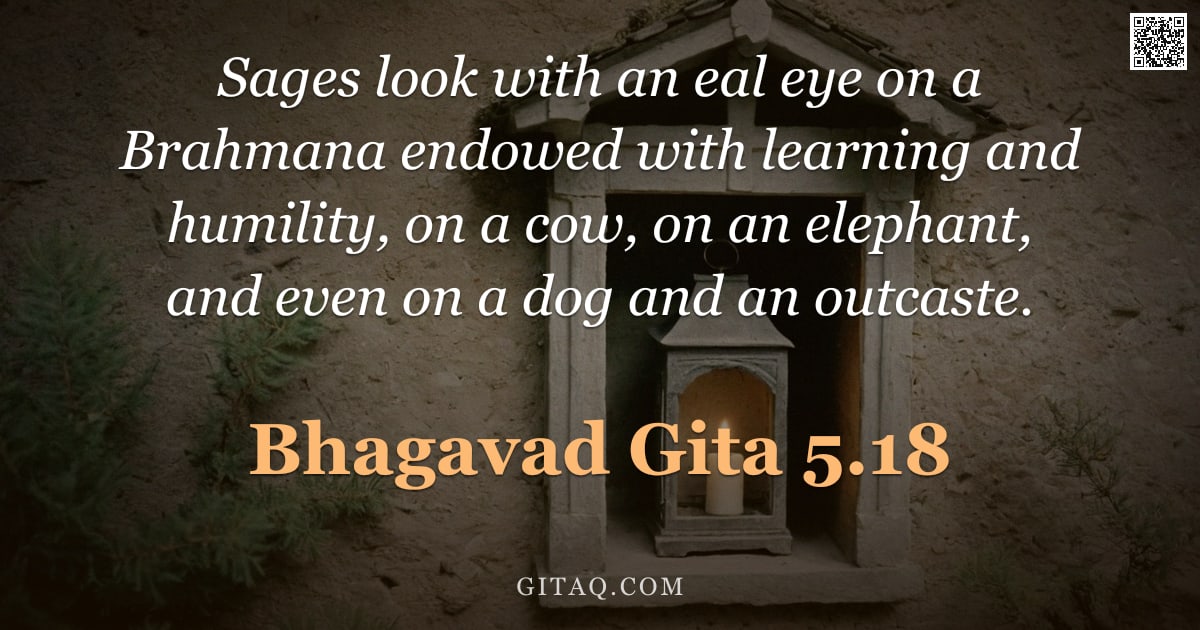
विद्याविनयसम्पन्ने ब्राह्मणे गवि हस्तिनि | शुनि चैव श्वपाके च पण्डिताः समदर्शिनः ||५-१८||
vidyāvinayasampanne brāhmaṇe gavi hastini . śuni caiva śvapāke ca paṇḍitāḥ samadarśinaḥ ||5-18||
What Does This Verse Mean?
In this verse, Lord Krishna teaches Arjuna that a truly wise person sees the same divine essence in everyone and everything, regardless of their social status or species. He lists examples ranging from a learned Brahmin to an elephant, cow, dog, and even someone considered an outcaste by society's standards. The core teaching is that external differences like caste, animal type, or wealth do not change the underlying spiritual reality within every being. This perspective of 'equal vision' (Samadarshinah) dissolves prejudice and leads to true liberation.
The Teaching Behind It
This verse belongs primarily to Jnana Yoga (the path of knowledge) and Sankhya philosophy, specifically developing the concept of 'Samadarshinah' or equal vision. It teaches that the ultimate reality (Brahman/Atman) is identical in all beings, making external distinctions like caste, species, or social status illusory to the wise mind.
Word by Word
Classical Commentary
Where This Happens
This verse appears in Chapter 5 of the Bhagavad Gita during the dialogue between Lord Krishna and Prince Arjuna on the battlefield of Kurukshetra, just before the great war begins. At this point, Arjuna is confused about whether to perform actions (Karma Yoga) or renounce them entirely for meditation; Krishna clarifies that both paths lead to the same goal if done with detachment. Having just explained the nature of a true sage who sees beyond material distinctions, Krishna uses these vivid examples—Brahmin, cow, elephant, dog, and outcaste—to ground his teaching in Arjuna's immediate reality as he prepares for battle.
Living It Out Today
Consider a workplace scenario where you are leading a team with members from diverse backgrounds: one is your closest friend who shares your views, another is an older colleague with different traditions, and the third is a new hire from a background you know little about. True leadership here means evaluating everyone solely on their current contribution and character, not letting biases about age, gender, or cultural origin cloud your judgment. By treating every team member's effort as equally valuable to the project's success, you foster an environment of trust where anxiety is replaced by collaboration.
Explained for Children
Imagine you are looking at a beautiful painting where everyone looks different—a king in fancy clothes, a dog sleeping on the floor, and a bird flying above. Even though they look very different, Krishna says that if we have wise eyes, we see something special inside all of them: their unique life force or 'spark.' Just like you shouldn't judge someone for wearing old clothes or being shy, a wise person doesn't treat a cow differently than an elephant because they both deserve love and respect. True wisdom means seeing the same beautiful heart in everyone.
Daily Reflection
Today, I invite you to examine where your eyes linger with admiration and where they instinctively look away with indifference. When you encounter someone who seems vastly different from you—whether due to status, species, or background—the Lord challenges you to pause and recognize the same inner self shining within them. This shift in perception is not about ignoring differences but realizing that true wisdom sees beyond the outer form to the eternal essence shared by all.
A Practice for Today
Close your eyes and visualize three distinct beings standing before you today: an elephant, a cow, and a dog. Notice how the Lord's gaze rests equally upon each without judgment or preference. Allow this vision to dissolve any subtle barriers of hierarchy in your mind, replacing them with a single heart that sees one divine consciousness everywhere.
Key Teachings
- The Vision of Equality
A wise person (pandit) does not judge based on external labels like caste, species, or social standing. Instead, they perceive the same fundamental Self dwelling equally within a learned Brahmin and an outcaste alike. - Transcending Dualities
True renunciation involves letting go of the mind's tendency to categorize beings as superior or inferior based on their physical nature. By seeing beyond the contrast between a noble cow and an outcaste dog, one transcends attachment to form. - Humility in Knowledge
The verse links true learning (vidya) with humility (vinaya), suggesting that knowledge without compassion is incomplete. The 'wise' are those whose intelligence leads them to treat all life with equal reverence and respect.
Themes
Related Verses
Read This Next
- 2.47 — Read this next to understand that while you have a right to action, your focus must remain on duty without attachment to results or judgment of others.
- 3.30 — This verse complements the theme by instructing one to offer all actions and fruits to the Divine, which naturally cultivates a non-judgmental perspective toward other beings.
- 12.15 — Explore this description of the devotee who is not disturbed and brings peace to others, as it illustrates the practical fruit of seeing all beings with equal vision.
Recommended Reading
GitaQ earns from qualifying purchases as an Amazon Associate.