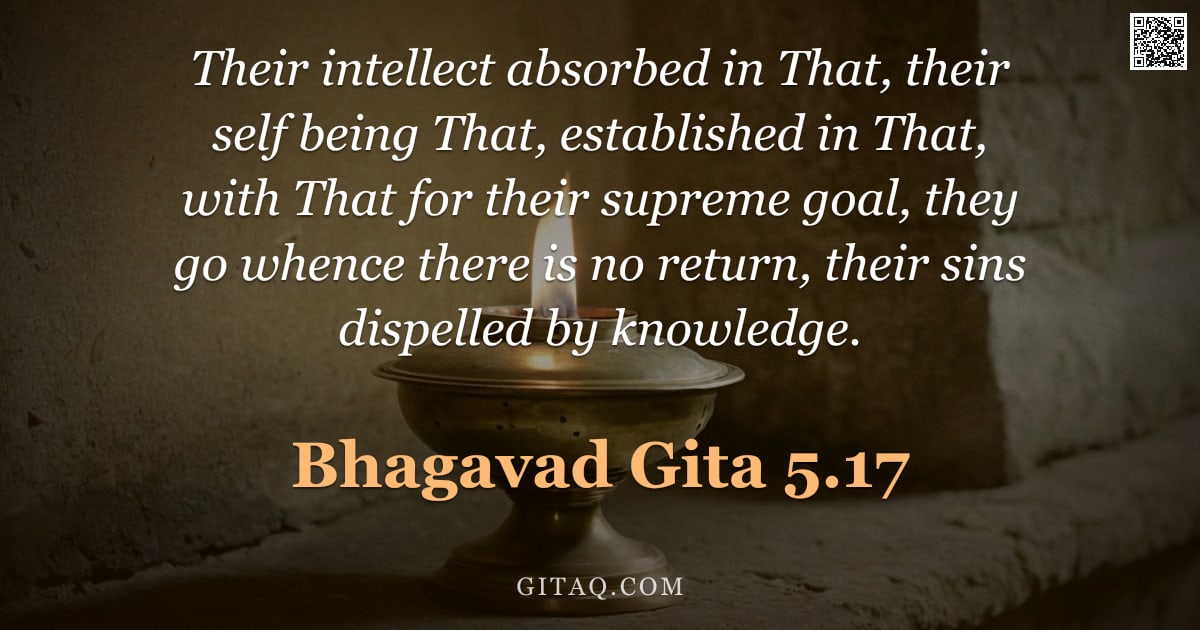
Bhagavad Gita 5.17
Karma Sanyasa Yoga · English Translation
तद्बुद्धयस्तदात्मानस्तन्निष्ठास्तत्परायणाः | गच्छन्त्यपुनरावृत्तिं ज्ञाननिर्धूतकल्मषाः ||५-१७||
tadbuddhayastadātmānastanniṣṭhāstatparāyaṇāḥ . gacchantyapunarāvṛttiṃ jñānanirdhūtakalmaṣāḥ ||5-17||
What Does This Verse Mean?
In this verse, Lord Krishna describes the state of a wise person who has realized their true spiritual nature. He explains that when one's mind, self-awareness, and ultimate goals are completely focused on the Divine, they attain liberation from the cycle of birth and death. This freedom is achieved because deep knowledge burns away all past negative actions or sins. The result is a permanent state of peace where there is no need to return to worldly suffering.
The Teaching Behind It
This verse synthesizes Jnana Yoga (the path of knowledge) and Karma Yoga by showing how realization leads to liberation. It develops the concept of 'Sthitaprajna' (steady wisdom), where intellectual understanding transforms into a lived state of being established in the Absolute.
Word by Word
Classical Commentary
Where This Happens
This verse occurs during the Bhagavad Gita's discourse on the battlefield of Kurukshetra, where Lord Krishna is instructing his cousin and devotee Arjuna. It follows chapters discussing renunciation (Sanyasa) and action without attachment, as Arjuna was confused about whether to fight or retreat into monkhood. At this specific moment, Krishna clarifies that true renunciation is not abandoning work, but purifying the mind through knowledge so one can act with total clarity.
Living It Out Today
Consider a professional facing an impossible deadline where every decision feels like it carries heavy personal risk and fear of failure. Instead of letting anxiety drive their choices or clinging to past mistakes (sins), they apply this teaching by shifting their intellect entirely toward the quality of work itself, viewing their self-worth as separate from the outcome. By making 'doing one's best' the supreme goal rather than success or reward, they act with such clarity that fear dissolves, and they complete the task without carrying emotional baggage home.
Explained for Children
Imagine you have been playing with dirty toys for so long that they look black, but then someone gives you the most powerful soap in the world—knowledge—that washes every speck of dirt away instantly. This verse tells us about people who use that special knowledge to clean their hearts and minds completely. When their thoughts are all focused on being good and loving God (like focusing only on sunshine), they become so pure that they never have to play with dirty toys again, but instead go live in a happy place forever.
Daily Reflection
Today, notice how often your mind chases external goals rather than resting in its own source. When you feel overwhelmed by past mistakes or future anxieties, remember that knowledge acts as a cleansing fire for these burdens. You are not defined by the sins you have committed but by the realization of who you truly are beyond them.
A Practice for Today
Settle your awareness on the breath, visualizing every thought and sensation as a ripple returning to the vast ocean of consciousness. As you breathe, gently affirm that your true intellect rests in That which is eternal, allowing the noise of daily concerns to dissolve into silence.
Key Teachings
- The Unity of Intellect and Self
This verse describes the state where one's intellect, self-identity, and ultimate purpose all merge into a singular focus on the Divine. It signifies that the seeker no longer operates as separate fragments but as an integrated whole absorbed in That which is absolute. - The Destination of No Return
Those who attain this state of absorption achieve liberation (moksha), entering a realm from which there is no rebirth or return to the cycle of suffering. This 'no return' marks the end of spiritual wandering and the beginning of eternal abiding in truth. - Knowledge as Purifying Fire
The verse explicitly states that sins are dispelled not by ritualistic washing but by the fire of true knowledge (jñana). This wisdom burns away the karmic impurities and doubts, leaving the soul pure and ready for its final destination.
Themes
Related Verses
Read This Next
- 2.47 — To understand how performing action without attachment lays the groundwork for this state of absorbed intellect.
- 3.30 — To see the practical application of surrendering all actions to the Divine, which aligns one's will with That supreme goal.
- 12.15 — To explore the qualities of a devotee who has attained such stability and purity that they are dear to Krishna and free from distress.
Recommended Reading
GitaQ earns from qualifying purchases as an Amazon Associate.