Bhagavad Gita 4.26
Jnana Karma Sanyasa Yoga · English Translation
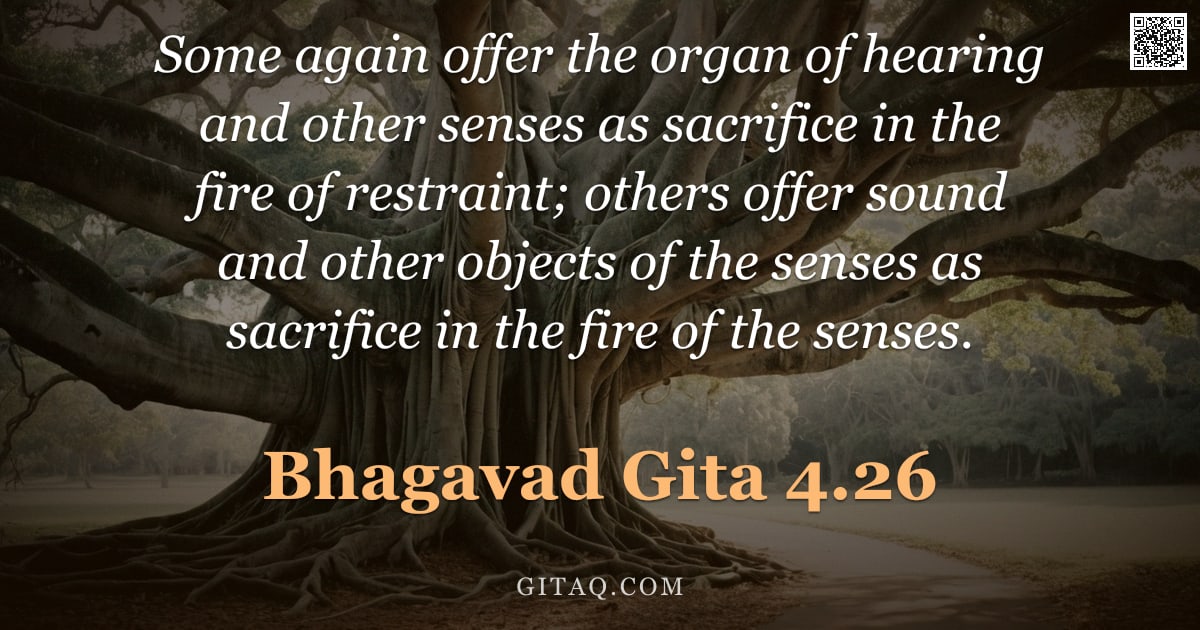
श्रोत्रादीनीन्द्रियाण्यन्ये संयमाग्निषु जुह्वति | शब्दादीन्विषयानन्य इन्द्रियाग्निषु जुह्वति ||४-२६||
śrotrādīnīndriyāṇyanye saṃyamāgniṣu juhvati . śabdādīnviṣayānanya indriyāgniṣu juhvati ||4-26||
What Does This Verse Mean?
In this verse, Lord Krishna describes two distinct paths of spiritual practice for those seeking liberation. The first group practices strict self-control by offering their senses back into the fire of restraint, effectively cutting off sensory distractions. A second group engages with the world but transforms ordinary sense objects like sound and sight into offerings through mindful awareness. Both methods are valid ways to purify the mind and burn away past karma.
The Teaching Behind It
This verse belongs primarily to the framework of Karma Yoga but integrates principles from Sankhya philosophy regarding the control of the senses. It develops the concept that action is not merely physical movement but can be an internal 'sacrifice' (Yajna) where the ego and attachments are burned away through disciplined practice or mindful engagement.
Word by Word
Classical Commentary
Where This Happens
This teaching occurs on the battlefield of Kurukshetra within the Mahabharata epic during a moment of deep confusion where Prince Arjuna has laid down his weapons in despair. Lord Krishna is addressing Arjuna, who is overwhelmed by attachment to family and fear of sinning, while explaining that there are multiple valid yogic paths depending on one's nature. Just prior, Krishna discussed the yoga of knowledge (Jnana), but here he expands the scope to show how specific types of renunciates can also achieve spiritual success through disciplined action or sensory mastery.
Living It Out Today
Consider a modern professional facing an overwhelming stream of notifications and emails that triggers constant anxiety; they might apply this verse by practicing 'restraint' (first path), turning off all devices for set hours to quiet the mind. Alternatively, someone in customer service dealing with angry voices could use the second method: instead of reacting defensively to the harsh words (sense objects), they offer those sounds as a sacrifice by listening with patience and empathy, transforming irritation into compassion.
Explained for Children
Imagine your five senses—like ears that hear or eyes that see—are hungry little monsters that always want more fun things, which can make you feel scattered and worried. Some people practice being like a strong gatekeeper who says 'not now' to keep these monsters calm inside their minds. Others are like chefs who take those same sounds and sights they love and cook them into something special by focusing on what is good about them. By doing this, the messy thoughts turn into clear energy that helps you feel peaceful.
Daily Reflection
Today, pause before reacting to every word you hear; notice how holding back judgment is actually feeding your inner fire with wisdom rather than anger. When you treat external sounds and sights as offerings in the sacred flame of restraint, they lose their power to disturb your peace. You are not avoiding life's noises but refining them until only truth remains.
A Practice for Today
Sit quietly and imagine your ears as fire, gently burning away the noise of the world to reveal inner silence. Offer each sound you hear not as a distraction, but as fuel that transforms into clarity within the vessel of your own awareness.
Key Teachings
- The Senses as Instruments
This verse redefines sensory organs from sources of distraction into tools for spiritual sacrifice, urging us to use hearing and touch consciously. By restraining their outward pull toward worldly objects, we transform ordinary perception into a sacred act. - The Fire of Restraint
Just as fire transforms physical fuel into energy and ash, the 'fire of restraint' (nirodha-agni) consumes sensory impulses to reveal pure consciousness. This metaphor teaches that self-control is not suppression but a transformative alchemical process. - Dual Paths of Offering
The verse presents two complementary approaches: offering the senses themselves inward, or offering sense objects outwardly through detachment in action. Both paths lead to liberation by neutralizing attachment and dissolving the ego's grip on experience.
Themes
Related Verses
Read This Next
- 2.47 — To understand how acting without attachment to results complements the renunciation described in this verse.
- 3.30 — To see how surrendering all actions to the Divine is another method of offering that aligns with this sacrifice.
- 12.15 — To learn about the qualities of a devotee who has mastered these senses and lives in perfect equilibrium.
Recommended Reading
GitaQ earns from qualifying purchases as an Amazon Associate.