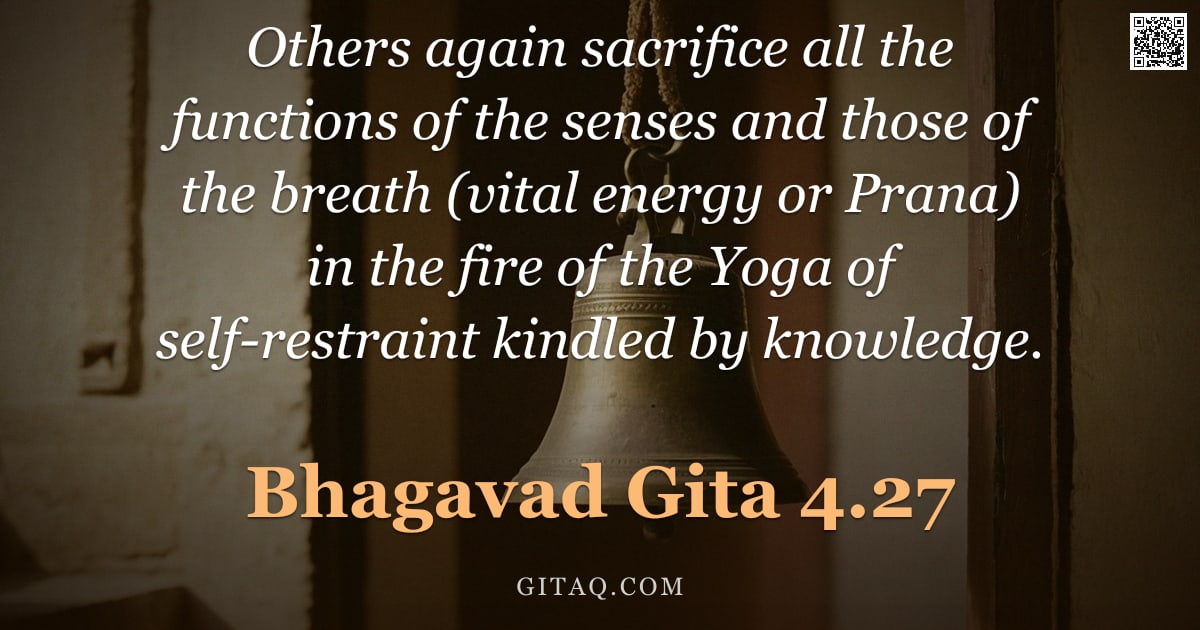
Bhagavad Gita 4.27
Jnana Karma Sanyasa Yoga · English Translation
सर्वाणीन्द्रियकर्माणि प्राणकर्माणि चापरे | आत्मसंयमयोगाग्नौ जुह्वति ज्ञानदीपिते ||४-२७||
sarvāṇīndriyakarmāṇi prāṇakarmāṇi cāpare . ātmasaṃyamayogāgnau juhvati jñānadīpite ||4-27||
What Does This Verse Mean?
In this verse, Lord Krishna describes a path of spiritual practice where individuals sacrifice their sensory actions and breath control exercises into the fire of inner wisdom. Speaking to Arjuna on the battlefield, he explains that those who are not yet ready for total renunciation can still progress by using knowledge as a tool to purify their senses and vital energy (Prana). The key teaching is that true self-restraint, ignited by deep understanding, acts as a transformative fire that burns away impurities without requiring one to abandon the world entirely.
The Teaching Behind It
This verse belongs primarily to the synthesis of Jnana Yoga (the path of knowledge) and Karma Yoga (the yoga of action), specifically focusing on Pratyahara (withdrawal of the senses). It develops the concept that intellectual realization is not just theoretical but acts as a transformative fire capable of purifying the subtle body's energy centers, leading to spiritual liberation.
Word by Word
Classical Commentary
Where This Happens
This verse appears in Chapter 4 of the Bhagavad Gita during the intense discourse on the battlefield of Kurukshetra. Krishna has just finished explaining the ancient lineage of this knowledge (Parampara) and is now detailing different methods people have used to attain liberation throughout history. Arjuna, who is currently confused about his duty as a warrior versus his attachment to family, hears this description of advanced yoga practices that involve restraining the senses rather than abandoning them.
Living It Out Today
Consider a professional facing burnout from constant notifications and endless meetings; instead of quitting their job immediately (renunciation), they practice 'internal sacrifice' by mentally detaching during high-stress moments. By applying knowledge—understanding that their self-worth isn't tied to every email response—they quiet the frantic activity of their senses and breath, finding a moment of calm within the chaos rather than fleeing it.
Explained for Children
Imagine you have a magical stove where you put in all your messy thoughts and too much running around inside. Instead of throwing them on the floor or letting them make a big mess, you drop them into this special fire made by knowing how smart and calm you can be. Just like putting dirty socks into a washing machine cleans them so they are fresh again, using what you know to control your senses makes your heart feel light and happy.
Daily Reflection
Today, notice how often you feel burdened because you believe you are the sole doer of your actions and sensations. When anxiety or distraction arises, try to shift your perspective: offer these moments not as problems to solve for yourself, but as fuel for a fire that is already lit by knowledge within you. By surrendering the functions of your senses and breath to this inner wisdom, you will find that the heaviness of effort dissolves into a lightness of being.
A Practice for Today
Sit quietly and visualize your breath as a stream of life energy flowing into you, then imagine offering every sensation from your senses and that very flow of prana into an inner fire fueled by wisdom. As this flame burns away the sense of 'I am doing,' rest in the stillness where action happens without the weight of personal ownership.
Key Teachings
- The Fire of Knowledge
This verse introduces 'Jnana' as the essential fuel that ignites the fire of yoga, transforming ordinary actions and vital energies. Without this kindling wisdom, self-restraint remains mechanical; with it, every function becomes a sacred offering. - Sacrifice of Vital Energy
Unlike external rituals that sacrifice objects, the path described here involves sacrificing 'Prana'—the vital life force itself—to the fire of self-control. This signifies a deep internalization where even one's breath and sensory inputs are consecrated to the divine. - The Path of Restraint
This teaching outlines 'Atmasamyama Yoga,' or the yoga of restraining the self, which is distinct from other forms of sacrifice. It emphasizes that true renunciation occurs when one stops identifying with the doer-ship of actions and offers them all to the higher Self.
Themes
Related Verses
Read This Next
- 2.47 — To understand that you have a right to your actions but no claim on their results, which is the practical foundation for this sacrifice.
- 3.30 — To see how Arjuna is explicitly instructed to surrender all works into Krishna's hands as an offering of knowledge and action combined.
- 12.15 — To learn the qualities of a devotee who, through such renunciation, becomes dear to the Lord by being free from personal desire.
Recommended Reading
GitaQ earns from qualifying purchases as an Amazon Associate.