Bhagavad Gita 5.26
Karma Sanyasa Yoga · English Translation
कामक्रोधवियुक्तानां यतीनां यतचेतसाम् | अभितो ब्रह्मनिर्वाणं वर्तते विदितात्मनाम् ||५-२६||
kāmakrodhaviyuktānāṃ yatīnāṃ yatacetasām . abhito brahmanirvāṇaṃ vartate viditātmanām ||5-26||
What Does This Verse Mean?
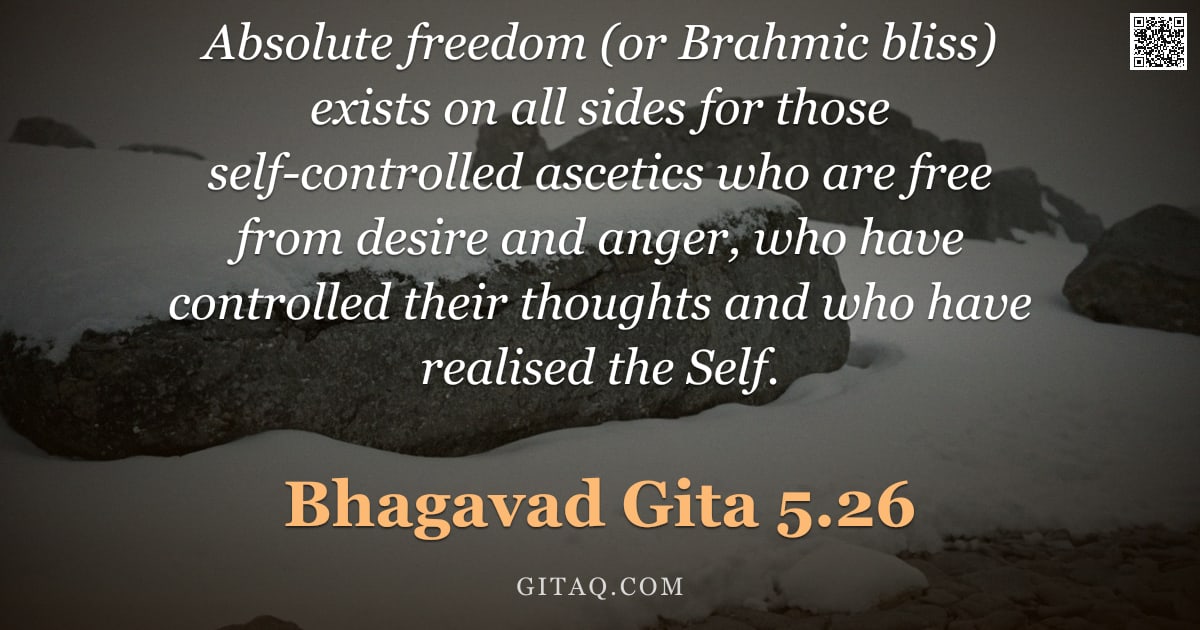
In this verse, Lord Krishna tells Arjuna that true peace and liberation are available immediately to those who have conquered their inner enemies of desire and anger. He explains that when a person controls their thoughts and realizes the truth of their own soul, they find freedom in every direction. This state is not something distant or future; it is an experience present for anyone living with self-mastery.
The Teaching Behind It
This verse synthesizes Karma Yoga and Jnana Yoga by demonstrating that selfless action purifies the mind, leading directly to Self-realization (Atma-jnana). It highlights the concept of Brahmanirvana—the state where one's consciousness merges with the absolute reality while still living in the body. The teaching emphasizes that liberation is not a future destination but an immediate experience for those who have extinguished the internal fires of desire and rage.
Word by Word
Classical Commentary
Where This Happens
This verse occurs during the Bhagavad Gita's discourse on the battlefield of Kurukshetra, where Krishna is guiding Arjuna through various paths of spiritual life. Following a detailed explanation of renouncing actions without attachment (Karma Sanyasa), Krishna describes the ultimate result for those who have mastered this path. At this moment, Arjuna has just heard about different yogic practices and is seeking to understand what tangible peace looks like for someone who has truly succeeded.
Living It Out Today
Consider a professional facing an aggressive critique from their boss that triggers immediate anger and the fear of losing their job; instead of reacting impulsively, they pause to observe the emotion without acting on it. By recognizing the trigger as temporary desire (for validation) or anger, they maintain inner clarity and respond with calm professionalism rather than defensiveness. This shift transforms a high-stress moment into an opportunity for mental stability, allowing them to navigate the situation effectively while remaining centered.
Explained for Children
Imagine your mind is like a garden full of weeds called 'wanting more' and 'getting mad.' If you pull out those weeds and keep your thoughts calm, the whole world feels peaceful around you. Just like a quiet room makes it easy to hear music clearly, when you stop fighting with yourself, you feel happy and free everywhere you look.
Daily Reflection
Today, try to catch yourself just before reacting with frustration or craving; pause and ask if your true self needs these external triggers to feel whole. You will discover that the freedom Krishna describes isn't far away in some distant heaven, but is right here on all sides whenever you let go of the grip of desire. This inner shift transforms your entire world from a battlefield into a sanctuary where Brahmic bliss naturally flourishes.
A Practice for Today
Close your eyes and visualize desire and anger as clouds passing through the vast sky of your consciousness; notice how they do not touch the clear space within you that remains untouched by them. Rest in this inner stillness, knowing that peace is not something to be created but a reality that surrounds you when the mind becomes quiet.
Key Teachings
- The Twin Enemies: Desire and Anger
Krishna identifies kāma (desire) and krodha (anger) as the primary obstacles that bind the seeker to suffering. True renunciation begins not by abandoning actions, but by uprooting these two internal fires from the heart. - The Discipline of a Controlled Mind
For those who have mastered their senses and thoughts (yatacetasām), the chaotic noise of the world loses its power to disturb them. This inner stability is not suppression, but a natural state achieved through consistent spiritual practice. - The All-Pervading Bliss
When self-realization (viditātmanām) dawns, the seeker perceives Brahman in everything and everywhere. This is not an escape from reality, but a realization that absolute freedom surrounds us on all sides.
Themes
Related Verses
Read This Next
- 2.47 — Read this next to understand the foundational principle of acting without attachment to results, which calms desire.
- 3.30 — This verse complements 5.26 by teaching how to surrender all actions to Krishna as a method for purifying the mind.
- 12.15 — Read this to see the qualities of one who is dear to Krishna, specifically those who are free from envy and anger mentioned in 5.26.
Recommended Reading
GitaQ earns from qualifying purchases as an Amazon Associate.