Bhagavad Gita 6.27
Dhyana Yoga · English Translation
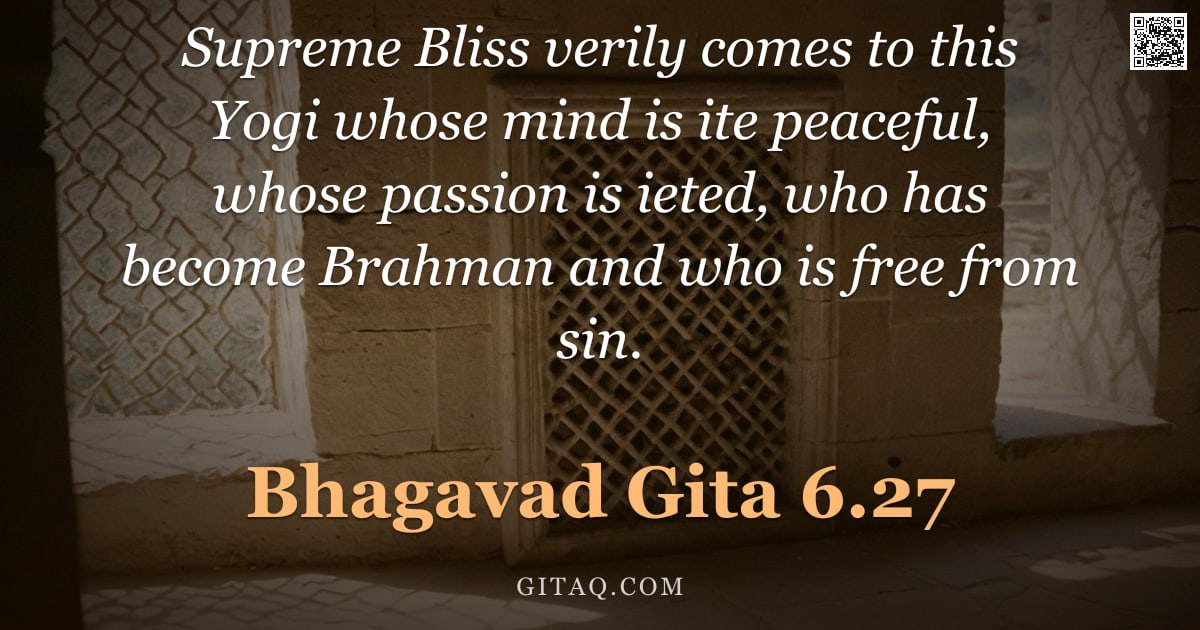
प्रशान्तमनसं ह्येनं योगिनं सुखमुत्तमम् | उपैति शान्तरजसं ब्रह्मभूतमकल्मषम् ||६-२७||
praśāntamanasaṃ hyenaṃ yoginaṃ sukhamuttamam . upaiti śāntarajasaṃ brahmabhūtamakalmaṣam ||6-27||
What Does This Verse Mean?
In this verse, Lord Krishna describes the ultimate reward for a dedicated meditator who has mastered their mind and emotions. He explains that when a person achieves inner peace, overcomes restless desires (passion), realizes their true spiritual nature as one with the divine, and cleanses themselves of negative karma, they naturally attain supreme bliss. This state is not something to be chased externally but arises spontaneously from within through consistent practice.
The Teaching Behind It
This verse synthesizes the teachings of Dhyana Yoga (the path of meditation) with Jnana Yoga (the yoga of knowledge), as it describes the state of 'Brahma-bhuta' (becoming one with Brahman). It develops the concept that mental purity and the transcendence of Rajas (passion/activity) are prerequisites for realizing the Self, leading to a permanent state of liberation from sin and suffering.
Word by Word
Classical Commentary
Where This Happens
This verse appears in Chapter 6 (Dhyana Yoga) of the Bhagavad Gita, set on the battlefield of Kurukshetra where Prince Arjuna is paralyzed by grief and confusion. Krishna has just finished teaching Arjuna about the nature of meditation and how to control the restless mind through practice. Here, he concludes this section by assuring a skeptical or struggling student that if they persist in calming their senses and overcoming desire, they will inevitably reach a state of divine union.
Living It Out Today
Consider a professional facing an impending layoff who feels overwhelmed by anxiety about money and future stability. Instead of reacting with panic (rajas) or despair, they can practice the technique Krishna describes: first stabilizing their breathing to quiet the racing mind, then consciously letting go of the fear-driven thoughts that cloud judgment. By focusing on what is within their control rather than external outcomes, they find a 'supreme bliss'—a calm clarity that allows them to make rational decisions and navigate the crisis without being consumed by stress.
Explained for Children
Imagine your mind like a muddy pond after a heavy rain; it's hard to see anything clearly because everything is swirling around. When you sit quietly and let the mud settle, the water becomes crystal clear so you can finally see exactly what is at the bottom of the lake. Krishna says that when we calm our busy thoughts and stop being upset by small things, our hearts become like that clear water, allowing us to feel a deep, happy peace that never goes away.
Daily Reflection
Today, notice how often your mind chases after distractions or clings to desires that disturb your tranquility. When you find yourself agitated, remember that true happiness is not found in the external world but within a heart free from sin and passion. You have the capacity to become like Brahman right now—pure, peaceful, and radiant with supreme bliss.
A Practice for Today
Begin by settling into silence and gently acknowledging any restless thoughts without engaging them, allowing the mind to settle like dust clearing from a still room. Visualize your inner passion transforming into calm clarity as you breathe in peace and exhale worry.
Key Teachings
- The Peace of Equanimity
Supreme joy is not an external reward but a natural state that arises when the mind rests in deep peace. This tranquility allows the yogi to transcend the turbulence of ordinary life and rest in their true nature. - Purification from Passion
The path requires quieting 'rajas'—the restless energy of desire that drives us into action without purpose. By settling this passion, we remove the inner agitation that blocks our connection to the divine. - Realization as Brahman
The ultimate goal is becoming 'Brahma-bhuta,' realizing one's identity with the infinite consciousness itself. This state of being sinless and free from all impurities allows for direct communion with the Supreme.
Themes
Related Verses
Read This Next
- 2.47 — To understand the foundational principle of performing duty without attachment to results before seeking higher meditation states.
- 3.30 — To learn how surrendering all actions to the Divine is a practical method for purifying the mind and removing sin.
- 12.15 — To explore the qualities of a devotee who has already attained this state of being pleasing to Krishna through selflessness.
Recommended Reading
GitaQ earns from qualifying purchases as an Amazon Associate.