Bhagavad Gita 18.54
Moksha Sanyasa Yoga · English Translation
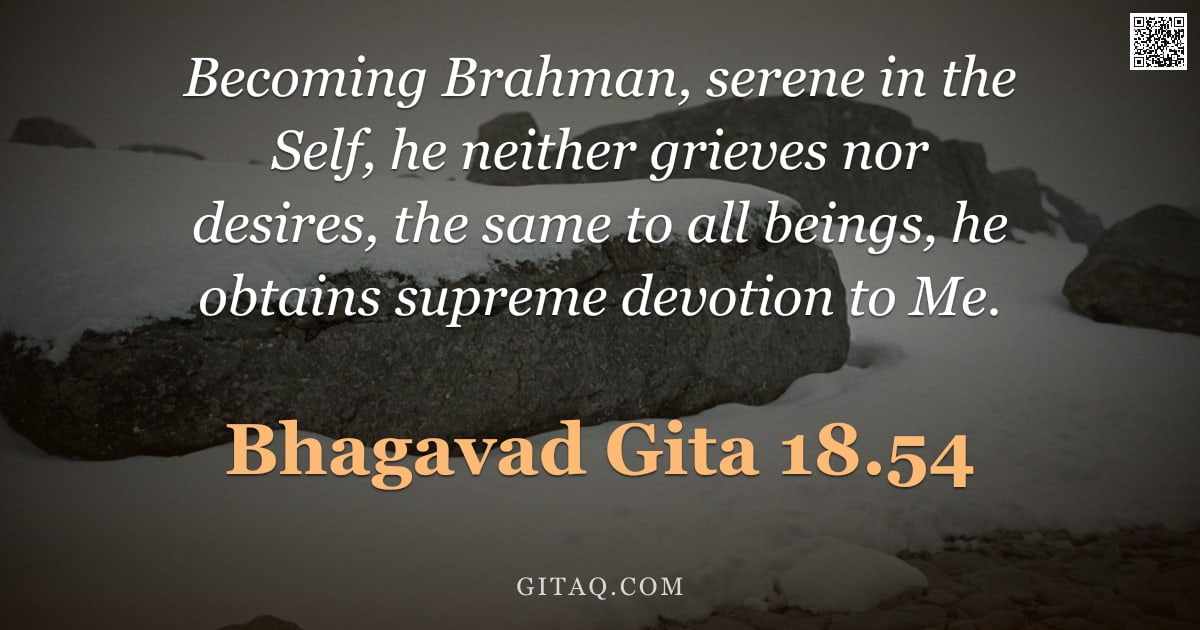
ब्रह्मभूतः प्रसन्नात्मा न शोचति न काङ्क्षति | समः सर्वेषु भूतेषु मद्भक्तिं लभते पराम् ||१८-५४||
brahmabhūtaḥ prasannātmā na śocati na kāṅkṣati . samaḥ sarveṣu bhūteṣu madbhaktiṃ labhate parām ||18-54||
What Does This Verse Mean?
In this verse, Lord Krishna describes the final stage of spiritual maturity to Arjuna as he concludes his teachings on renunciation. He explains that when a person realizes their true nature as part of the divine (Brahman), they naturally become free from grief and unfulfilled desires. This state brings an equal vision toward all living beings, which is the essential foundation for attaining supreme devotion to God.
The Teaching Behind It
This verse synthesizes Jnana Yoga (the path of knowledge) and Bhakti Yoga (the path of devotion), showing that true self-realization naturally leads to supreme love for the Divine. It teaches that 'Brahman realization' is not an abstract concept but a practical state where one sees no difference between themselves and all other beings, which dissolves the egoic barriers preventing spiritual connection.
Word by Word
Classical Commentary
Where This Happens
This verse appears at the very end of Chapter 18, titled 'Moksha Sanyasa Yoga,' where Krishna is summarizing the path of liberation for Arjuna. It follows the intense dialogue on duty and the nature of action that has occupied the battlefield of Kurukshetra since dawn. As the sun begins to set over the field, Krishna guides a confused but increasingly receptive Arjuna toward a state of inner peace where he can finally act without attachment.
Living It Out Today
Consider a manager who receives harsh criticism from their boss or an unexpected compliment; instead of spiraling into self-doubt or becoming arrogant, they view both events with equanimity. They recognize that their worth is not defined by external validation but remains steady regardless of the outcome. This mental stability allows them to lead their team with genuine care and clarity, rather than reacting out of fear or ego.
Explained for Children
Imagine you are sitting in a park watching children play; sometimes they win games and make noise, while others lose or cry quietly. A truly wise person sees everyone with the same kind smile because they understand that every child has their own feelings but is still special inside. When we learn to see this inner light in ourselves and others, we stop feeling sad about small things or wanting too many toys, and instead feel a deep happiness that connects us to something bigger than ourselves.
Daily Reflection
When you feel overwhelmed by loss or driven by endless wants today, remember that true freedom begins when your mind stops reacting to these dualities. You are invited to pause and recognize the serene presence of Brahman already living within you, untouched by external circumstances. From this place of inner balance, you will find yourself treating everyone with equal love, seeing the same divine spark in all.
A Practice for Today
Sit quietly and visualize your mind as an ocean that has finally settled, free from the waves of grief or craving. Resting in this stillness, offer a silent wish for every being you encounter to find equal peace within themselves.
Key Teachings
- The State of Brahman
This verse describes a consciousness that has realized its identity as the Absolute, moving beyond individual limitations. Such a person no longer identifies with the fleeting fluctuations of the material world. - Freedom from Grief and Desire
By transcending attachment to outcomes, one naturally ceases to mourn losses or crave future gains. This equanimity is not indifference but a profound stability born of spiritual realization. - Universal Equality in Devotion
Seeing the same divine essence in all beings allows for unconditional love and equal regard across social divisions. It is from this posture of universal equality that one attains supreme devotion to the Divine.
Themes
Related Verses
Read This Next
- 2.47 — To understand how to perform duty without attachment, which is a prerequisite for the equanimity described in this verse.
- 3.30 — To see practical instructions on surrendering all actions and fruits to God as the path to liberation.
- 12.15 — To encounter the description of a devotee who is dear to Krishna specifically because they are free from agitation, envy, and grief.
Recommended Reading
GitaQ earns from qualifying purchases as an Amazon Associate.