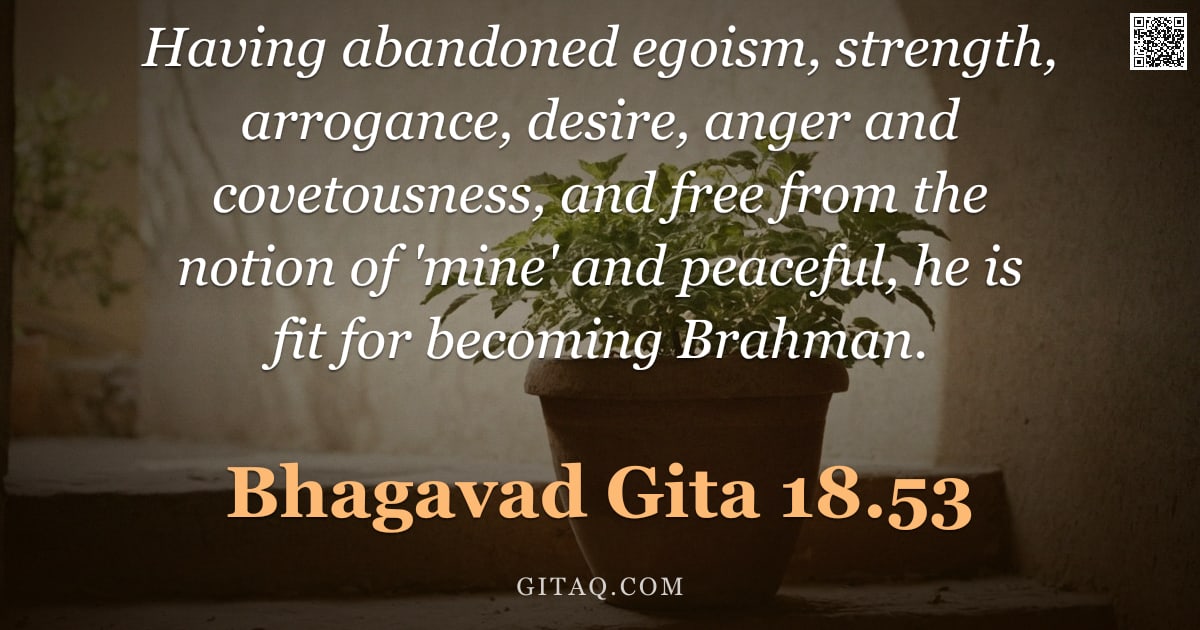
Bhagavad Gita 18.53
Moksha Sanyasa Yoga · English Translation
अहंकारं बलं दर्पं कामं क्रोधं परिग्रहम् | विमुच्य निर्ममः शान्तो ब्रह्मभूयाय कल्पते ||१८-५३||
ahaṃkāraṃ balaṃ darpaṃ kāmaṃ krodhaṃ parigraham . vimucya nirmamaḥ śānto brahmabhūyāya kalpate ||18-53||
What Does This Verse Mean?
In this verse, Lord Krishna tells Arjuna that true liberation comes from letting go of six inner enemies: ego, excessive pride born of strength or status, arrogance, selfish desires, anger, and the urge to cling to possessions. When a person frees themselves from these mental burdens and stops identifying things as 'mine,' they naturally become peaceful. This state of purity prepares the soul for union with the ultimate reality, Brahman.
The Teaching Behind It
This verse synthesizes the paths of Karma Yoga (acting without attachment) and Jnana Yoga (knowledge of the Self). It specifically addresses the removal of Avidya (ignorance) manifesting as egoism, which is seen in Vedanta as the primary barrier preventing the individual soul from realizing its identity with Brahman.
Word by Word
Classical Commentary
Where This Happens
This shloka appears at the very end of Chapter 18, which is titled 'Moksha Sanyasa Yoga' (Liberation through Renunciation). It occurs after Krishna has finished his extensive teachings on duty, devotion, and knowledge to Arjuna. At this moment, Arjuda has listened intently, resolved all his doubts about the war, and is now being given a final checklist of internal qualities required for spiritual perfection.
Living It Out Today
Consider a professional who gets angry after their project fails or feels intense jealousy when a colleague succeeds. Instead of reacting with ego-driven defensiveness ('It's not my fault') or covetousness ('I need that promotion more than anyone'), they pause to acknowledge these feelings as temporary mental clouds. By releasing the grip on 'my success' and finding inner peace, they make clearer decisions for their team rather than being driven by anger.
Explained for Children
Imagine you are carrying a heavy backpack filled with rocks labeled 'Me!', 'I'm Better Than You', 'That's Mine', and 'I Want That!'. Carrying this bag makes it hard to walk or see clearly. This verse is like being told that if you take off the heavy backpack, set down all those heavy thoughts, and feel calm inside, you can finally run free and be your best self without any weight holding you back.
Daily Reflection
Notice how often today you felt a need to defend yourself or claim something as yours just because. When that urge arises, gently remind yourself that true freedom lies in being free from this 'mine' mentality rather than adding more possessions to it. You are already whole and peaceful without the noise of arrogance or desire clouding your vision.
A Practice for Today
Close your eyes and silently repeat, 'I am not my ego; I am the peace behind it.' As you breathe out, visualize releasing the tight grip of possession and anger from your hands, letting them fall away like old garments.
Key Teachings
- The Six Chains of Ego
Krishna identifies six specific vices—ego, false strength, pride, lust, anger, and possessiveness—that bind the soul to suffering. These are not merely bad habits but deep-rooted delusions that prevent us from seeing our true divine nature. - The Power of Nirmama
Being 'free from the notion of mine' is a radical shift in consciousness where one acts without attachment to results or ownership. This state dissolves the barrier between the self and the universal, allowing for spontaneous compassion. - The Path to Brahman
Liberation (Brahma-bhūya) is not a destination reached after death but a quality of being that manifests when these inner impurities are cleared. Peace and the loss of egoic identity naturally lead one into oneness with the Absolute.
Themes
Related Verses
Read This Next
- 2.47 — This verse establishes the foundational discipline of action without attachment that makes abandoning possessiveness possible.
- 3.30 — It expands on surrendering all actions to the Divine, directly addressing how to handle ego and personal ownership in daily life.
- 12.15 — This verse describes the qualities of a devotee who has transcended anger and possessiveness, serving as an ideal portrait for this teaching.
Recommended Reading
GitaQ earns from qualifying purchases as an Amazon Associate.