Bhagavad Gita 18.52
Moksha Sanyasa Yoga · English Translation
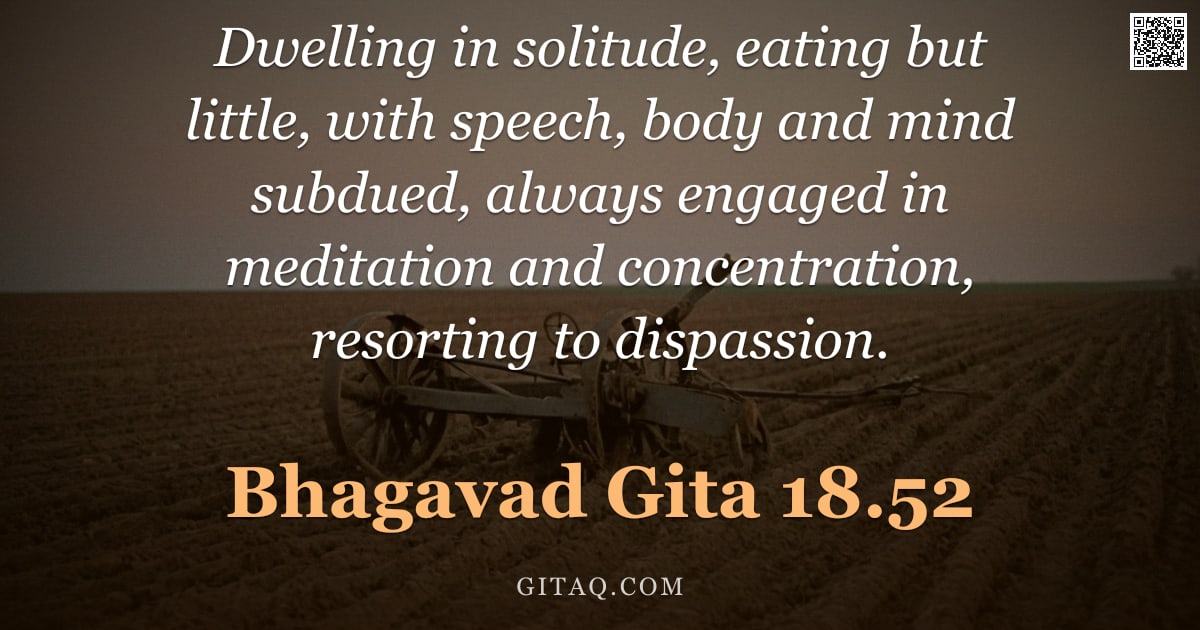
विविक्तसेवी लघ्वाशी यतवाक्कायमानसः | ध्यानयोगपरो नित्यं वैराग्यं समुपाश्रितः ||१८-५२||
viviktasevī laghvāśī yatavākkāyamānasaḥ . dhyānayogaparo nityaṃ vairāgyaṃ samupāśritaḥ ||18-52||
What Does This Verse Mean?
In this verse, Lord Krishna describes the essential lifestyle of a spiritual seeker aiming for liberation from Arjuna's perspective on what is required to attain peace. He outlines five key habits: living in seclusion, eating moderately, keeping one's speech and body under control, focusing constantly on meditation, and cultivating deep detachment from worldly desires. The core teaching is that true inner freedom comes not just from physical isolation but from mastering the mind and senses through disciplined practice.
The Teaching Behind It
This verse synthesizes the practices required for Dhyana Yoga (the yoga of meditation) as outlined in Chapter Six, serving as the practical foundation for Jnana Yoga (knowledge). It emphasizes that intellectual understanding must be supported by a lifestyle of sensory control and detachment to realize the Self. The concept developed is that liberation requires an active renunciation of external distractions through internal mastery.
Word by Word
Classical Commentary
Where This Happens
This verse appears in the final chapter (18) of the Bhagavad Gita on the battlefield of Kurukshetra, where Lord Krishna is concluding his teachings to Prince Arjuna. After explaining the paths of renunciation and action throughout eighteen chapters, Krishna now summarizes the specific qualities that define a person who has truly mastered these disciplines. At this moment, Arjuna's confusion has lifted into clarity, and he is ready to listen to the final instructions on how to live as a liberated soul.
Living It Out Today
A modern professional facing burnout can apply this by setting strict boundaries: turning off notifications during deep work hours (solitude), avoiding late-night heavy meals that disrupt sleep (moderation), pausing before reacting angrily in meetings (subduing speech and body). By dedicating just ten minutes to mindfulness meditation daily, they cultivate a steady mind capable of making difficult decisions with clarity rather than anxiety.
Explained for Children
Imagine you are trying to focus really hard on building a giant Lego castle without any distractions; if your friends kept talking or eating snacks near you, it would be impossible. Krishna tells us that to find peace inside our hearts, we sometimes need quiet time alone, eat just enough food so we don't feel sleepy, and take deep breaths to calm down when we are upset. By doing these things often, like a daily game of 'focus,' we can make our minds strong and happy.
Daily Reflection
In our fast-paced lives, we often mistake constant activity for progress, yet true peace is found in the quiet spaces between our actions. You have a unique capacity to find strength not by doing more, but by simplifying what you eat, say, and think today. When you choose solitude over noise and restraint over impulse, you are not restricting yourself; you are making room for your deepest self to breathe.
A Practice for Today
Begin by finding a quiet corner where you can sit alone for ten minutes, allowing the noise of the world to fade into silence. As you settle your breath and soften your thoughts, gently withdraw your attention from external distractions, offering it instead to the steady rhythm of your own inner presence.
Key Teachings
- The Sanctuary of Solitude
True spiritual growth requires withdrawing from the chaos of constant social stimulation to find a 'vivikta' or secluded space. This solitude is not an escape from life, but a necessary condition for reconnecting with one's inner divine nature without external interference. - The Discipline of Moderation
By practicing 'laghvāśī', or eating only what is sufficient to sustain the body and mind, we reduce physical lethargy and mental agitation. This control over appetite extends naturally to speech and thought, creating a unified field where all energies are conserved for higher pursuits. - The State of Dispassion
'Vairāgya' is the cultivated ability to engage with the world without being entangled by it emotionally or mentally. It is a state of inner freedom where one performs duty while remaining untouched by the desire for results, anchored in meditation rather than reaction.
Themes
Related Verses
Read This Next
- 2.47 — This verse establishes the foundational principle of performing duty without attachment, which is the practical application of the dispassion mentioned in 18.52.
- 3.30 — It expands on surrendering all actions to the Divine, providing a spiritual context for the 'subdued mind' described in your current study.
- 12.15 — Krishna describes how one who is not disturbed by others and does not disturb them perfectly embodies the qualities of solitude and dispassion found here.
Recommended Reading
GitaQ earns from qualifying purchases as an Amazon Associate.