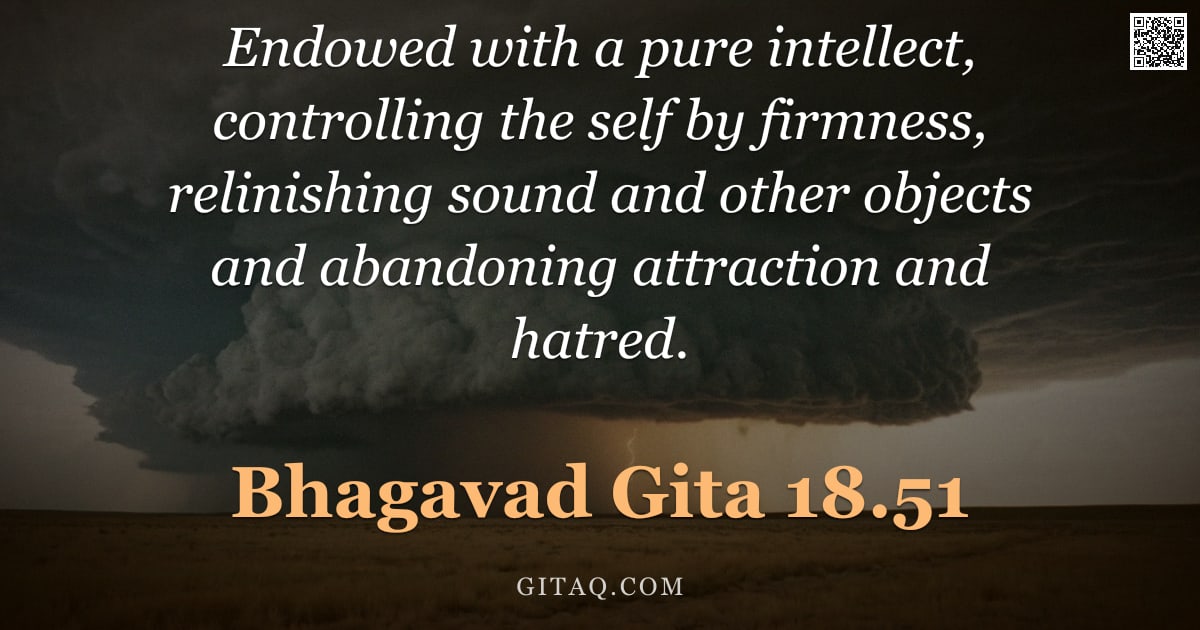
Bhagavad Gita 18.51
Moksha Sanyasa Yoga · English Translation
बुद्ध्या विशुद्धया युक्तो धृत्यात्मानं नियम्य च | शब्दादीन्विषयांस्त्यक्त्वा रागद्वेषौ व्युदस्य च ||१८-५१||
buddhyā viśuddhayā yukto dhṛtyātmānaṃ niyamya ca . śabdādīnviṣayāṃstyaktvā rāgadveṣau vyudasya ca ||18-51||
What Does This Verse Mean?
In this verse, Lord Krishna continues his final instructions to Arjuna on the path of spiritual liberation. He teaches that true freedom requires a mind purified by wisdom and self-discipline. One must consciously let go of external sensory distractions like sound while simultaneously letting go of internal emotional extremes like attraction and aversion. This balanced state allows the seeker to act without being bound by desire or fear.
The Teaching Behind It
This verse is a cornerstone of Jnana Yoga (the path of knowledge) and Sankhya philosophy within the Gita's framework, emphasizing discrimination between the self and sensory objects. It develops the concept of 'vairagya' or detachment, where purification of intellect ('buddhi') becomes the primary tool for transcending the dualities of pleasure and pain. The teaching aligns with Karma Yoga by suggesting that action must be performed from a state of inner stability rather than emotional reactivity.
Word by Word
Classical Commentary
Where This Happens
This verse appears in the final chapter of the Bhagavad Gita, where Lord Krishna is concluding his teachings to Prince Arjuna on the battlefield of Kurukshetra. After explaining various paths to liberation through different yogas and analyzing the nature of action and renunciation, Krishna outlines the specific qualities required for a practitioner ready for Moksha (liberation). At this moment, Arjuna has just received clarity on his duty and is preparing to put these spiritual principles into practice before engaging in the righteous war.
Living It Out Today
Consider a high-pressure situation at work where you receive harsh criticism from a client. Instead of reacting with immediate anger or letting it destroy your confidence (attraction/aversion), you pause to let your intellect process the feedback objectively. You set aside the noise of social media and office gossip, focusing only on the facts needed to resolve the issue effectively. This disciplined detachment allows you to make clear decisions rather than acting out of emotional volatility.
Explained for Children
Imagine your mind is like a clean, calm lake that can reflect the sky perfectly. To keep it looking clear, you need to stop throwing rocks (distractions) into it and not get too excited when something good happens or sad when something bad occurs. Krishna tells us that by using our brains wisely and holding ourselves steady, we can ignore noisy distractions around us and stay happy inside, no matter what is happening outside.
Daily Reflection
You often find yourself swept up in the rhythm of likes and dislikes, chasing one thing while fleeing another without realizing it is your mind creating this turbulence. Today, try to pause before reacting; let that moment of stillness be where you reclaim control over your inner world rather than letting external stimuli rule you. When you steady your heart with firm resolve, you discover a peace that exists independently of the noise around you.
A Practice for Today
Sit quietly and observe your mind as it reacts to sounds, sights, or thoughts that arise today. Notice the pull of attraction toward what pleases you and the push away from what disturbs you, then gently release both with a steady breath.
Key Teachings
- The Purity of Intellect
True transformation begins when our discriminative wisdom (buddhi) is cleansed of bias and confusion. A purified intellect acts as a clear mirror, allowing us to see reality without the distortion of ego or desire. - The Discipline of Self-Restraint
Controlling the self requires dhriti, an unshakable firmness that anchors the mind against the waves of impulse. This is not mere suppression, but a conscious alignment where willpower directs our actions toward higher goals. - Transcending Dualities
The path to liberation involves letting go of raga (attachment) and dvesha (aversion), which bind us in a cycle of endless craving. By abandoning the extremes of attraction and hatred, we cultivate an equanimity that remains undisturbed by sound or sensory objects.
Themes
Related Verses
Read This Next
- 2.47 — Read this next to understand how acting without attachment creates a foundation for the purity required in verse 18.51.
- 3.30 — This verse complements the theme of renunciation by teaching you to offer all actions and their fruits, aiding the abandonment of attraction.
- 12.15 — Read this final selection as it describes the qualities of a beloved devotee who has transcended both joy and sorrow, embodying the state described in 18.51.
Recommended Reading
GitaQ earns from qualifying purchases as an Amazon Associate.