Bhagavad Gita 6.19
Dhyana Yoga · English Translation
यथा दीपो निवातस्थो नेङ्गते सोपमा स्मृता | योगिनो यतचित्तस्य युञ्जतो योगमात्मनः ||६-१९||
yathā dīpo nivātastho neṅgate sopamā smṛtā . yogino yatacittasya yuñjato yogamātmanaḥ ||6-19||
What Does This Verse Mean?
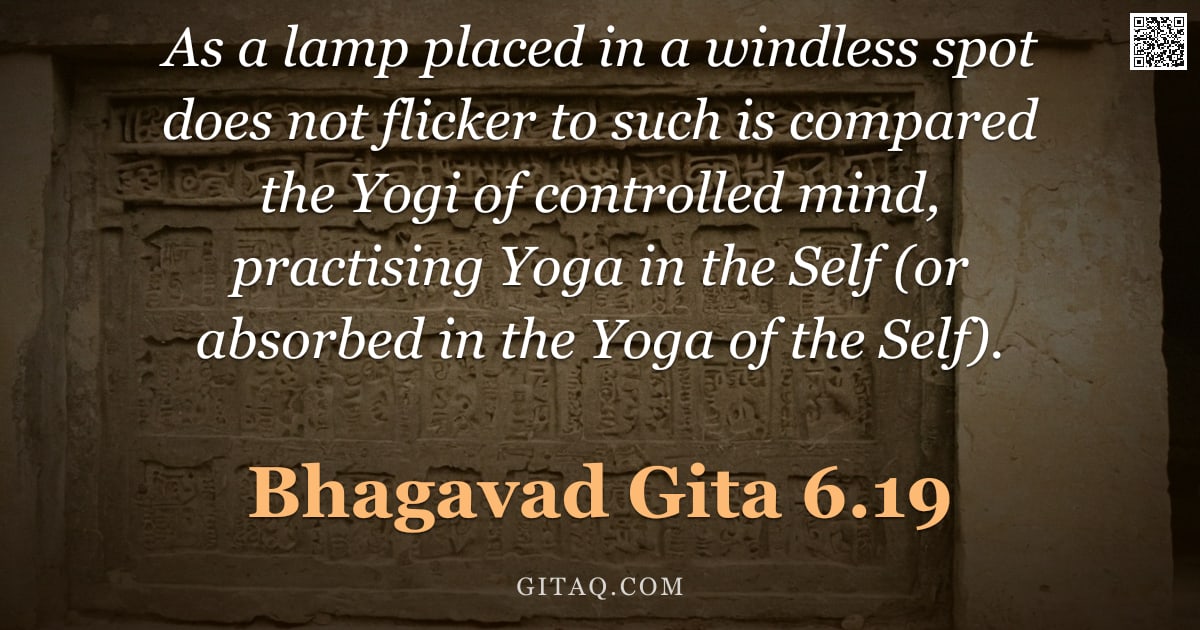
In this verse, Lord Krishna explains the ideal state of a meditator to Arjuna by comparing it to a steady lamp shielded from wind. Just as a flame in a draftless room remains perfectly still and bright, a yogi's mind stays undisturbed when controlled through practice. The key teaching is that true meditation requires an internal environment free from the 'winds' of distraction and desire, allowing for deep absorption in the Self.
The Teaching Behind It
This verse belongs primarily to Dhyana Yoga (the yoga of meditation) within the broader framework of Raja Yoga. It develops the Sankhya concept that the true Self (Atman) is distinct from the fluctuating mind, teaching that stability arises not by suppressing thoughts violently but by withdrawing the senses and establishing a steady focus on the inner light.
Word by Word
Classical Commentary
Where This Happens
This verse occurs during Lord Krishna's discourse with Prince Arjuna on the battlefield of Kurukshetra as part of the Mahabharata. After explaining the nature of the Self and the necessity of performing duty without attachment, Krishna now shifts to describing the practical method of meditation (Dhyana Yoga). Arjuna is in a state of deep emotional turmoil and confusion about his duties; he has just asked how one can control their restless mind, prompting this specific analogy to offer him hope for inner stability.
Living It Out Today
Consider a modern professional facing a high-stakes negotiation or a difficult family decision where emotions are running wild. Instead of reacting impulsively to the 'wind' of stress and anxiety, they pause to create an internal windless space by focusing on their breath and purpose. Just as the lamp does not flicker despite external chaos, this person maintains clarity and composure throughout the situation because their mind is anchored in stillness rather than turbulence.
Explained for Children
Imagine you are holding a tiny candle inside your house with all the windows closed; if no wind blows on it, the flame stays straight and steady. That is exactly what happens when we practice meditation: by closing our eyes to outside distractions and calming our thoughts like turning off noisy toys in a room, our mind becomes calm and focused just like that quiet candle.
Daily Reflection
You have likely felt that restless flickering in your own spirit when surrounded by noise and chaos, yet this verse reminds you that true stability is always available. Just as a lamp does not struggle to stay still but simply needs protection from the wind, your inner light remains steady whenever you withdraw it from external turbulence. Take a moment today to acknowledge that peace is not something you must chase, but rather a state of being found when you turn inward with intention.
A Practice for Today
Imagine your mind as a flame, and today's distractions as the wind around it. Find one quiet spot where you can sit undisturbed for five minutes, focusing solely on the rhythm of your breath or the presence within you.
Key Teachings
- The Necessity of Stillness
A flame cannot burn steadily in the wind; similarly, a mind agitated by external stimuli or internal desires can never achieve true focus. The practice begins with creating an environment—both physical and mental—that is free from these disruptive forces. - The Metaphor of Unflickering Light
This verse uses the lamp to illustrate that a controlled mind does not suppress thoughts but maintains a constant, unwavering focus on the Self. It is the difference between a chaotic fire and a steady flame that illuminates without consuming itself. - Yoga as Absorption in the Self
The ultimate goal described here is not merely concentration but 'yuñjato yogamātmanaḥ,' where the practitioner becomes absorbed entirely in their true nature. This state represents a union where the individual consciousness rests effortlessly in its divine source.
Themes
Related Verses
Read This Next
- 2.47 — Read this to understand how Arjuna is taught to perform his duty without attachment, which creates the inner stillness required for meditation.
- 3.30 — This verse offers a complementary instruction on surrendering all actions to the Divine, further quieting the ego that causes mental flickering.
- 12.15 — Read this to see how Krishna describes the qualities of His devotee who is steady-minded and free from agitation, mirroring the lamp metaphor.
Recommended Reading
GitaQ earns from qualifying purchases as an Amazon Associate.