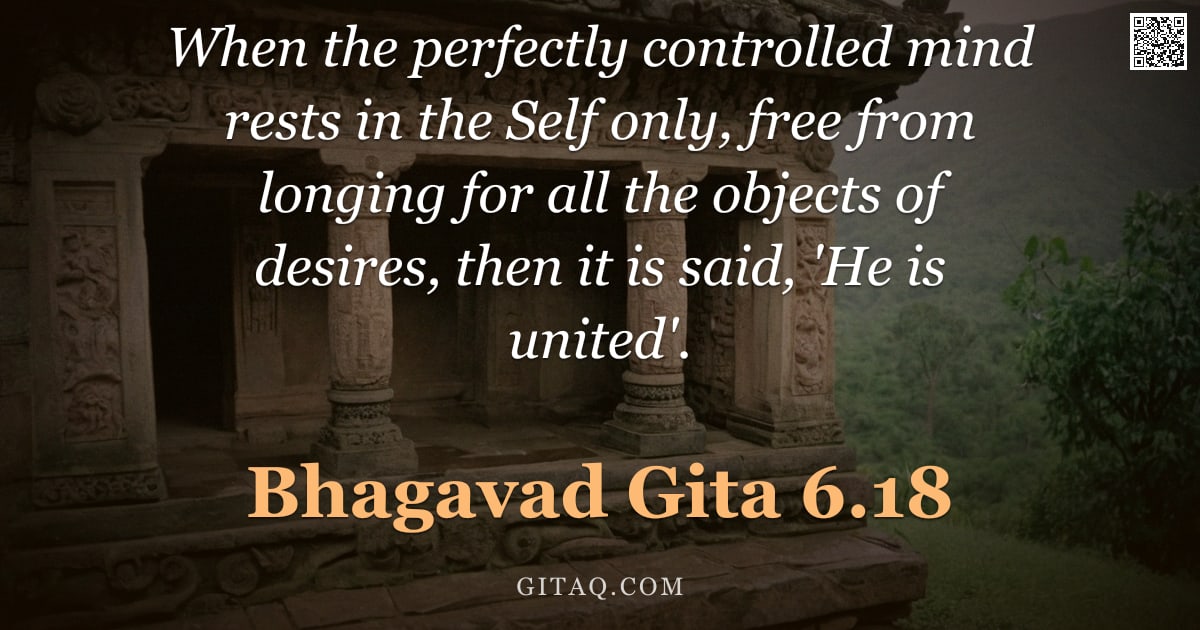
Bhagavad Gita 6.18
Dhyana Yoga · English Translation
यदा विनियतं चित्तमात्मन्येवावतिष्ठते | निःस्पृहः सर्वकामेभ्यो युक्त इत्युच्यते तदा ||६-१८||
yadā viniyataṃ cittamātmanyevāvatiṣṭhate . niḥspṛhaḥ sarvakāmebhyo yukta ityucyate tadā ||6-18||
What Does This Verse Mean?
Lord Krishna is explaining to Arjuna the final stage of meditation, where a person's mind becomes completely still and stops chasing after external desires. He describes this state as one where the individual rests entirely within their own inner Self (Atman) rather than seeking happiness from outside objects. When all cravings for worldly things vanish and the mind is perfectly focused inwardly, Krishna declares that such a person has truly achieved 'union' or Yoga.
The Teaching Behind It
This teaching belongs specifically to Dhyana Yoga (the yoga of meditation) within the broader framework of Sankhya philosophy presented by Krishna. It develops the concept that true spiritual union is not an active pursuit but a resting state where the mind ceases its outward projection into sensory objects and abides in the Atman.
Word by Word
Classical Commentary
Where This Happens
This verse appears in the sixth chapter of the Bhagavad Gita during Arjuna's intense questioning to Krishna regarding the nature of meditation. On the battlefield of Kurukshetra, just before this moment, Arjuna had asked how a person who loses focus can be saved and what specific signs prove one has mastered self-control. In response, Krishna details the progressive stages of yoga, culminating here in verse 6.18 as the definition of the perfected yogi.
Living It Out Today
Consider a software developer facing an imminent product launch deadline; instead of panicking or scrolling through social media to escape stress (seeking external gratification), they practice resting their attention solely on the task at hand and their inner composure. By detaching from the fear of failure and the urge for immediate validation, they enter a state where work flows naturally without anxiety. This allows them to make clear decisions under pressure, embodying the 'united' state described in the verse.
Explained for Children
Imagine you are playing with your favorite toys so much that you forget to eat dinner; suddenly, someone tells you it's time to stop because eating is more important for being healthy. This verse teaches us about the moment when we finally put down all our distractions and just sit quietly inside ourselves, feeling calm without needing anything else to make us happy. It says that when your mind stops wanting new toys or games and feels complete on its own, you have found a special kind of peace called 'being united.'
Daily Reflection
You do not need to be a monk to find this peace; simply notice how often your mind wanders toward 'what if' and 'I want.' Today, try catching yourself just before reaching for another object of desire—a phone, a snack, or validation—and instead pause in the stillness where you are already whole. When that longing subsides, you will discover a quiet joy that does not depend on anything outside of you.
A Practice for Today
Begin by gently closing your eyes and observing the restless currents of desire rising within you, acknowledging them without engaging or acting on them. Visualize these desires dissolving like mist in sunlight as you allow your attention to settle deeply into the silence of your own inner Self.
Key Teachings
- The Nature of True Yoga
This verse defines the moment of 'union' not as a physical posture but as the mind's complete stabilization in its own essential nature. It marks the transition from struggling against distractions to abiding effortlessly in the Self. - Freedom Through Non-Attachment
The term 'niḥspṛha' signifies a state of being free from all craving for sensory objects, which is the prerequisite for true mental control. Without this freedom from desire, the mind remains scattered and unable to rest in its source. - The State of Perfection
When the controlled mind rests solely within itself ('ātmanyevāvatiṣṭhate'), it has achieved the state described as 'yukta,' or established in union with the Divine. This is the culmination of all previous yogic practices, where effort becomes effortless abiding.
Themes
Related Verses
Read This Next
- 6.19 — To see Arjuna's description of this very state as a lamp that does not flicker in a windless place.
- 2.54 — To understand the specific signs and characteristics ('lakṣaṇam') of someone who has attained steady wisdom.
- 6.31 — To learn how this inner union expands to see the same Self in all beings, completing the vision of oneness.
Recommended Reading
GitaQ earns from qualifying purchases as an Amazon Associate.